
Popular Categories

Politics

Geo Economics

Lifestyle

Analysis

Geopolitics
Civilizational Lens
Defence

Middle East Power Map Shifts as US Reinforces Gulf, Iran’s Rial Sinks and Saudi-UAE Ties Reset
30 Sept 2026
Created by
The BV Team
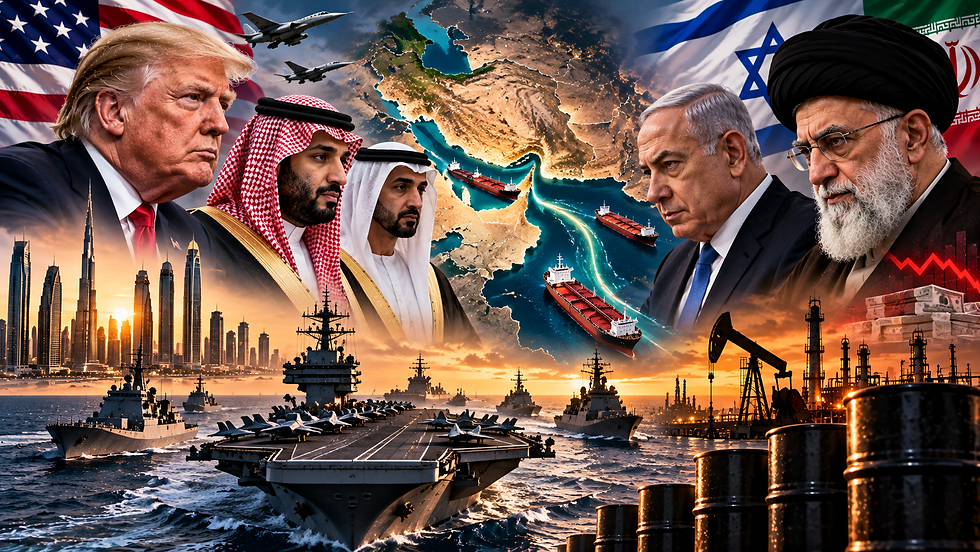
The Middle East is no longer facing a crisis. Rising demands for military deployments, oil routes, Gulf diplomacy and economic pressure are converging to create a regional dynamic in which Washington, Tehran, Israel and the capitals of the Gulf nations are all gearing up for conflict, and looking for leverage.
The most obvious indication is at sea.
On September 27, the USS Theodore Roosevelt departed San Diego, reportedly heading for an "extended" Middle East deployment. Two American carrier strike groups (USS George Washington and USS George H.W. Bush) are already deployed in the Arabian Sea to assist U.S. activities in the region. Currently, it is expected that Theodore Roosevelt will be dismounted from service not replaced by a permanent three-carrier deployment but eventually, that is the plan. The carrier is to launch F-35C stealth fighters, F/A-18E/F Super Hornets and EA-18G electronic-warfare aircraft as part of Carrier Air Wing 11.
In that force posture, Washington has a lot of escalation control and has security over increasingly important shipping lanes as well. It is coming as talks with Tehran stall. Both sides have so far not revealed the terms of any immediate breakthrough, though Iran said Wednesday it had received an official American response to its latest offer to end the conflict. Tehran has been trying to ease the blockade and sanctions and has cited a broader settlement as the key to reopening the Strait of Hormuz. But Washington has made little public offer to accept Iran's terms.
Meanwhile, Iran is threatening the Gulf governments to be more involved with Israel. Tehran denounced Benjamin Netanyahu's visit to the UAE and said the UAE's growing Israeli military presence would have "dangerous consequences. The comments should be interpreted as Iranian "signalling" and not a confirmation of plans for a new military strike. But they indicate Iran's worry over a gradual integration of the Gulf security architecture with Israel and the United States.
Netanyahu's quiet trip to Abu Dhabi is thus not just a gesture of goodwill between the two countries, but also one of national interest. Both the Israeli Prime Minister and the UAE President discussed bilateral relations and regional issues, with the governments recognizing discussions on the matter. The exact agenda and length of the visit are unclear and reports that the visit coincided with warnings ahead of the October 7, 2023 attacks have been attributed to Israel. It is indisputable that Netanyahu went with top national-security officials, making the meeting much more serious than mere diplomacy.
At the same time, another relationship between the Gulf began to shift. UAE Vice President Sheikh Mansour bin Zayed visited Riyadh and met Saudi Crown Prince Mohammed bin Salman, the first visit by a senior Emirati leader since a serious rift between the two countries surfaced. The disagreement among Yemen's southern groups over the peace and the security bordering Saudi territory has been at the heart of that friction. The fresh round of engagement is an indication that both capitals in the Gulf are aware that their competitive strategy will grow more costly in the face of Iran, the Houthis, oil market volatility and maritime insecurity all pushing them at once.
The November contract for Brent rose above $103 a barrel on Wednesday, the December contract in active trading was about $97.78 and WTI about $90.57. Brent was due for about a 14% gain in the month. But Middle Eastern oil transport has picked up considerably with alternative ports, pipelines and shipping arrangements. Saudi Arabia has prioritised its Red Sea infrastructure, downplaying (but by no means wiping out) the leverage that disruption around Hormuz provides.
As significant as Iran's missiles may be, its currency is just as important. On the unofficial market the rial has plunged to a historic low of 2.5 million to the dollar, increasing the price of imports in the country and inflation and the sanctions. Another challenge Tehran faces is the rise in the prices of goods and services, which in turn makes it difficult to buffer households from the effects of continued conflict. The endurance of a military force is not just in how many weapons it has, but in its ability to obtain foreign exchange, trade, its fiscal strength and the tolerance of its people for a diminishing purchasing power.
India is seeing this battle from another angle. In his recent remarks on the competition between the US and China, the External Affairs Minister S. Jaishankar said that de-risking and diversification, and the protection of national interests, were the new mantra, instead of a single world divided between Washington and Beijing. This is important because the new order is not just a new bipolar order. India, Saudi Arabia, UAE and the other middle powers are now creating multiple linkages instead of belonging to stereotypical camps.
In India, strategic autonomy is an economic imperative because of the energy requirement. The higher crude prices impact on the import bill, inflation, rupee and corporate margins. The rupee depreciated by 0.7% in September and 1.2% in the July-September quarter on back of high oil prices and tough global financial conditions. A long Gulf battle will thus quickly wind its way from the Hormuz into Indian fuel costs, transport, manufacturing and monetary policy.
The pressure point for Pakistan is quite different. Khyber Pakhtunkhwa and Balochistan continue to experience clashes and skirmishes. Balochistan's political landscape has become more polarised with debate on governance and militancy taking place in KP. This week, the Pakistani security forces announced that they have carried out some fresh operations against militants in Mir Ali and other areas. Islamabad thus finds itself facing a sizable domestic-security challenge in any larger reconfiguration in the region.