
Popular Categories

Politics

Geo Economics

Lifestyle

Analysis

Geopolitics

Civilizational Lens

Defence

The World Is on Fire at Both Ends and Oman Just Got Caught in the Middle
3 Jun 2026
Created by
The BV Team
President Trump has threatened Oman, Washington's “silent partner” in the Middle East and a key U.S. ally in negotiations with Iran, regarding reports that it is discussing fees for its foreign vessels transiting through the Strait of Hormuz. The Strait is "going to be open to everybody," Trump told reporters at the White House. “It's international waters and Oman will do what everybody else does, or we'll have to blow them up.
It's a sentence you should read again. The United States just threatened to "blow up" a country it has been a trusted diplomatic interlocuteur to for decades. The threat wasn't hidden inside a policy memo, but was uttered by the president himself, in front of the cameras.
Treasury Secretary Scott Bessent had already sent a more official message on Thursday, which said that the U.S. would “aggressively target” anyone who was “facilitating tolls” for the strait. Squeeze from all angles.
What does Muscat have to choose from? On the other hand, a historical close friendship with Washington that has rendered Oman the only diplomatic channel through which Washington and Tehran can communicate if they do not want to do so directly. Then there's a growing dilemma with another nation whose land borders the Strait, the foreign minister of which country, Abbas Araghchi, immediately "expressed Iran's solidarity with Oman in the face of any threat" following Trump's statement.
The control of the Strait of Hormuz, part of which is in Iranian and Omani territorial waters, has emerged as one of the most important issues in talks between the U.S. and Iran aimed at ending the three-month-old war. The effective closure of the Strait has skyrocketed energy prices and disrupted the trade of several other commodities around the world.
Oman is not only diplomatically cornered it's geographically cornered.
The game of nuclear chess no one can win.
As part of the continuing negotiations, there is "the prospect" Iran could negotiate aspects of its nuclear program, Secretary of State Marco Rubio told the Senate Foreign Relations Committee June 2. He restated the reopening of the Strait of Hormuz is at the heart of any de-escalation.
The words "there is the prospect" are diplomatese for "we're not there yet, but we're not giving up on the idea either. With the chasm between what Washington is asking for and what Tehran is willing to concede still wide, it is intentionally vague.
Trump has demanded Iran never produce a nuclear weapon or bomb, and that the Strait of Hormuz be "immediately open" to free shipping trade without tolls. He also announced that the U.S. blockade of Iran in the Gulf of Oman "will now be lifted," although it was not clear if the move would be made contingent on the previous measures.
A clue to the other side's thinking came in the morning from Iran's parliamentary speaker, who posted on X, “This is what drives us. “When we take concessions, we don't do it through dialogue; in the process of negotiation, we only let them know.” They don't believe in guarantees and words, only the actions count. No action will be taken when they do not act first.”
That is NOT a negotiating position. That is a warning.
Iran's Fars news agency quoted a source on June 2 as saying Iran and the U.S. had ceased exchanging messages several days ago, but Trump and Rubio both backpedaled, claiming that talks continue. The paradox in itself is an indicator. If one side says "we're still talking" and the other one says "the line went dead", then this negotiation is hanging by a thread.
Meanwhile, Rubio was being pretty forthright in his testimony on Iran: “If you come and do anything about our nuclear program, we will overwhelm you with missiles, we will overwhelm you with drones, and we will overwhelm you with our navy.” He noted Operation Epic Fury had been "highly successful," and that Iran's capacity to make missiles and drones had been "significantly curtailed" but that Tehran "still has a lot of drones," as they are "easy to make.
The last one is not reassuring; they're easy to make.
The real cost to the world of the Strait's Closure.
For the moment, let's ignore the geopolitics and just talk about the money. The Strait of Hormuz is not just a strategic waterway, it's the world energy system's ‘throat.
About 27% of the world's sea lanes carrying crude oil and petroleum products go through the Strait. Beginning on March 4, 2026, Iranian troops declared the Strait "closed" and threatened and attacked vessels trying to pass through the waterway.
As per the Commodity Markets Outlook 2026 report by the World Bank, the war in the Middle East and the disruption in the Strait of Hormuz resulted in the biggest oil market shock in history, pushing oil prices higher, leading to a reduction in the global supply of oil. Global oil supply crashed by 10.1 million barrels per day in March, due to attacks on energy infrastructure and restrictions on tanker traffic in the Middle East. The anticipated drop in global oil output for Q2 2026 is 6.9 mb/d (-6.6 percent year-on-year), the biggest quarterly decline since the Covid-19 pandemic.
In early May, the benchmark crude for global oil prices, Brent, jumped almost 6 percent to $114.44 a barrel, as markets were factoring in “the risk of more oil infrastructure damage and the likelihood that the Strait of Hormuz will be closed beyond the time frame the Trump administration has outlined.”
Those numbers after that price shock are felt in every kitchen in the world. Global oil demand dropped in March by 0.8 mb/d year-on-year as disruptions in the supply chain intensified and oil prices went up. Advanced economies, Asia and the Middle East are all expected to experience a decline in demand due to trade disruptions, with demand expected to decline by an additional 1.5 mb/d in Q2.
There has been a silent explosion in shipping insurance. When war breaks out, war risk insurance policies reportedly have a 72-hour cancellation clause that the insurance companies can choose to invoke, which allows them to re-evaluate risk which means that premiums can be quadruple or quintuple the figures before the war.
Not just oil, though. Helium, fertilizers and other industrial products have been affected by the Hormuz closure. Although the situation could potentially drive faster progress in moving to clean energy, it has highlighted significant exposures in the timeline of hydrogen projects and hydrogen export infrastructure. Although considered a major opportunity to become a green hydrogen hub, the scale up of the production capacity could be significantly delayed by the continuing instability and uncertainty of shipping routes and investments in the Middle East.
In one stroke, the closure has set back a decade of energy transition planning. This is what is being done to achieve that.This is how they are going about doing that.
The events at sea reported during the past week are not random. Iran has demonstrated time and time again its ability to weaponise the international shipping system.
The U.S. Navy fired shots on an Iranian container ship that attempted to evade the U.S. naval blockade of Iranian ports in the Gulf of Oman, before the Marines took control of the ship. The seizure followed an attack by Iran on a tanker in the Strait of Hormuz, in which the Revolutionary Guard gunboats fired on the tanker and a container ship was hit by an unknown projectile. Global markets are reminded with each incident that until the diplomacy resolves nothing is safe.
A certain amount of oil has been diverted in the pipelines but pipelines have their limit. The U.S. and other nations are releasing 400 million barrels of oil from strategic reserves the largest on record and the U.S. has suspended sanctions on some Russian and Iranian oil to allow the market some breathing space.
The last bit was only barely one of the headlines, but it should have been. But even temporary and crisis-related easing of Iran sanctions by Washington is a big concession, which is a sign of how severe the supply shock is on the global economy.
Russia Bombs Ukraine: World Elsewhere
Then there's Eastern Europe where Vladimir Putin seems to have decided that with the world distracted by the Middle East, it's a time that should not go to waste.
Russia attacked at least 22 civilians and injured 138 others in Kyiv and other Ukrainian cities overnight on June 2 with hundreds of drones and dozens of missiles. In the central Ukrainian city of Dnipro, bodies of an 8-year-old boy and his mother were discovered by emergency rescue teams in the ruins of apartment buildings, while bodies of a three-year-old child were found there.
Over the last night, Russia fired 656 drones and 73 missiles at Ukraine. The primary targets were the capital city of Kyiv, central city of Dnipro and the eastern cities of Poltava, Kharkiv, and Zaporizhzhia. The Ukrainian Air Force shot down or neutralised 40 missiles and 602 drones.
The magnitude of it is astounding, 729 projectiles in one night. That most of them were intercepted by Ukrainian air defenses is proof of extraordinary ability under extraordinary pressure. The math still stands though, 87 projectiles did get through. Into apartment blocks. Into children's rooms.
In recent weeks, Russian President Vladimir Putin has stepped up his air force operations in an apparent attempt to capitalize on Ukraine's lack of U.S.-made air defense systems, and to convince an increasingly pessimistic public within his country that Moscow is winning the four-year-old conflict.
It is no coincidence that this is happening now. Meanwhile, with Washington pre-occupied with talks with Iran, Gulf energy crisis and the Oman standoff, Moscow is pushing on all the pressure points.
1997-98/30/101: What is the impact of flying at thirty thousand feet?
The Oman ultimatum, the Iran nuclear negotiations, Russia's Ukrainian bombardment all have one thing in common: The international order that came into place after 1991, which basically was run by one great power, is a thing of the past. What it's being replaced with is yet to be identified.
Previously, Iran was not in control of the Strait of Hormuz. The decision by the Trump administration to withdraw from the 2015 nuclear deal, the JCPOA, was “a completely reckless and absurd one,” as said by the former nuclear negotiator Robert Malley, and the Trump administration is negotiating many of the same terms and adding the new idiosyncrasy of the Strait of Hormuz, which was not part of the previous deal. “It's a situation we wouldn't be in had it not been for us.”
That's a cut in several directions. The U.S. is in a strong military position, but a weak strategic one, having wiped out a lot of Iranian military potential but unable to come to a deal. Iran is negotiating from a position of economic disaster, but psychological strength, because the world economy is losing more than Tehran can afford, every day the Strait remains closed. And all of this is playing out under the watchful eyes of Russia as they make their calculations on what they can get from a distracted Western alliance.
What, no question from the headline-writers loud enough to ask: What does a settlement that satisfies all parties even look like? Iran will not give up its nuclear future completely. The U.S. must have a victory to sell back home. Oman can ill afford to lose either relationship. As long as the western attention is split, and Russia has no reason to stop anything.
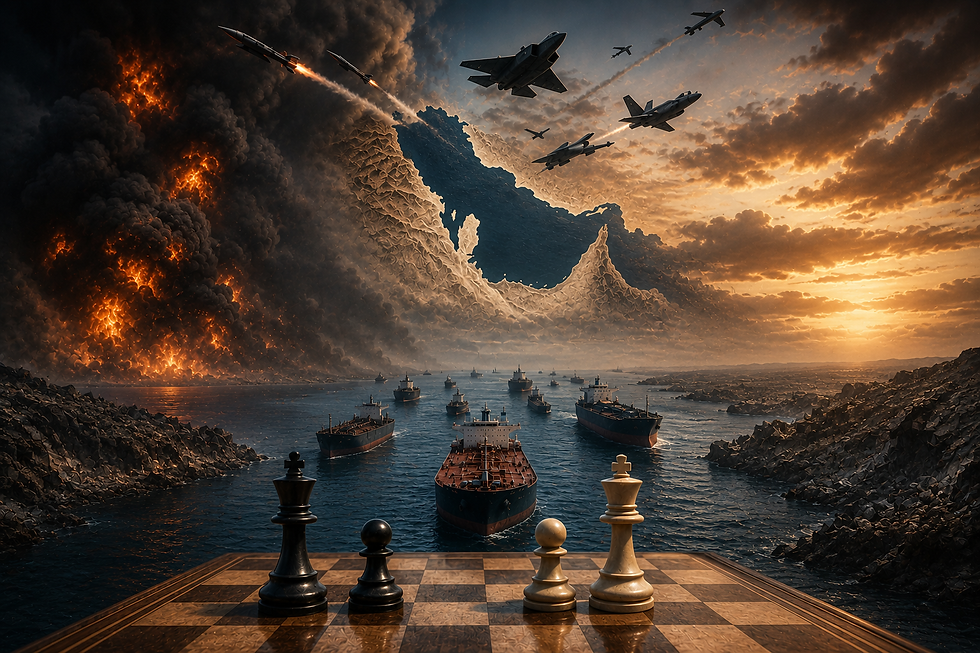
There are more moves on the chessboard than ever before in the world. If they can be patient with and have the statecraft to maneuver through all of them at once is a question June 2026 will answer one way or another.