
Popular Categories

Politics

Geo Economics

Lifestyle

Analysis

Geopolitics
Civilizational Lens

Defence

India Is the G20's Fastest-Growing Economy. The Reason Is Older Than Capitalism.
26 Jun 2026
Created by
The BV Team
This spring, the narrative the markets wished to hear about India was that of fragility, for a few uneasy weeks. Crude had gone past $100 a barrel after a 107-day war in West Asia, rupee was inching towards 95 and had hit record lows of around 97 per dollar, foreign portfolio investors were exiting and selling in April, May and June to the extent of about ₹1.72 lakh crore in net sales. India, which imports close to half its crude, about 70 percent of its LPG and nearly 90 percent of its LNG from the Gulf, was frantically seeking oil from farther sources as shipping via the Gulf froze up. The Reserve Bank, which has held its repo rate at 5.25 per cent at the February and April meetings, stated categorically that it will act if inflation became entrenched. Under normal score keeping, the economy was in trouble.
After that the war ended. Washington and Tehran clinched a deal, the Strait of Hormuz was reopened and crude returned to the $70-to-$80 range. The rupee strengthened, oil prices came down, and Goldman Sachs immediately upgraded India's growth forecast for 2026 to 6.8 percent, even as it lowered its inflation and current-account deficit projections to 4.4 percent of GDP and 1.1 percent, respectively. All this was not news to anyone who had been paying attention to the numbers, not the headlines. India was growing at its fastest since its recovery from the Covid-19 pandemic and the fastest among all the G20 economies, closing in on 7.7 percent in its 2026 fiscal year, and the growth was driven by private consumption and investment, not exports.
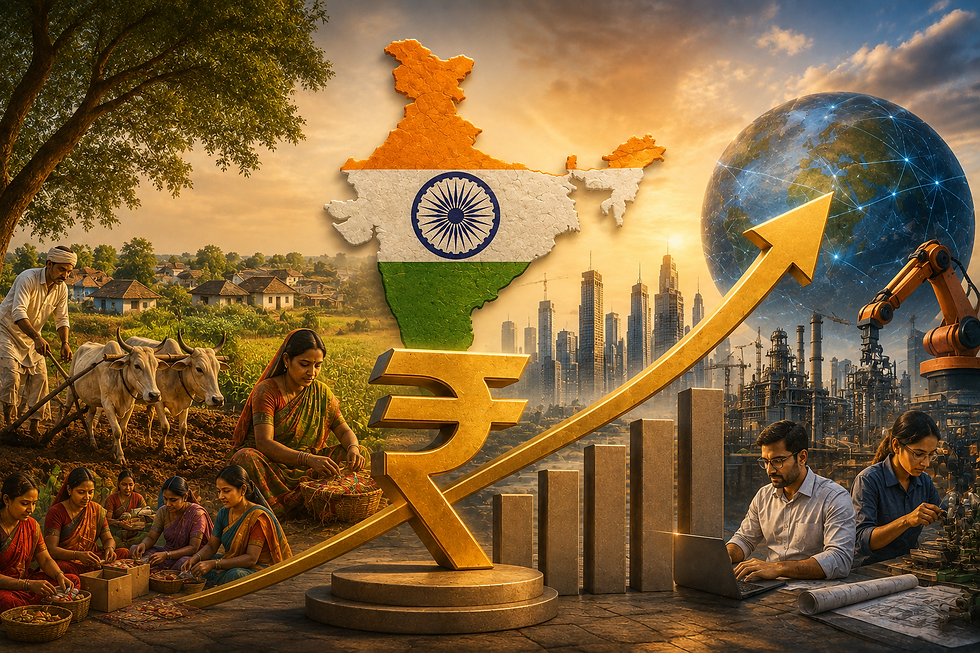
What the entire sequence shows is something India forgets about itself. The jolts that startle the tickers come from outside, via oil, via capital flows, via tariffs. The resilience that absorbs them comes from within, out of households and small businesses, and the spending habits of ordinary folks all over the countryside. The number that tops the league table has never been the real measure of this country's strength. It lives in the structure underneath it.
The distinction is important because the previous year was spent debating the right (but wrong!) number. The government has announced that India has become the fourth largest economy in the world, surpassing Japan, and this was declared as a national slogan. Then, the statistics ministry changed its approach to measuring output and the picture changed again. The rebasing shaved approximately 3-3.5 percent from India's GDP, which dropped the headline figure from around $4.2 trillion to near $3.9 trillion and helped Japan regain its rank of fourth and India its rank of fifth. The tables of IMF were even gloomier in April. It's not as though the lesson in that lesson was that India is weaker than advertised: in fact the same revision revealed manufacturing and recent growth as more robust than earlier methods indicated. The takeaway is that ranking is vanity metrics. The fact that India is a nation of 1.47 billion people with per capita income of approximately $2,800, does not imply that the country is rich because of its size. The by-product is size and all India has been doing till now is chasing the by-product.
The more detailed description of what that "something else" is, is from a tradition much older than the contemporary terminology of GDP. It is a clear cut order of obligations set forth in the Mahabharata via the counsel of Vidura: a man can be sacrificed for the good of the family, the family for the good of the village, the village for the good of the nation and even the entire material world for the good of the self in the real sense of the word. If read as economics, not ethics, it is a system that has been constructed from scratch. Value starts with the person, then adds up in the household, is organized in the village and only then is aggregated at the national level. Prosperity is not a gift from the state, but is extended upwards through a chain of responsibility, and each link pays tribute to the one above it in a spirit of sacrifice.
That intuition was given backbone by the economic historian Angus Maddison. According to his reconstruction, India accounted for one fourth to one third of the world output during the greater part of the period between the first century and 1700, and even in 1700, its share of the world wealth was nearly one fourth, several times of what was possessed by the Britain of that time. It was not centrally planned or the result of a colonial empire. It was based on self-sufficient villages growing crops, weaving, firing pots, and doing business, each family being a small economic entity in itself. In the early modern world, there were luxurious goods such as Bengal muslin and Kashmiri pashmina, and the cotton from the south. As the chart above shows, what followed was a policy of the colonizers in which they were responsible for depleting the local craft, answering with prohibition and with a process of undercutting, and by 1947 local production was only about 3 percent of the world's total. The industry was not the only thing that was broken. It was the whole ladder from person to home to village to country. When the rungs are cut, it is no longer possible to climb, and this is just what the old verse warns against.
Then, India in the twentieth century adopted two foreign solutions in succession, without either being very cosy. The approach of state socialism was to centralize decision-making and to plan the citizen as one. The liberalization which ensued, swung toward a market individualism which was imported whole from the West, where the person is addressed primarily as voter, taxpayer and consumer, as opposed to the member of a web of obligations. They are both "top down" ideas and the idea is that prosperity should "trickle down" through policy. The civilizational instinct goes in the other direction, and this should not be discounted as nostalgia, as the numbers on the ground continue to bear it out.
Think about the places of economic activity in India. Rural demand revealed by sales of two-wheelers and tractors, and evident in volumes held up for consumer goods still has about 65 percent of the population. Today, the MSME sector has grown to include more than 7.47 crore enterprises, generates approximately 35 per cent of manufacturing output, accounts for second largest employment after agriculture and is disproportionately distributed across villages and small towns, with more than half of the units in rural India. By the end of 2025, the cumulative investment under the production-linked incentive schemes reached around ₹2.16 lakh crore, and the production has reached around ₹20.41 lakh crore with the creation of some 14.39 lakh jobs. Underlying all of it are the self-help groups, with more than nine million of them mobilizing more than 100 million women into the world's largest microfinance network. A household brand, Lijjat Papad was begun by seven women with borrowed money. All this was not designed according to a plan from a ministry. It's the household-as-enterprise model that the verse describes, writ large on a subcontinent.
The policy language used in the current policy simply states the old concept in administrative language. In all such policies as Atmanirbhar Bharat, Vocal for Local, Startup India, national capability is built out of local capability, not the other way round, as in the case of the village industries pushed through the Khadi commission and the new mission for self-sufficiency in pulses, which has an outlay of ₹11,440 crore. The finance ministry takes pains to stress that this is not a return to protectionism, and they're right. The goal, as the government itself puts it, is to become a larger and more integral part of the world economy, first by being self-generating at home.
In this case, the world has subtly swung in India's favor. Two decades of treating the lowest cost supply chain as a no-brainer have led to the rediscovery of the importance of resilience, redundancy and production nearer home in the wake of the pandemic and the years of conflict since. In fact, friend-shoring, strategic stockpiles, semiconductor sovereignty and the resurgence of domestic manufacturing in the West and in Europe is Indian civilizational thought catching up with the West: that an economy that cannot sustain itself in terms of feeding, clothing and manufacturing is not really rich, no matter how big its trade volume is. The eccentric model India is no longer striving for.
It is not a victory lap argument, and the sincere version of this argument doesn't go there. Manufacturing still accounts for just around 15 percent of GDP, just below the level in 2014-15, and more than 40 percent of the population are still engaged in agricultural activities, much higher than the figures in China and the USA. The per capita income is low, the rebasing controversy illustrated how laxly the country's own statistics are sometimes interpreted, and the rural base that is touted by everyone is overlaid with real distress in the consumption figures. An existing ladder is not a ladder for everyone.
But what really counts is whether India is the fourth or fifth largest economy. It is about whether responsibility at the individual level still leads to a good household, a good village and a good country. That was why India was one-quarter of the world economy for sixteen centuries, and that's why the number became a rounding error in a single colonial lifetime. This is the fastest growth of the G20 countries this year and it wasn't caused by a nifty prediction or a drop in oil prices. It was borrowed from the part of the economy already constructed in this manner. It has turned out that the oldest concept in the room is actually the most modern concept around.