
Popular Categories

Politics

Geo Economics

Lifestyle

Analysis

Geopolitics

Civilizational Lens

Defence

India's newest warship is really a message, and the message is about money as much as missiles
14 Jul 2026
Created by
The BV Team
The Indian Navy's Eastern Fleet expanded with the addition of another hull on July 11 when Defence Minister Rajnath Singh commissioned INS Mahendragiri, the Naval Dockyard, Visakhapatnam. It was, on paper, a ceremony, a reading of a motto about steadfastness, a christening under a mountain range named, and a guard of honour. But below the surface, it's a tale of how India is attempting to end its reliance on outsiders' shipyards, and the unheralded profits being accrued by a group of Indian and European firms.
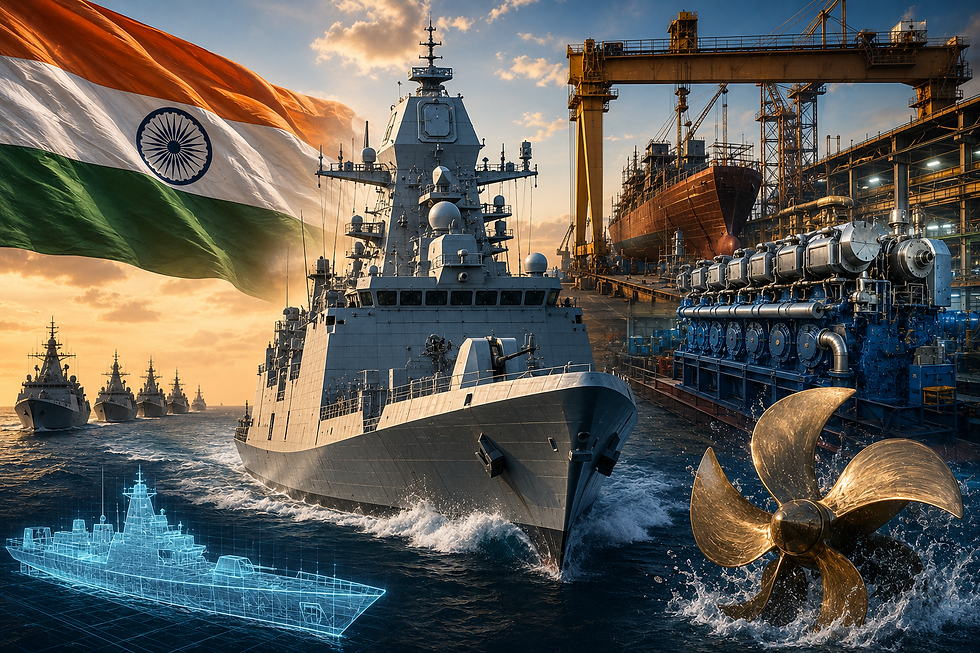
The sixth out of seven ships of the Nilgiri class under Project 17A, which has been underway, in some shape or form, since the mid-2000s, costs about ₹45,000 crore. The government has been relying heavily on her when it speaks of Aatmanirbhar Bharat, as the frigate has over 75 pc indigenous content, designed entirely by the Navy's own Warship Design Bureau and built by Mazagon Dock Shipbuilders in Mumbai. It is capable of displacing almost 6,670 tonnes, speeding beyond 28 knots and is armed with BrahMos cruise missiles, Barak air defence missiles, torpedo tubes, anti submarine suite and close in weapon system. Less talked about is that of keeping a nearly 7000 tonne warship afloat for weeks at a time: electrical power. This week Rolls-Royce has revealed that Mahendragiri is powered by four of its 1MW mtu 12V 396 TE54 generator sets, which power the ship's radars, weapons, cooling and life support systems. The sister ship INS Dunagiri and also the anti-submarine ship INS Agray were commissioned during the same period and have similar mtu configurations. It's not even a footnote. It is a reminder that even a warship meant to maintain self-reliance has to rely on foreign propulsion and power engineering systems for some of the most safety-critical systems something India has been trying to localise with a joint venture between Rolls-Royce and Force Motors at Chakan near Pune.
The induction really begins to tell when zoomed out! It's been 18 months since the induction of the first six Project 17A frigates, with Nilgiri joining the fleet in January 2025, followed by the simultaneous induction of Udaygiri and Himgiri in August 2025, Taragiri in April 2026, Dunagiri just one month before Mahendragiri, and now this. The only ship that is still under construction at Garden Reach Shipbuilders in Kolkata is Vindhyagiri. That's important because Indian shipbuilding has been chided in the past for a lack of timeliness and budget control in fact, for the reverse of that issue. The delivery of about one frigate a month is a radical change from previous schedules, and naval officers have made it abundantly clear they consider it an example of the domestic industrial sector now being capable of simultaneous, complex construction in two yards.
There's a harder economic argument behind the ceremony, as well. India's Navy has expressed a desire to have a force of 200 ships, all of which will be indigenously developed, by 2035. The research by the brokers suggested a gap of about 876 platforms between China and Pakistan, thus creating a market opportunity for shipbuilders of the size of $75 billion- $100 billion over the next 15-20 years, which is projected to remain largely with Indian yards with near 95 per cent of the demand. Mazagon Dock ended FY26 with an order book of over ₹20,000 crore, with over a third of it from the P17A frigates and P15B destroyers, submarine work from Project 75 and diversification plans for projects in ONGC offshore and a Colombo Dockyard acquisition in Sri Lanka. At the end of the year, Garden Reach had an order book of more than ₹15,000 crore on 39 platforms and analysts believe this could triple to around ₹50,000 crore by 2028 if it is successful in securing the Next Generation Corvette programme it is the leading bidder on. No part of this is charity expenditure. It is a risked bet that naval shipbuilding, which was perceived purely as a defence liability, will be transformed into an export industry and an employment creating industry as South Korea and Japan did in commercial shipbuilding by building military capability.
The geopolitical framing is not simply a by-product either. The Strait of Hormuz to the rest of the Indo-Pacific is fraught with potential trouble spots, and New Delhi has come to recognise that maritime power is now inextricably linked with economic security, with about 90 percent of India's trade in volume, and a similar percentage of its crude imports, being transported by sea. It was Singh himself who made that connection straight from the Visakhapatnam ceremony, and who highlighted that Mahendragiri is a weapon used in battle and also a proof that Andhra Pradesh is no longer only a recipient of one-off contracts but a hub for defence and aerospace manufacturing. It is equally important to mention, albeit in the smallest terms, that India's shipbuilders are beginning to cast their eyes beyond the Navy; Mazagon Dock has been in touch with Malaysia and Indonesia for possible orders and the Japanese shipping line MOL has expressed an interest in the shipyards Indian commercial vessels.
What Mahendragiri really represents, however, is not just a ship but a model of an industrial strategy: the ability to link up domestic design bureaus with private and public ship yards, MSME suppliers and even foreign engine makers via joint ventures, and create a repeatable production line for warships that India has rarely managed to do at such a pace, and at such a price point. That proof of concept will prove to be the leaden liners that allow the country to transition to a 200-ship Navy by 2035 will not be determined by one commissioning ceremony but by whether order books, capital expenditure and skilled labour continue to increase at the pace they have in the past eighteen months.