
Popular Categories

Politics

Geo Economics

Lifestyle

Analysis

Geopolitics

Civilizational Lens

Defence

India's stratosphere play- why New Delhi is arming for a war fought at 65,000 feet
14 Jul 2026
Created by
The BV Team
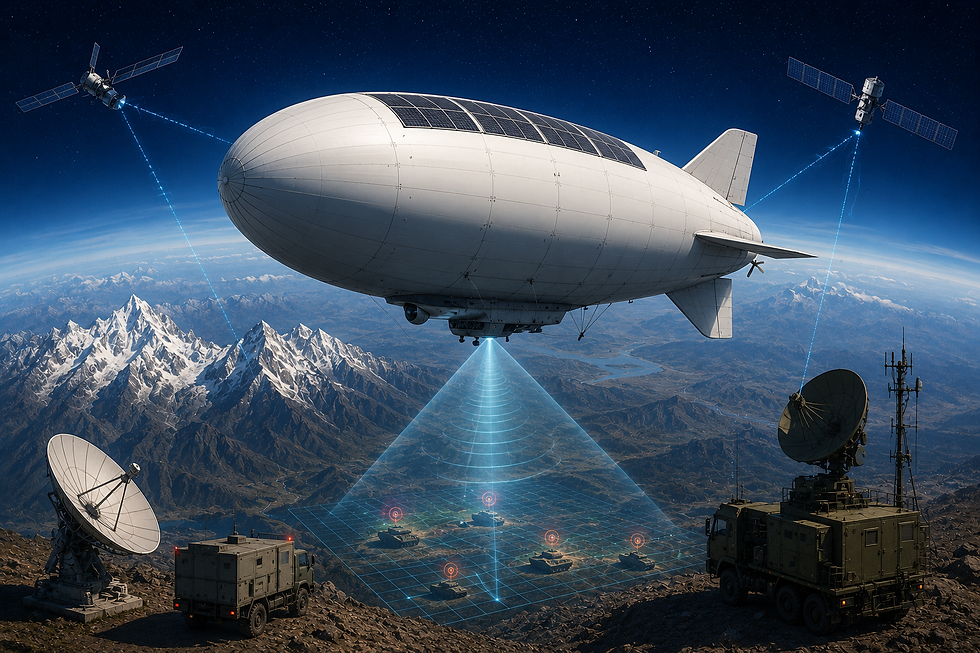
Private aerospace is a sector whose shadow hangs over India's defence sector, and one of the most significant surveillance programmes in the country's modern military history is quietly afoot for India. The Indian Air Force is formally approaching domestic firms to develop and manufacture the Airship based High Altitude Pseudo Satellite, which will hover above 20 kilometres for months at a stretch and monitor borders, track electronic signals and pass on communications long after a conventional drone has exhausted its fuel and much before a satellite would even know something was moving on the ground.
It has a price tag of about ₹15,000 crore, apart from the ₹3.6 lakh crore investment approved by the Defence Acquisition Council on February 12 this year in the capital procurement of 114 Rafale fighters and P-8I maritime patrol aircraft. It will be under the Make-I route and the government will absorb up to 70 per cent of the development cost for the selected companies, a rare case where it would de-risk private capital on a technology bet, which has a gestation period of 10 years or more, and an area where Indian companies have never had the appetite or the balance sheet to take such risks. Two or more development partners are likely to be short-listed on technical capability and financial strength and the prototype stage will be followed by acquisition of a yet-to-be-specified number of operational systems.
It is helpful to put the airship in the right context to understand the impact on the balance sheet it goes beyond that.It's helpful to put the airship in the right context to understand that it goes beyond the balance sheet. They are created to fill the space between high-altitude drones that usually fly at an altitude of 12 kilometres, and low-earth-orbit satellites that can be fixed anywhere from 500 to 2,000 kilometres in the air. This space is not just left for the sake of it. It is above commercial air traffic and most weather systems but below the cost, complexity and inflexibility of orbital hardware and that is why militaries and telecom businesses in the world have been chasing it for the past decade or more with little success.
The first attempt to grab a share of that vacuum was made by DRDO's Aerial Delivery Research and Development Establishment (ADRDE), at Agra, in May last year, when it successfully tested a prototype of the payload-carrying glider, which was carried to the altitude of about 17 kilometres and hung in the air for 62 minutes while the pressure control and emergency deflation systems were validated. It truly marked an achievement, and Defence Minister Rajnath Singh, at the time, stated that India now belonged to a "small club of nations" that could build their own stratospheric airship. However, a 62-minute test flight is a long time to wait for a platform capable of months of loitering and no Indian private company has come close to performing even that demonstration. The difference in what is possible within the programme and what the programme requires now is just that, and that is what the government is attempting to bridge, with cheques instead of instructions.
There's a clear geopolitical need, and the tone is Chinese. The high-altitude balloon programme in Beijing is shrouded in mystery, although Beijing balloons have appeared in both Indian and American airspace, most recently in the high-altitude balloon shot down off the American coast at nearly 20 kilometres in 2023. India is seeking to develop a version of that technology in its own homeland, but experts in the field say that the type of balloon China is developing is much more capable and more likely to be used for military purposes. Throw in the ongoing tensions along the Himalayan border and the greater competition for a surveillance advantage over the Indian Ocean and it soon becomes clear why it makes sense to have a platform that can keep an eye on a section of the border, without even the need to relocate or refuel it in orbit, for weeks at a time.
India is not alone in this race and it is fair to say that the field is still uneven. The EUROHAPS project of Europe is still in the stage of a demonstration prototype. Thales Alenia's Stratobus is not likely to reach maturity before the early 2030s. Airbus has completed a record 25-day uninterrupted solar flight with its Zephyr, and the US has conducted successful test flights of airship models but failed to make a viable machine available for service. Nobody has yet worked out the commercial-scale technology, so it's not as if India were playing catch-up, rather, they are getting in on the game very late, and with a very awkwardly placed starting gun.
The economy confirms that read. Independent market analysts estimate the worldwide high-altitude pseudo-satellite industry is worth around one-to-three billion dollars now, and will increase at compound annual growth rates of 15 percent and more over the coming decade, with defence and government still making up some 45 percent of spending as telecom and disaster-response applications rise more quickly. Nearly a quarter of that market is growing at a near 27 percent rate in China India is not far behind at about 25 percent compared with the more mature but more sluggish markets of America and Europe, according to sector forecasts. This is perhaps the first truly open lane in a fighter jet and missile world dominated by legacy public-sector weapon makers for Indian aerospace and defence-electronics companies waiting for the opportunity to get a toehold in the business.
None of that can be guaranteed to be successful. There's still a long way to go before lightweight envelopes that can withstand the frigid temperatures of the stratosphere, the UV radiation and the ozone corrosion, can be mass-produced; even the lower temperatures of the stratosphere still require maturing station keeping algorithms, and energy storage for extended endurance of even a few months is still a problem around the globe, not just in India. What the government has done is eliminate the biggest obstacle that would face private Indian industry which would prevent it from even going near the edge of hardware the cost of failure. The chances of that bet being won is not as much a matter of self-reliance rhetoric, but whether the shortlisted companies can convert seed funding into something that lasts at least 90 days, not 62 minutes.