
Popular Categories

Politics

Geo Economics

Lifestyle

Analysis

Geopolitics

Civilizational Lens

Defence

Kochi becomes the classroom for the world's largest naval coalition, and the stakes go well beyond a training drill
16 Jul 2026
Created by
The BV Team
The Southern Naval Command in Kochi will host something that will not catch headlines like a missile test or a border skirmish and yet, it says more about the direction in which India is heading from 20th to 23rd July. Operation Southern Readiness 26-2 is a four-day transnational training exercise involving the navies of the Combined Maritime Forces (CMF), a coalition of about 47 navies who collectively guard some of the most important oceans on Earth. It appears like an ordinary note on the calendar. It is, of course, a reflection of how far India has moved in the structure of international maritime security and of the significance of money and geopolitics in that repositioning.
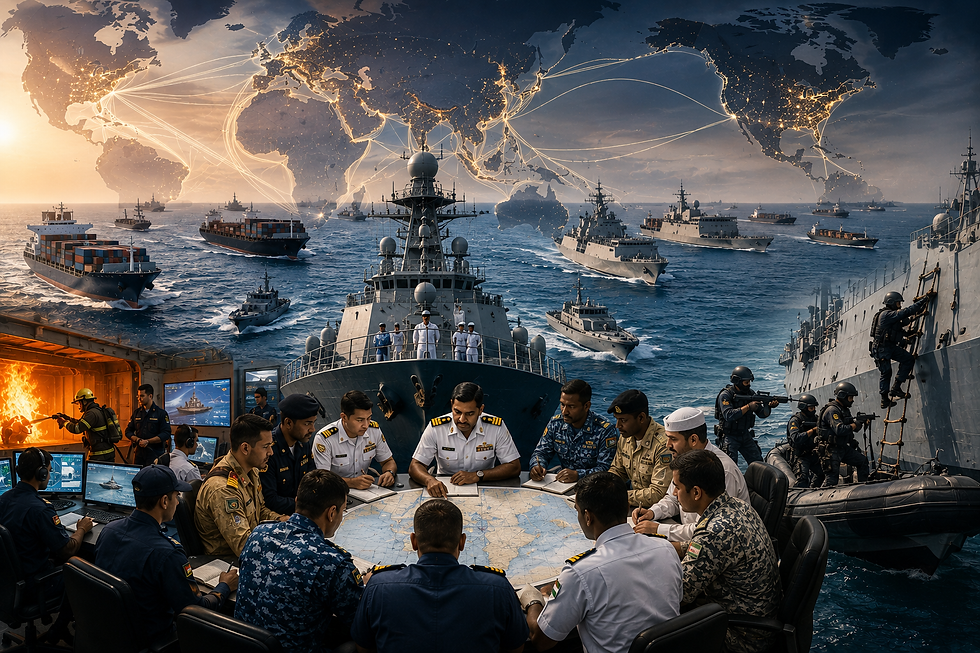
The mechanics are simple enough. Students and officers from other countries will undergo classroom training on maritime law, hours of damage control and firefighting training on simulators and then the practical training on board an Indian naval ship. The Syllabus includes counter-narcotics, force protection, asymmetric threats, boarding procedures, survival at sea and the more recent concern of uncrewed maritime systems (UMS), the drone boats that have already revolutionised naval thinking from the Black Sea to the Red Sea. This is actually the where the real story begins and is run by the CMF's dedicated training and capacity building arm Combined Task Force 154.
The Indian Navy recently took over control of CTF154 from Italy in February this year at a ceremony held in Manama, Bahrain, under the auspices of the US Navy's Fifth Fleet commander. It was the first time that India led a Combined Maritime Forces task force since the inception of the grouping and was not given easily. The departing commander of the Italian force had completed the largest version of the exercise, Operation Compass Rose V, which involved almost 140 maritime professionals. Giving that baton to an India and not to any of the other 46 member navies reflected the perception of who the established and emerging powers in the region deem a competent teacher of other people's sailors, and not a mere taker of security assurances that were drafted elsewhere.
This is more important than it sounds; the Indian Ocean is not some backwater where training is good-naturedly granted. It handles nearly half of the worldwide volume of containers and about four-fifths of all ships that transport oil by sea. The figures for India are even starker: approximately 95 percent of all India trade in volume and 70 percent in value passes through these waters. It is no exaggeration to say that the Strait of Malacca, which leads from this ocean to the Pacific, handles some 40 per cent of global trade annually by value, and scores of thousands of ships are packed into a stretch of water just 900 kilometres long. Further west in the Strait of Hormuz, a fifth of the world's traded petroleum liquids pass through. If any of these arteries clogs up, even for a short while, insurance premiums rise, freight costs go up, and shock waves can be felt in London's supermarket aisles and in Ohio's factory floors within weeks. Everyone speaks of the Indo Pacific as an abstraction and here are the pipes that the modern economy breathes through.
India's own maritime footprint has increased in proportion. In the past financial year, the major ports managed approximately 855 million tonnes of cargo with the number continuing to rise due to the development of port facilities and coastal logistics corridors. By 2030, the government has ambitious goals to become one of the top ten shipbuilding nations and by 2047 it wants to become one of the top five, but that seems like a huge stretch when you consider how much money is chasing that dream. If you zoom out further, the 23 core economies bordering the Indian Ocean from the Gulf to East Africa to Australia make up nearly 11 per cent of the world's GDP, 14 per cent of global trade in goods and close to a third of the world's foreign direct investment inflows. At some point in history between ancient times and now, it went from being a local thing to being a pillar of the world economy.
What is not obvious when a four-day training drill is broadcast as typical defence briefing is that that's the glue that holds that load-bearing wall together. They're not designed to do things that make headlines; they're designed so that one of the first responses when a hijacked vessel, a drug shipment or a stranded fishing crew arrives on the scene.They are not designed to create headlines; they are designed so that one of the first responses when a hijacked vessel, a drug shipment or a stranded fishing crew arrives on the scene, they can speak the same operational language as an Indian warship and a coast guard vessel from one of the small states in the Gulf. Training is the immediate need. The medium-term calculation is influence: who trains the region's navies determines the standards, equipment preferences and, ultimately, the diplomatic instincts of the navies for one generation. Underneath all this, there's a little more than a recalibration of the civilisations, and the Romans' trade taxes are one third of an empire's revenue, 2000 years ago, being recouped by the country whose coastline it borders, bit by bit, though without the grandeur.
All this does not ensure a smooth ride. Regional arrangements such as IORA are still underfunded, the Chinese navy is still gradually increasing its footprint in the area and shipping is already having trouble with cyclones due to climate change. But one exercise that brings sailors from dozens of countries together to learn how to cope with piracy, trafficking and disaster response is, in its stealthy manner, more effective at protecting the world's economic veins than much of what passes for news this week.