
Popular Categories

Politics

Geo Economics

Lifestyle

Analysis

Geopolitics

Civilizational Lens

Defence

Modi and Albanese bet on uranium and rare earths to outflank China's mineral chokehold
13 Jul 2026
Created by
The BV Team
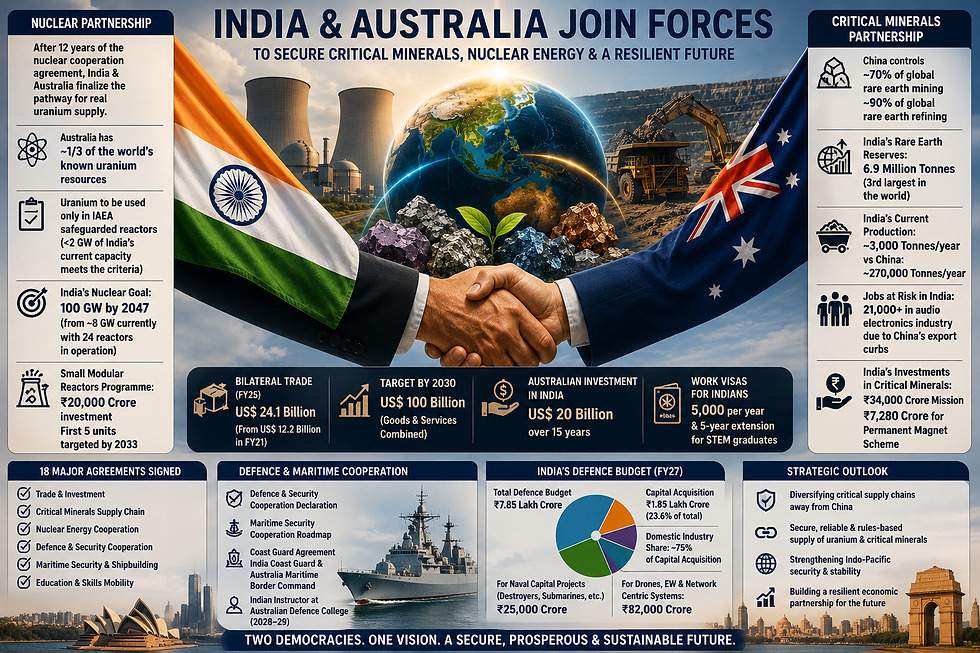
Melbourne is now the site of the most pivotal India-Australia engagement in years, and the number of the agreements signed in one day eighteen is just a part of the story. The actual news is under the table: India and Australia have finally negotiated out the nitty-gritty of how to get real uranium from Australia mines to Indian reactors, after 12 years of a nuclear cooperation treaty that hasn't delivered much beyond a token 2017 test shipment. It's a big technical solution for a nation that has quietly made one of the boldest energy goals in the world.
India has 24 reactors operating to produce about 8 gigawatts from the total energy production. New Delhi expects it to reach 100 GW by 2047, when it celebrates 100 years of independence, and has to add to the fleet by over 10 times in that span of time while also maintaining the existing plants. That doesn't add up with their domestic uranium resources the ore is thin and low-grade in India as opposed to the world's top producers. Australia, with nearly 1/3 of the world's known uranium, is obvious the counterparty, and the political bonus that New Delhi cherishes, is supply not dependent upon Moscow or Beijing. The quid pro quo is that Australian uranium can only be used in reactors under IAEA safeguards, and less than 2GW of India's current capacity meets the criteria. The administrative arrangement is not a demand, it is only termination of a legal obstacle. It will depend on India's rate of commissioning of safeguarded reactors and also on the rate of progress on its Small Modular Reactor programme, for which the government has committed itself to spending ₹20,000 crore with the goal of commissioning the first five units by 2033.
The marquee issue was nuclear energy, but critical minerals could turn out to be more important to the broader economy. China's near total control of global rare earth mining, with just under 70 percent of the world's supply, and its near complete domination of global refining capacity with about 90 percent of the world's capacity has been a willingness Beijing has shown to weaponise, with restrictions being placed on global exports of gallium and germanium in 2023, graphite curbs being placed on the United States in 2024, and again on rare earth shipments in 2025. Those actions shook manufacturers far beyond the immediate reach of China – reports of more than 21,000 jobs being vulnerable in India's audio electronics industry were recently reported. The new Australian-Indian partnership on critical minerals and a pipeline from the source to India to process the minerals are direct responses. Australian former prime minister Scott Morrison, who attended the summit sidelines, said that the basic scheme of work should be: "Australia digs it up, India refines and manufactures. A clean sheet, but India's own statistics muddy the waters. Reserves of rare earth oxides are estimated to be 6.9 million tonnes, making it the third largest reserve in the world, but the country is producing only about 3,000 tonnes annually compared to 270,000 tonnes annually produced by China. The intent is reflected in budget announcements for dedicated rare earth corridors in Odisha, Kerala, Andhra Pradesh and Tamil Nadu, a ₹7,280 crore permanent-magnet scheme, and a ₹34,000 crore critical minerals mission. It's another level of difficulty to transform stockpiles of sand-mineral deposits into working separation and refining plants, and the chemistry, capital and time involved make this a 10-year bet, rather than a short-term replacement for Chinese supplies.
Less flashy, but in essence, the defence and maritime measures embed a security dynamic that previously worked on the basis of goodwill rather than agreement. A Defence and Security cooperation declaration, a maritime security roadmap, which highlights shipbuilding and interoperability, and a Coast Guard level agreement between India's Coast Guard and Australia's Maritime Border Command, all indicate routine and structural cooperation and not ad hoc exercises. An Indian instructor will be appointed at the Australian Defence College for 2028-29, a small but significant step to express trust on the long haul from the institutions.
The summit's ambitions collide with the most unfashionable of constraints in trade. The 2022 Economic Cooperation and Trade Agreement (ECTA) saw bilateral merchandise trade grow from around $12.2 billion in FY21 to $24.1 billion in FY25, with both sides setting a combined goods and services target of AUD 100 billion by 2030. But the early harvest agreement has been put off until the next Comprehensive Economic Cooperation Agreement, now in its 11th round of negotiations with no deadline for a deal, that will address the more difficult questions of access to services, protection of investment, and primarily agriculture. Even though the exports from Australia constitute nearly two thirds of the bilateral goods flow, and are predominantly coal, gas and copper ore, India's exports are still mostly petroleum products, pharmaceuticals and textiles, which makes it difficult to make the relationship more transformative until India has true market access for its manufacturing and services exports. The biggest divide is agriculture: Australia is after access to wheat; dairy and pulses; India's average farm size is less than a hectare and its people are overwhelmingly dependent on the agriculture sector, and so has never given an inch there.
None of this is to take away from what was accomplished in Melbourne. It took 12 years of a moribund nuclear pact and another 10 years of on-and-off talks during one summit, and the phrasing, two democracies protecting an overconcentrated, increasingly assertive supply chain out of Beijing, is solid and, on this occasion, backed up by budget lines, not just by declarations. What Melbourne has come up with is scaffolding: real, useful, but years away from being tested by a real shipment of uranium, a real stream of RE refined output and a real trade deal that won't get the thumbs-up from India's farm lobby. This partnership will be measured in terms of the time between signing and delivering.