
Popular Categories

Politics

Geo Economics

Lifestyle

Analysis

Geopolitics

Civilizational Lens

Defence

PTC Industries turns missile-parts maker into missile-systems player with landmark BrahMos contract
17 Jul 2026
Created by
The BV Team
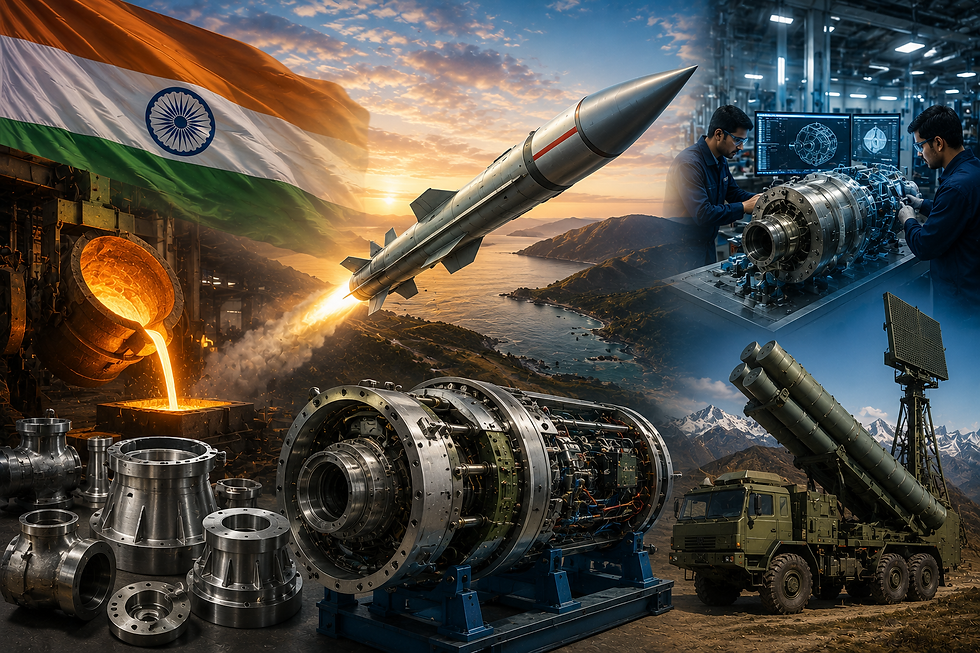
The short, guarded language of a quiet stock exchange filing out of Lucknow on Friday has a greater impact than it lets on. Not only will they have to design and cast a part but to build and integrate a complete missile subsystem, BrahMos Aerospace has awarded a two-year contract to specialty metals and precision-casting company PTC Industries to supply such components to the India's defence establishment for the last decade. Confidentiality clauses are commonplace in the world of strategic defence work, so the company's contract value hasn't been disclosed, which is hardly surprising, but the change in scope is the point to watch: the move is as much about where Indian defence manufacturing is going next as it is about the fortunes of one company.
The idea is to fully appreciate the significance by knowing what PTC did before. Since 2019, the firm has been a supplier of materials and components to BrahMos, HAL and DRDO, providing titanium castings, mill forms and structural parts that are bolted to a different assembly. It's a decent, high dollar position, but it's at the bottom of the defence value chain, you aren't paid for engineering judgment, you're paid for metal and machining. This week the difference is that BrahMos has now requested PTC to take care of a mission critical structural assembly with hermetic sealing, specialised joining techniques and its very own control assemblies which must withstand punishing thermal, structural and dynamic loads of supersonic flight. That's systems integration a layer of the business with higher margins and where, so far, foreign contractors and a few Indian public-sector giants have held sway. Chairman and managing director Sachin Agarwal described it as a watershed moment and said that it was the result of a multi-year plan to progress in the raw material-to-subsystem value chain of the company. This is PTC's first such order, and this is what PTC is becoming.
It's a significant timing factor, given the financial context. PTC's net sales grew by almost 85 per cent to ₹225 crore in the March quarter from a year ago, while its operating margin reached 32 per cent, the highest in eight quarters, as it received aerospace and defence orders. That quarter's net profit stood just around the ₹60 crore mark. That's reflected in the stock price, as it has jumped over 20 per cent in a year and is valued at a market capitalisation exceeding ₹26,000 crore, although at a price-to-earnings multiple above 250, which is high compared to numerous analysts' favourable ratings for the operating performance below the shares' value. Inside a rising defence company as it moves into a bigger ticket area of the operations at a time when its balance sheet is becoming more robust is the stuff value investors cringe at but momentum investors thrive on.
It is India's effort to rise to the stature of a legitimate defence exporter just a big importer of technology from other countries under licence than is reflected here in the larger canvas. The government's current estimate of defence exports is over ₹50,000 crore by 2028-29 and estimates in the industry suggest it would be nearer to ₹38,000 crore in the year just ended, from about ₹1,521 crore in 2016-17. BrahMos itself is the poster child for that ambition. In 2022, the Philippines signed a $375 million contract to become the first foreign recipient of the missile, deliveries of which were scheduled to start in 2024, while this year Indonesia became the second confirmed export customer, as other Southeast Asian countries sought to diversify their investments in coastal anti-ship capability away from Chinese influence and towards something that is fast, hard to intercept and far cheaper than similar systems developed by the People's Republic of China. Vietnam has also been in talks to buy the system. None of this renders India a major arms exporter, however its total exports are still just over one per cent of the United States' annual exports, and India does not appear in the top 25 global suppliers tracked by the Stockholm International Peace Research Institute, as yet but the pace, and the quality of buyers lining up, indicate that India is closing the gap on the United States faster than the numbers suggest.
It's a significant repositioning for PTC, as a subsystem integrator instead of a components vendor. It brings the company nearer to the economics that the BrahMos benefits from when it secures an export order for Rs 200-350 crore, instead of the slimmer profits of selling raw titanium forgings. It also indicates partially the trend by which the private sector Indian manufacturers are becoming more involved in strategic programmes that were till recently exclusively the purview of the public sector giants like Bharat Dynamics and Hindustan Aeronautics. The next two years will tell if PTC can pull it off at such a technical level, on time and within the tolerances required for supersonic equipment. The direction of travel from castings to control assemblies, from vendor to integrator is clear and it's a template that other mid-sized Indian defence suppliers will have their eyes on as the country pursues its next, more challenging course of export expansion.