
Popular Categories

Politics

Geo Economics

Lifestyle

Analysis

Geopolitics

Civilizational Lens
Defence

Washington Admits What Rivals Long Suspected: American Weapons Are Already Orbiting Earth
16 Sept 2026
Created by
The BV Team
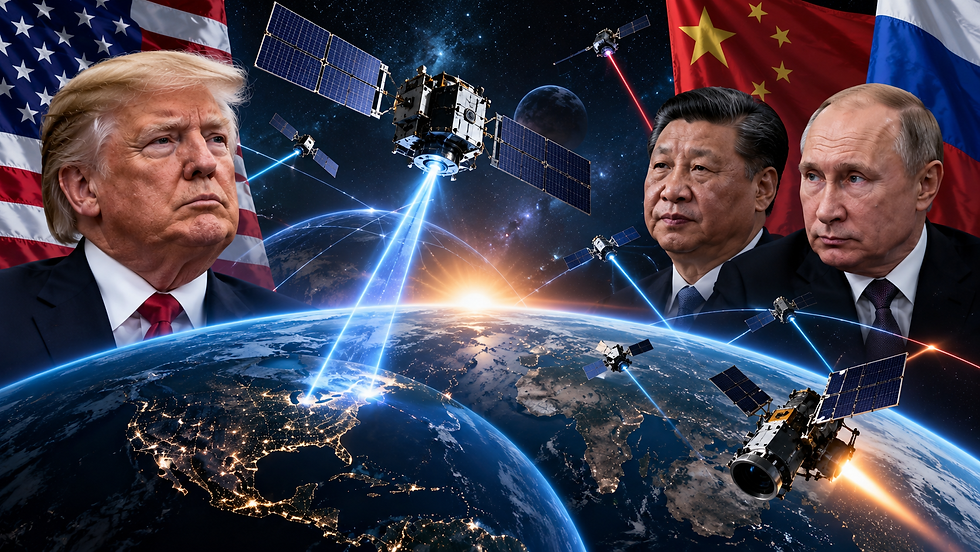
Washington has been dealing with the militarisation of orbit in a euphemistic way for decades. American officials talked about "space situational awareness," "resilient architectures" and "protecting assets," only to deliberately not mention that the United States itself was straying across that line that it blamed Moscow and Beijing for crossing. After a week of studied ambiguity, it's time for this.
The United States has on-orbit space control weapons that can defend the Joint Force against hostile adversary action, Air Force Secretary Troy Meink told a crowded room at the Air, Space and Cyber Conference in Maryland. He did not explain what these systems are, how they work or how long they have been orbiting the planet. However, the news was the sentence itself. No U.S. defense official in public service has ever come out and proclaimed anything like this before.
Meink's comments were not the result of a slip of the tongue. Officials briefed after said that the language was carefully chosen, worked out ahead of time and "meant to be read as a warning to Beijing and Moscow and not as an accident. The rationale, explained to reporters, was that the logic of an adversary is that if he thinks they can't do anything about it, he won't do anything about it. Now the question of whether or not that bet will pay off has become a hot topic of debate among folks who make their living thinking about just this sort of brinkmanship.
The response was most likely from the two countries in which the reaction was most expected, which was within one day. China "will never use outer space for military expansion or military confrontation," said Beijing's foreign ministry spokesman, Guo Jiakun, "and will call on all other countries to do the same. Foreign Minister of Russia Sergey Lavrov pointed to the need to keep space "free from any weapon in Moscow's statement. Neither spoke of any denial of the fact both nations have their own counterspace programmes well underway Russia's anti-satellite tests go back years; and in 2024, Washington officials said Moscow is working on a new orbital weapon that could pose a threat to satellite constellations, but at the time the threat was not considered imminent.
After all, that 2024 episode is worth keeping in mind, as it was a warning that the admission this week isn't actually a reassurance to arms-control experts. In April of that year, Russia vetoed a resolution by the U.N. Security Council drafted by the U.S. and Japan, which had urged all nations to not place weapons of mass destruction in orbit as stipulated by the Outer Space Treaty that both Washington and Moscow have signed. The resolution was described as hypocritical by Russian diplomats and was backed by a parallel proposal by them that banned all weapons in space 'for all time', which never got off the ground. Essentially the treaty process has been languishing since then and this week's announcement offers no impetus to it.
Victoria Samson, chief director of space security and stability at the Secure World Foundation, has become the loudest critic of Meink's deterrence rationale, saying to several media outlets that the admission "goes too far" and will likely spur Beijing and Moscow to either make an official statement on the use of their own orbital weapons or speed up projects they didn't want to be bound by their words. Her worry, shared by people at the Foreign Policy Research Institute and by nuclear policy scholars at Stanford, is that this level of transparency tends to give a license to the exact action it is supposed to be discouraging: Once the largest power makes it public that it has weapons in orbit, it becomes easier politically for other powers to say the same. Other analysts have also said the causality is reversed the arms race and China's and Russia's investment in counterspace systems were caused by America's retreat from arms treaties and the rapidly advancing Golden Dome programme for missile defence.
But there's a hard monetary story under the diplomatic one as well. The Space Force's base budget for the fiscal year is about $26 billion, though the sum will rise to $40 billion when the funds for the Golden Dome missile-shield programme are added in, and exceed the defense budgets of all NATO nations except the United States.
Congressional documents divide up that money into categories: about 5.6 billion dollars for space-based interceptors, 7.2 billion dollars for space-based sensors, 2 billion dollars for airborne targeting satellites and 350 million for command-and-control infrastructure. The market for the military use of space, including weapons, surveillance equipment and military satellite networks, was also estimated to be near $59 billion worldwide in 2025 and is expected to exceed $83 billion at the end of the decade, before this week's announcement, but with it likely to be strengthened.
There is already a roster of contractors around that spending. Awards for the Space Development Agency's Tranche 3 tracking-satellite contracts alone were worth up to 1.1 billion dollars for Lockheed Martin, 805 million for Rocket Lab and up to 764 million for Northrop Grumman in a wider architecture designed to bridge the gap between the detection of a hypersonic missile launch and the means to respond. Rocket Lab's own figures show the rapid growth of the niche: revenues of 234 million dollars in its last quarter, growth of 62 percent compared to the same period of the previous year, and a backlog of over 2.3 billion dollars.
What Meink actually said was a basic, un-technical statement. What it unleashed is far greater: an admission of the most powerful military force on earth has long since passed deterrence by implication into deterrence by declaration, in a domain where the rules are built for the 1967 world, which has already ceased to exist. The treaties have not kept pace, the budgets are on the move and the next disclosure, from Beijing or Moscow, will have a precedent set by Washington itself.
