
Popular Categories

Politics

Geo Economics

Lifestyle

Analysis

Geopolitics
Civilizational Lens

Defence

Washington bankrolls the kingdom's air shield as the Gulf edges toward a wider war
16 Jul 2026
Created by
The BV Team
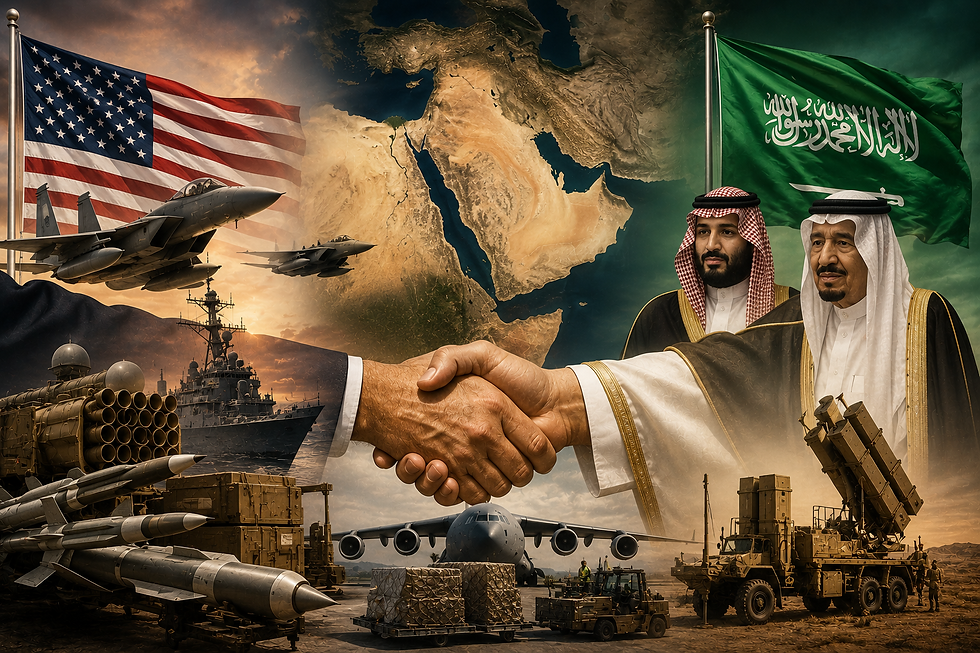
The State Department has approved a $1.96 billion bundle of precision-guided munitions for Saudi Arabia, and the time is telling. The approval, announced Wednesday, comes as the Middle East has been in a state of fluctuating ceasefire talks and fresh strikes for weeks, with Iran and its regional proxies clashing with the US and Israeli forces, while Riyadh is still playing a more ambiguous game.
The terms of the deal are simple in theory. Saudi Arabia is seeking to purchase as many as 10,000 Advanced Precision Kill Weapon System (APKWS-II) guidance kits for air-to-air engagements, and 10,000 for air-to-ground attacks, as well as related support equipment. The APKWS system is a conversion package that turns unguided rockets into laser-guided weapons, and the US Navy sells it as a cost-effective means of firing a laser-guided shot at a target without destroying the blockage in the area. The principal contractor is BAE Systems of Nashua, NH. The State Department is issuing a technically a determination, not an actual contract; so Congress has a chance to block a package before it reaches the stage of formal contract, but that's rarely what happens.
Riyadh wasn't the only capital in the list that day. Kuwait also was given a nod for $484 million for a C-17 transport fleet, albeit a small one that signified that Washington is at the same time trying to rebuild its stockpiles of a number of Gulf partners. Combined, the two approvals appear to be less a typical arms-bureaucracy affair and more an organized attempt to beef up the air-defense system for the region during the shooting.
The State Department's rationale is in familiar terms: to support a big non-NATO ally, to stymie existing and future threats, to enhance the interoperability with America and NATO forces. What the statement fails to mention outright is what nearly everyone in the region is now out loud and clear saying: Saudi Arabia is an odd bird among the targets in this round of conflict it's a target that Tehran has avoided. That is a remarkable omission as it is Saudi Arabia's and Iran's history, as they almost squander the past ten years of their existence over Yemen, fighting as a proxy war and still claiming the custodianship of different branches of Islam. Their participation in the funeral of the late supreme leader of Iran nor was overlooked, and it has been rumored that the kingdom may have secretly agreed with Tehran to keep its soil off the list while continuing to import U.S. weapons.
It is no exception that Pakistan's shadow hangs over this also. Islamabad has used the recently signed Strategic Mutual Defense Agreement with Riyadh, which has been loosely based on NATO's Article 5, to threaten Iran against targeting Saudi soil, as Pakistani officials have done in the public arena. But the interpretation might be doing Iran's case of diplomacy a favor and its strategy a disservice. For decades, Tehran has used proxies instead of direct action to do damage to the Israelis running Hezbollah against Israel and the Houthis against the Saudis and this is a tactic Tehran has employed all along to damage its enemies while keeping its own name off the scene. If the Houthis are still carrying out the job in Yemen, then Saudi Arabia is spared direct strikes with no cost to Iran.
There, the economics of this deal become more important than the diplomacy. Last year, Saudi Arabia's military budget was about 78 billion dollars, nearly one-fifth of government spending and more than seven percent of GDP, making it the seventh largest military spender in the world by absolute spending and one of the top few by military spending as a share of GDP. It has also been the third biggest arms importer in the world in the last five years behind only Ukraine and India and the United States supplies about three-quarters of all its arms imports. The new deal comes in addition to a $9 billion Patriot missile order that the kingdom approved back in January, and it follows a similar trend to a five-billion-dollar contract with a Chinese aerospace company to manufacture drones in Riyadh, which indicates that Riyadh is not satisfied with Washington as its sole arms supplier despite the fact that it continues to write checks to American contractors.
Deals such as these are not simply line items for BAE Systems and the wider American defense industrial complex they are lines of revenue that help sustain production lines and give jobs the footing they need to stay in their current locations, like New Hampshire. The world's military budgets reached their highest-ever level last year, at $2.7 trillion, and the Gulf capitals have become one of the most consistent spenders contributing to the upward trajectory. Whether that investment brings "real stability" or merely feeds all sides of a conflict that does not appear to have an end, is the more difficult question, and one Washington's press release doesn't attempt to answer.