
Popular Categories

Politics

Geo Economics

Lifestyle

Analysis

Geopolitics

Civilizational Lens

Defence

Dubai Doesn't Wait For The Dust To Settle It Builds Through It
Created by
The BV Team
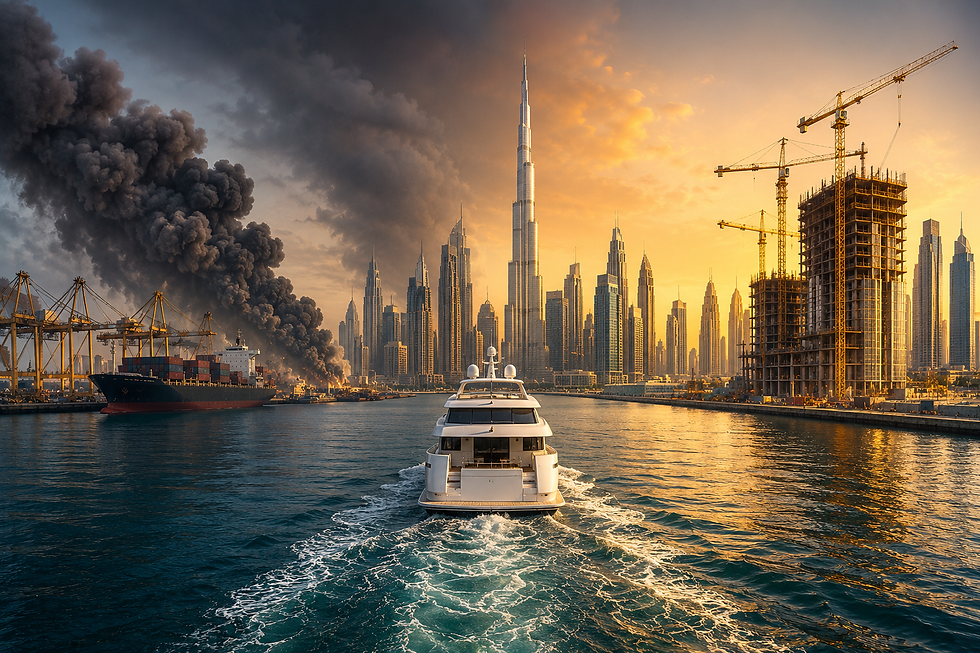
The yacht in the picture is cruising away from Jebel Ali, with smoke in the background, created by an Iranian attack in the first week of March. For a few news cycles it was the face of a scared Gulf. That image hasn't held up well after 3 months. The ships have returned. The cranes have returned. The cargo is back. But Dubai, without much fanfare, has done what it has done after every regional shock since 2008: it has resisted the pressure of being a city that's supposed to be in trouble.
It's not a victory lap. With fighting starting on 28 February, the battle became the worst single test the emirate has endured in a generation. The Strait of Hormuz, which normally carries about one in five of the world's seaborne oil, was closed almost completely for weeks. At the peak of the closure, more than 90 per cent of ship traffic through the chokepoint was interrupted, involving container ship traffic. Hapag-Lloyd imposed a war-risk surcharge of $1,500 per 20-foot equivalent (TEU) on shipments to the Arabian Gulf, and reefer containers were charged $3,500. Hull war insurance for Hormuz transits, which was about 0.25 per cent of vessel value, virtually vanished from the market for several weeks as London underwriters withdrew cover. Dubai home valuations were down 5.9 per cent in March for the first time since 2020, according to Bloomberg. In the emirate, headline inflation more than doubled from the double-digit range to reach a high of 5.4 per cent this month.
So, no one is claiming the bullet went astray. The trick, and this is where the Dubai story gets misread by every analyst that flies in just for the bad weeks, is what happened underneath. Banks opened. Salaries were paid. ATMs worked. Schools ran. The metro ran. Renewals of visas were carried out in time. No one complained about the lack of public services. That sounds banal. It's actually the whole product selling to the mobile capital of the world Dubai.
On a podcast, spotted by Khaleej Times in mid-April, a property and residency adviser, who actually lives in the city, said that bluntly, the war hasn't hurt Dubai's pitch. It validated it. His argument is gaining traction among the local business community and is one worth listening to. “It takes the majority of economies to recover to ‘business as usual' once the shooting has ended,” he notes. The UAE is designed to be a never ending "business as usual". When the recovery comes, it's not a restart. It is a speeding-up of something that was already in operation.
Some persuasion is being done by the numbers since the 7 April ceasefire. At least one of the big Dubai developers was already publicly claiming a threefold increase in customer conversions within 10 days of the announcement and the formal reopening of the Strait of Hormuz on 17 April. On the day when a fragment of a drone was used to attack the US Consulate annex in Dubai, the price of brent crude fell around 13 per cent with the ceasefire headline. Routes were resumed in just days by both Emirates and flydubai, with the national carrier operating to some 125 of its usual 140-plus destinations by late April and continuing to add destinations each week. On 30 March, the Dubai Executive Council headed by Sheikh Hamdan granted an economic relief package of Dh1 billion, which includes a 100 per cent deferral of the Tourism Dirham and deferrals in the hotel sales fees, in addition to licensing charge relief to hospitality operators between April and September. The package was on the table before the guns went silent, and that is the idea.
The farther you move away, the more difficult it is to make the structural case. The Federal government estimates UAE real GDP in 2024 at Dh1.776 trillion, which is 75.5 per cent non-oil meaning it is not related to what comes out of the ground. Almost 148 million passengers were transported through UAE airports to assist transport and storage's growth of 9.6 per cent year-on-year. Non-oil merchandise trade rose to Dh3.8 trillion in 2025, growing by 27 per cent. For the first time, services trade surpassed Dh1.14 trillion. In the last print in February, the Central Bank reported banking sector assets of Dh5.47 trillion, while credit expansion was still in positive territory, climbing 1.2 per cent month-on-month despite the war going on. S&P affirmed the sovereign rating at AA/Stable and it is projecting a current account surplus of an average of 8.6 per cent of GDP from 2026 to 2029, placing the UAE in the top tier of external balance globally. Moody's had a stable outlook on Aa2. Emirates NBD's growth forecast for Dubai in 2026 is 4.5 per cent, versus the IMF's average for the world of 3.1 per cent and advanced economies of 1.6 per cent.
Then there's the demographic engine nobody wants to talk about because it's unglamorous. By 2025, Dubai's resident population had surpassed four million, and is expected to reach 5.8 million by 2040. The total population of the UAE is more than 11 million. Golden Visas, 0% personal income tax, and a regulatory environment that gives answers in days and not quarters ensures that the inbound queue is full. By autumn 2025, real estate transactions had already surpassed AED 624 billion, the best year ever prior to the war. But even the dip in March valuation seems like a buying window high-net-worth capital has been reinvigorating Marina, Downtown and Palm Jumeirah listings since the ceasefire, and the prime end has been strongest.
This is not to say that the risk picture is clear. It is not. The Strait of Hormuz is a space that is managed and not a free space. Iran's new Persian Gulf Strait Authority established earlier this month is now issuing transit permits and operating a parallel insurance platform, Hormuz Safe, while a US naval blockade of Iranian ports remains in place and LNG carriers were turned back during the short reopening attempt earlier this month following a warning from Iran's security forces. War-risk surcharges have not been lifted completely. Since February, the price of jet fuel has more than doubled and is still not back to normal. Inflation may return to its level of 2.9 per cent around December, but several analysts at Emirates NBD and elsewhere say the drop would also be due to weaker demand in the tourism and retail sectors and a lack of cost relief for residents. On some estimates, Saudi Arabia's Vision 2030 drive, including setting up regional headquarters in Riyadh, could divert up to $5 billion from the UAE as financial capital by the end of the year. There are no footnotes in any of these.
But it's the same story all over the trade. In a stressed-out area, people still invest in keeping the lights on. The UAE economy as a whole is expected to grow anywhere between 5 per cent by Christie's, ValuStrat and Standard Chartered. The D33 Economic Agenda, which seeks to make Dubai's economy double by 2033 and the city one of the world's top three destinations for living, working and investing, has not been quietly shelved. If anything, Emirates' announcement this week of a huge new MRO facility at Dubai World Central, with landing gear workshops, eight-hundred-thousand-square-foot maintenance halls, and four million square feet of logistics space, is a clear indicator of where management believes the wind is blowing.
It's a structural and not a tactical lesson for Indian investors and businesses that are watching this from afar. The UAE has come through this once before the 2008 crash that saw the rug pulled out from under Dubai World, the 2014 oil collapse, the pandemic, the 2019 tanker incidents and every Red Sea spasm triggered by the Houthis in the past two years. The pattern is repeated because the architecture stays the same: a sovereign with high fiscal buffers, a dirham peg that absorbs fluctuations in the foreign exchange market, a banking sector with ample liquidity, a logistics backbone that gets around damage, and a political class that avoids using a crisis as a reason to pursue domestic points.
Three months ago, a drone part fell near a U.S. consular outbuilding in this city. Whether the rich buyers will depart is not the biggest topic on today's desks of Dubai's brokers. Whether or not the inventory pipeline can keep up with the rich buyers coming. That's all the answer.