
Popular Categories

Politics

Geo Economics

Lifestyle

Analysis

Geopolitics

Civilizational Lens

Defence

Hyundai’s $15.5 Billion India Investment Signals a Major Shift in Global Manufacturing Away from China
14 Oct 2026
Created by
The BV Team
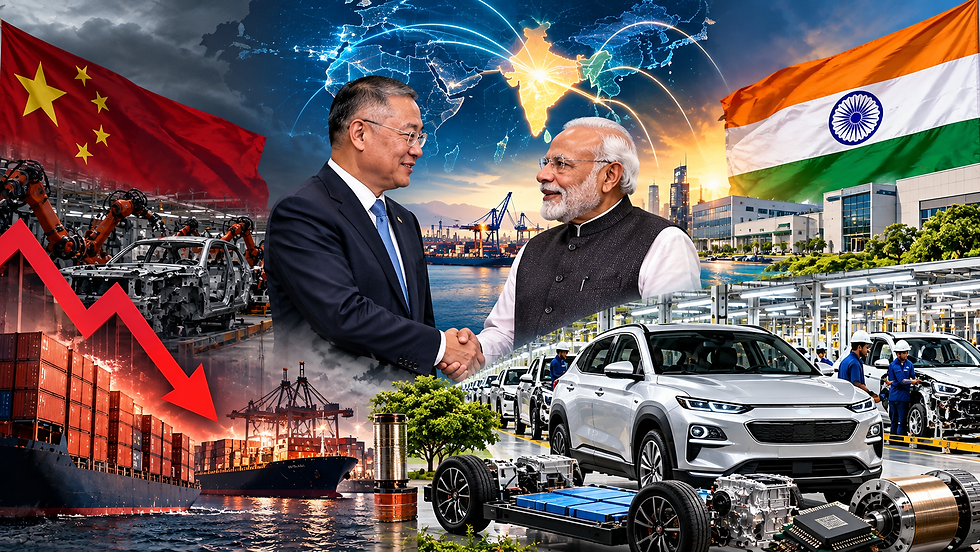
The $15.5 billion planned investments in India from Hyundai Motor Group are much more than just a business expansion. It marks a major shift in the way that multinationals are perceiving China, the fragility of global supply-chain and the rise of India as an industrial and economic power. South Korean conglomerate has invested nearly ₹1.4 lakh crore in India with a focus on manufacturing, research, technology and supplier development.
The announcement came hours after a meeting between Hyundai Motor Group's executive chairperson Euisun Chung and the Prime Minister Narendra Modi in New Delhi on October 13. The investment will help Hyundai and Kia cement their manufacturing base, increase their engineering capacity and boost domestic component makers. Some $700m is set to be allocated for research and development, and capital will be deployed by a dedicated investment entity.
The key to the significance is in the timing. As the world's largest companies begin to mull over their manufacturing strategies, they are increasingly wondering whether to focus their operations in a single nation, especially in the context of geopolitical tension, trading barriers and technological rivalry, which can stop production dead in its tracks. China is still the world's biggest industrial ecosystem but by relying on the factories and components of China, companies have created a strategic weakness in their operations that they are beginning to realize is a problem.
India is making a case for itself as an alternative, but not necessarily an alternative to China.
Recent data from Boston Consulting Group (BCG) shows how investment has shifted. During 2021-2025, the India received about USD 351 billion of greenfield FDI, while China received USD 159 billion of greenfield FDI. In comparison, India's growth was 61% from the previous 5 year period, whereas China's was 54% decrease from the previous 5 year period. The 125% growth in Malaysia shows that India is part of a wider Asian manufacturing realignment.
These are announced greenfield projects, rather than realised foreign direct investment inflows or completed investments. Still, they indicate the location of the next generation of international businesses' production facilities.
The move is significant as Hyundai is already having a good industrial base in India. Its integrated production capability (with Kia) is greater than 1.4 lakh cars per year in Chennai, Pune and Anantapur. The group has over 24,000 direct employees in India and indirect employees in the form of dealerships, component makers and logistics service providers.
This could create an economic gain far greater than just in car manufacturing. Automotive manufacturing is an end user of steel, aluminium, electronics, industrial machinery, specialized chemicals, transportation and engineering services. Eventually, domestic suppliers able to produce products that meet the international quality standards may become exporters themselves.
Government estimates have the auto industry already accounting for about 6% of India's GDP. Production of vehicles is around 28 million in FY2023-24, and their exports are around 4.5 million units. The sector has also received significant foreign investment, given the support of the production linked incentives and policies in favor of the electric mobility.
But the next phase of industry growth can't rely solely on traditional vehicle production. The future of the industry will be defined by electric vehicles, battery technology, advanced electronics, and software-defined mobility and automotive semiconductors, and these technologies will decide which countries will be leaders in the future.
The attention to factory expansion should be matched with the investment in research infrastructure, Hyundai's. Vehicle manufacturing is a jobs and export-producer; vehicle technologies are an intellectual property, a development of engineering and a creation of higher value industrial employment.
Economically significant distinction. Only a part of the value of a product is captured by a country that assembles imported components. The more a country is involved in the design, engineering, manufacturing and exporting of the final product, the larger percentage of the economic benefits is captured.
The geopolitical impact is not limited to South Korea. Japanese manufacturers are taking similar measures. Suzuki had earlier revealed plans to invest around $8 billion in India, whereas, Toyota and Honda have been working on increasing their manufacturing and export plans. The diversification of global manufacturing is already making its way into the world of consumer electronics, as Apple's expanding iPhone manufacturing network shows.
However, it's too early to say that China is being replaced. China still has a huge edge on industrial scale, machinery, battery materials, electronics manufacturing and integrated supplier networks. The Hyundai is still looking for business in China. The Indian expansion is more accurately described as an Indian diversification than a withdrawal of the industry.
The hurdle for India is to create a lasting competitive advantage from this opportunity.
Although the highways, ports and industrial corridors have been improved, logistics costs, regulatory delays, and unreliable power, as well as a lack of specialized manufacturing skills, remain challenges. Vietnam, Thailand, Indonesia and Malaysia are vying with a high degree of competitiveness for these investments, sometimes with well-developed export markets and productive industrial districts.
India also needs to make sure that foreign manufacturers establish local suppliers rather than having assembly operations that rely on foreign technology and components. True economic value addition will occur when Indian companies become indispensable in the global automotive value chains.
There is a more strategic dimension. Better manufacturing linkages with South Korea, Japan, Europe and the United States will help India mitigate their dependence on the foreign supply chain and enhance their negotiating stance in international trade. The geopolitical power shift hinges more and more on the capability of the industry, as the countries that own the key technologies, components and production infrastructure have economic leverage.
There also needs to be a realistic view of the financial commitment required. If evenly distributed over seven years, that amount is roughly $2.2 billion each year, which is the planned investment by Hyundai. The real effect will depend upon actual spending, achievement of projects, and employment and export results.
Measurable outcomes that should be the priority for New Delhi are increased domestic value addition, improved component exports, improved engineering employment and manufacturing costs that are competitive globally.
The move by Hyundai is an important sign of good faith on India's industrial future. The declaration of investments is not enough to create manufacturing leadership. That demands steadfast policy, consistent infrastructure, technical skills and the capacity to remain competitive on the international market without relying on incentives for all time.