
Popular Categories

Politics

Geo Economics

Lifestyle

Analysis

Geopolitics

Civilizational Lens

Defence

India's Billion-Dollar Battery Gamble: Two Giants Bet the Nation Can Outgrow China's Grip
7 May 2026
Created by
The BV Team
In every industrial revolution, there comes a time where the worry from the procurement desk turns into a sense of urgency in the boardroom. That day has apparently arrived for the two most ambitious Indian conglomerates — and the bill for it is almost a billion dollars.
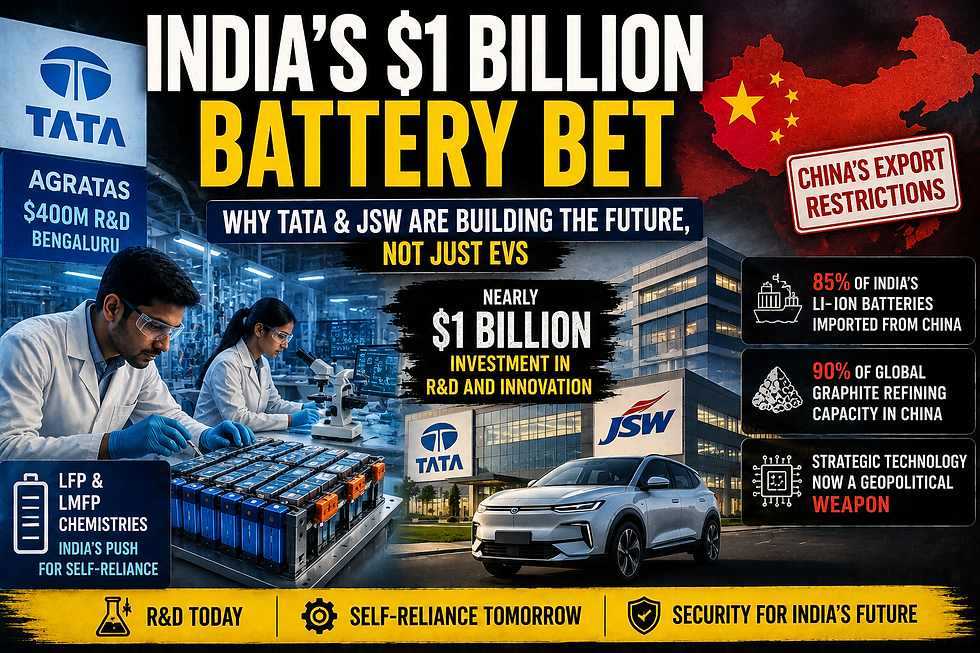
Tata Group and JSW Group have each pledged to invest in domestic research and development for electric vehicle batteries and advanced EV systems, respectively, and the total investment will be close to $1 billion. Bloomberg reported the details on Wednesday, which were confirmed to the Associated Press by people close to both companies. Both conglomerates have kept their respective moves quiet so far, but the numbers and rationale have been confirmed by several industry sources throughout the day.
The funds are not being invested in additional factories. That is already taken care of for both groups. The knowledge they are paying for — and paying dearly for — is knowledge that has to be built, one that is not readily available through a license or on a shelf or from a supplier relationship, but one that involves deep materials science and cell chemistry. The chasm hasn't been apparent for years while the supply chain has been functioning, but Beijing's decision to turn battery technology into a strategic export has made it difficult to ignore.
Tata's battery unit, Agratas, is investing over $400 million in a new R&D facility in Bengaluru to develop lithium iron phosphate and lithium manganese iron phosphate chemistries — on which it is currently reliant on China. Not a far out future-state battery. That is because LFP cells are more cost-effective, safer, and longer-lived than the previous generation of nickel-based stationary storage cells and batteries, making them the preferred stationary energy storage solution globally, especially for mass-market EVs. That India's top EV company is almost entirely dependent on imports from a single country is also a testament to the structural exposure that the sector has accumulated over a decade of rapid growth on the back of Chinese imports.
Agratas has already announced its plan to start industrial production in India by 2027, and the company has finished the steel frame for its 20 GWh Sanand facility in Gujarat. That manufacturing push is upstream of the new Bengaluru R&D spend, which is in chemistry, cell design and process know-how that the group hasn't owned and historically either licensed or sourced from others. An Agratas spokesman said that the company's R&D programme is going on full swing across the globe with its laboratories in Bengaluru and Oxford with the main thrust on next generation battery innovation.
JSW's approach is architecturally different but motivated by the same anxiety. JSW Motors is set to invest at least $500 million over a course of five to six years in a research hub in Maharashtra. The centre will be working on localising vehicles developed by global partners, developing an own software and on connected vehicles, the chief executive officer said, detailing that the explicit objective of the centre will be to adapt the global automotive technology to the Indian road conditions, price and quality standards.
Though it is not the same structural problem JSW is facing as Tata, but it rhymes. The MG joint venture, which is 35 per cent owned by Sajjan Jindal's group, is using about 60 per cent Chinese-made components. Were it not for Beijing's frequent tweaks to export licensing requirements, then JSW's public objectives of a million new-energy vehicles by 2030 and a 10 GWh battery plant in tandem with LG Energy Solution would appear more achievable.
JSW Motors is aiming to build up its R&D team from the existing strength of 150 to nearly 500 engineers by 2027 and to 2000 engineers by 2029. The true long game is that talent building. Patent rights are subject to challenge. Equipment can be obtained from other sources. However, it takes time to build an engineering culture that grasps battery electrochemistry from the ground up or one that can redesign a vehicle architecture to fit with multiple cell suppliers.
The immediate drivers behind the two investments are a series of policy moves that have been taking place in China since around 2024, and into this year, that have been asserting themselves. While top Indian executives press suppliers and regulators to keep equipment from the customs, Beijing has ratcheted up restrictions on critical battery-making technology and equipment, dealing a direct set-back to Indian companies including Reliance with costly machinery awaiting in Gujarat but commercial production stalled due to a lack of further access to technology.
The Minister of State (MoS) for Heavy Industries has admitted that India's end-to-end demand for lithium-ion battery materials is being imported and that China's export restrictions and licensing requirements for high-performance batteries, cathode materials, artificial-graphite anodes and battery manufacturing technology could significantly impact the availability of materials in the near future.
The statistics behind that vulnerability are shocking. China supplies more than 85% of India's lithium-ion batteries and in the past five years India has purchased over $7 billion worth of batteries from China alone. Meanwhile, China has more than 90% of global graphite refining capacity, processes 60% of the world's lithium, 73% of cobalt and 68% of nickel — establishing multi-layered linkages of supply chain dependency across the battery value chain.
It's not solely an Indian issue. That's the dependency picture that Europe is facing, and one that is now guiding capital allocation in Mumbai and New Delhi as much as in Berlin and Paris. The EU's battery industrial policy is being formulated from the same arithmetic. There's no definitive answer in terms of countries whether they can develop a real depth in the technical side quickly enough to be a factor.
There are a few things that it is good to be clear about what this investment does, and doesn't. Tata as well as JSW aren't trying to emulate China's vertically integrated battery sector. That means multiples of this capital, decades of work, and Indian control over raw material deposits, which, to date, the country has only secured in part.
The more modest goals are to develop enough in-house expertise to specify, validate and tailor cells, to qualify other suppliers and to negotiate with Chinese partners from a less tenuous position. The majority of the investments will be directed towards talent, lab equipment, and pilot lines instead of gigawatt-scale factories. One gap that is closing is that between buying technology and owning it.
This is important framing because it sets proper expectations. The EV market is expanding at a rate that India needs a new supply chain architecture. This will further increase the trade deficit and expose the sector to supply chain issues, unless an effective parallel strategy is in place to localise EV and battery manufacturing. The Tata and JSW investments are about private money being invested in what the government can't do alone: build proprietary chemistry programmes, which require messy and uncertain investments over the long haul.
It is worth adding that Tata Motors has not been spared of the same thing which it is trying to invest in getting rid of. One of the company's most recent releases, and most anticipated, is the Curvv.ev, which features cells from Chinese supplier Octillion Power Systems. The dependency was further consolidated as a result of a sourcing deal with Envision AESC for packs with higher density. The Bengaluru R&D venture is the medium term insurance coverage to that structural bind.
Private investment of this magnitude is critical but not enough. Thirty-three of India's 36 states and union territories now have EV policies, although most of these are aimed at deploying EVs and not manufacturing them, a new report by the International Institute for Sustainable Development has found. Upstream and midstream segments, where the capital needs, technological sophistication and risks in the value chain are the highest, still get relatively little policy attention.
The message is that there needs to be a more coordinated national structure around the Tata and JSW wagers in order for them to succeed at scale. While R&D centres create IP, this requires manufacturing ecosystem, testing ecosystems and procurement pipelines to make it commercial. On all three, India has made advances but is still lagging in the type of policy envelope that helped South Korea and Japan become battery technology creditors and not debtors.
What the latest announcement does clearly indicate, however, is that industry in India has decided it cannot wait for such architecture to be ready before it begins to develop capability. Beijing has set the export control timeline and not New Delhi. The answer is imperfect and incomplete, of course – but it is being paid for from Bombay House and Jindal offices, not any ministry budget.
That will be sufficient if the talent can build up quickly enough, if the lab lines turn into productive output in a timely fashion and — most importantly — if China continues to be just as stingy with other materials and equipment in short supply around the world. The truth, at this time, is that no one knows. But when it's a billion dollars, it means that the biggest industrial houses in India are no longer prepared to take the gamble that it will be comfortable.