
Popular Categories

Politics

Geo Economics

Lifestyle

Analysis

Geopolitics

Civilizational Lens

Defence

India's Singapore bet just got a lot more concrete
21 Aug 2026
Created by
The BV Team
The week-long meeting in Singapore came with the numbers to substantiate the description that India and Singapore officials have given the relationship for all these 60 years “special”. With Finance Minister Nirmala Sitharaman, External Affairs Minister S. Jaishankar and a seventy-member Indian business delegation in tow, Commerce and Industry Minister Piyush Goyal toured among the three locations, Istana, Shangri-La and INSEAD Asia campus, in an attempt to strengthen the soft diplomatic relationship with India into a more firm economic dependency, which both sides would like to admit.
The number that everyone has quoted and rightly so is $36.1 billion. The current level of bilateral trade between the two countries is $6.7 billion, which was higher than it was 20 years ago when the Comprehensive Economic Cooperation Agreement was signed. The figure of a more than fivefold increase in 20 years is impressive until you realise that the GDP of Singapore is less than that of Maharashtra and the city hosts trading and re-routing activities of capital, which ends up at Indian ports, factories and startups. It's the true nature of a roundtable that made its way into the press during the closed-door discussions, and why Temasek Holdings and GIC, Singapore's two sovereign wealth funds, received as much attention as the ministers during the meet.
Think about the investment aspect as a standalone scenario. Singapore was the top source of foreign direct investment in India during the past fiscal year, accounting for $19.8 billion, and has been the top source of all FDI inflows into India coming in since 2000, reaching a total of nearly $194.6 billion. No other country in the world can match that level: the United States, Mauritius, Japan. It's a concentration that is worth taking time to sit with. It means that India's growth story, for whatever the underlying reforms are, is being funded disproportionately on Singaporean pipes and it means that the pension and reserve managers at Singapore are effectively making a generational bet on Indian infrastructure, financial services, urban development and renewable energy working.
That wager was made very clear by Goyal in his separate talk with Temasek chief executive Dilhan Sandrasegara. The pitch from the Indian side that the country's fiscal fundamentals, the reform agenda based on investment and its expanding opportunities by sectors warrant more serious commitments for the long haul is not new rhetoric. New is the "time pressure. Global capital is now flowing into multiple markets at once: the China-plus-one manufacturing trend which hasn't yet fully settled on Indian factory floors, semiconductor and AI investment mania focused on the United States and parts of East Asia, and a Gulf sovereign fund community with its own India aspirations. Singapore's selling point is that it has methodically built up its footprint in India over the last two decades, while others were still considering whether they wanted to make the trip. That advantage is what New Delhi seeks to hold on to, and continue, and not give to newer suitors.
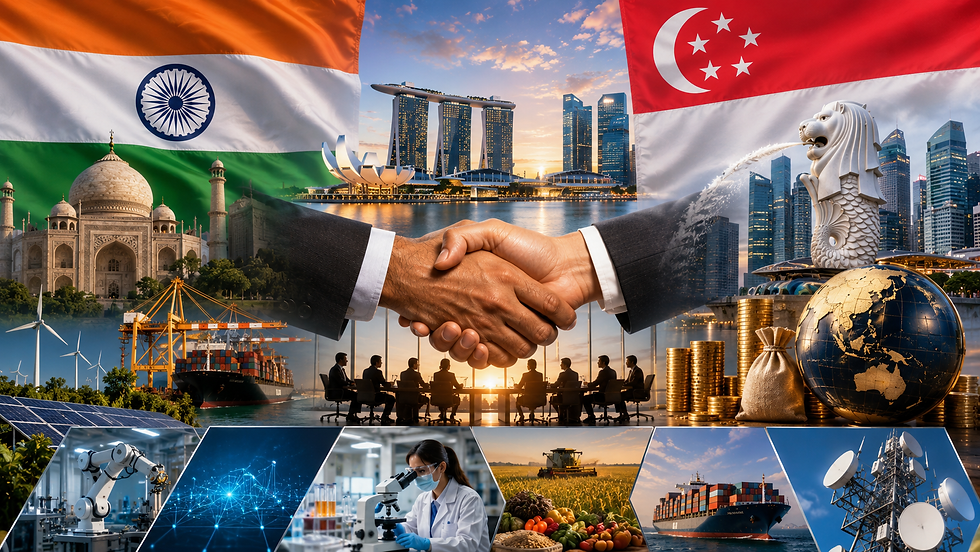
The fact that this money was being spread across the various sectors of the business roundtable spoke volumes about where it is going next. It was a list of 70 people a technology and AI group, an advanced manufacturing and engineering group, a financial services and fintech group, a healthcare and life sciences group, a food and agriculture group, a maritime logistics group not such a list of “courtesy”, but more of a “shopping” list for the next stage of the relationship. Three memoranda and one letter of intent were signed covering maritime heritage cooperation, food safety standards and telecom and broadcasting regulation, all of which are far from sexy topics but tend to be more relevant than investment commitments when companies actually attempt to implement cross-border activity. Harmonisation of food safety regulations, for example, directly impacts the ease of Indian agri-exporters clearing Singapore ports and the comfort of Singaporean distributors in giving shelf space and credit to Indian agri-exporters.
Of course, there is an undercurrent in all this India's exports to Singapore reportedly doubled in the first quarter of the current fiscal year as compared to the same period last year, which would indicate a real change and not a one-off measurement spike if it continues in the coming quarters. Both governments are now taking a gamble that the next stage of development will be new and improved capital ties, rather than more product-specific tariff reductions which are likely to be limited in scope but instead be made through new and more compelling talent flows and regulatory convergence in areas such as fintech, digital infrastructure and clean energy.
But none of this cancels out the asymmetries of the relationship. The Indian domestic market, labour and scale are what Singapore's economy depends on, and the financial sector is built for this type of intermediary. Since its inception, the two sides have reached a momentum with the photographs and joint statements having less of an impact than the more subdued follow-up on skilling institutes, centres of excellence and sectoral regulatory pacts in the last six Ministerial Roundtables held alternately in New Delhi and Singapore. Will that follow through be the type of manufacturing and technology transfer that India needs and not simply recycled portfolio money flowing through Singaporean funds will be answered at every future roundtable of this partnership.