
Popular Categories

Politics

Geo Economics

Lifestyle

Analysis

Geopolitics

Civilizational Lens

Defence

India-Singapore Economic Ties Deepen as Sitharaman Pushes Investment, Energy Security and Strategic Trade
10 Oct 2026
Created by
The BV Team
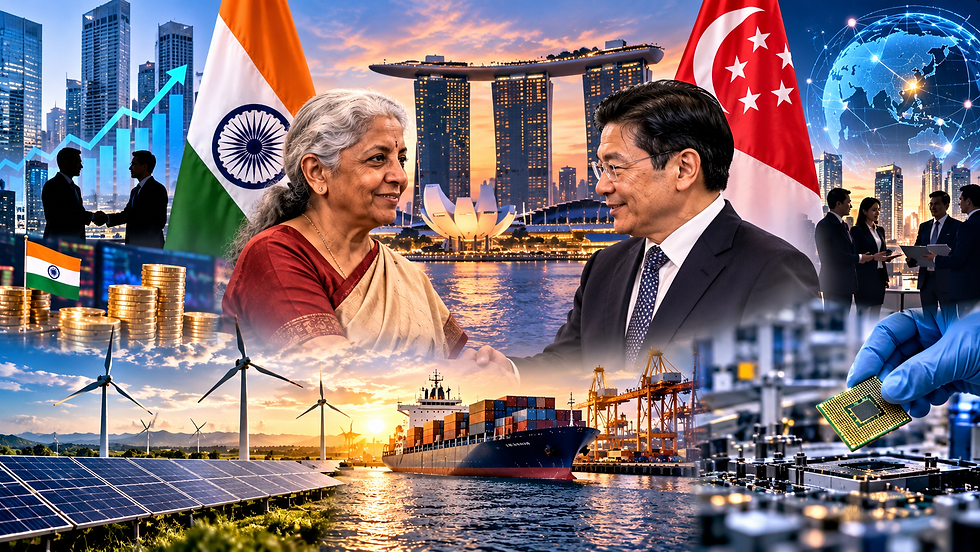
India is accelerating its economic outreach to Singapore amid ongoing uncertainty in global trade, energy crisis and changing investment patterns in the Asian market driven by Asian economies to look again at their long-term economic ties. The talks between Finance Minister Nirmala Sitharaman and Singapore President Tharman Shanmugaratnam and Prime Minister Lawrence Wong are not just diplomatic consultations but a chance to deepen their economic ties. They illustrate New Delhi's efforts at attracting investment funds, enhancing financial ties and extending its economic reach to Southeast Asia as it braces for increasing uncertainty in western markets.
Sitharaman spoke on bilateral economic cooperation and international financial developments and investment opportunities in India during her visit from 9-11 October. She met President Tharman at The Istana to explore the development of the India-Singapore Comprehensive Strategic Partnership, and Prime Minister Wong in a meeting discussed the international economic environment and the impact of the energy crisis.
Minister of State for Foreign Affairs Vivian Balakrishnan also singled out Singapore's businesses for opportunities to contribute to India's long-term economic growth. The visit also involves meetings with institutional investors, hedge funds, portfolio managers and senior corporate executives, indicating one of the main priorities is to attract private investment.
This relationship is significant financially. Singapore continues to be India's biggest source of FDI flows and has contributed foreign direct investments worth of about $194.68 billion, cumulatively, till March 2026. That's a significant amount of foreign investment channeled through one of the world's most advanced financial hubs in Asia.
The sovereign investment companies in Singapore, such as GIC and Temasek have built strong holdings in Indian businesses, its infrastructure, technology and financial services. Their participation is significant because long-term institutional investment can help to finance projects that take a long time to develop and invest heavily.
But there is a distinction for Singapore as it is the largest investment source for India. Some investments from Singapore are from multinational companies and foreign funds that have their regional financial headquarters based in the city-state. Thus, investment statistics represent Singaporean investment as well as the role of Singapore as a financial intermediary in the world.
The wider economic linkage is now getting beyond traditional investment transactions. The bilateral agenda includes cooperation in the manufacturing of semiconductors, in the development of advanced industrial production, in digital financial infrastructure, in the aviation industry, in tax relations and in workforce development. These sectors are directly linked to India's industrialization agenda and its goal to move away from imports.
Semiconductors are a specialty that must be given special consideration. The plans to build fabrication plants in India aren't merely about the plants—they'll also need to build access to specialized equipment, industrial expertise, supply-chain networks and skilled workers. There are opportunities for cooperation in advanced manufacturing, packaging, testing, investment financing in Singapore's established semiconductor ecosystem.
Another strategic factor has been energy security. India is looking into a proposed 3,000-km electricity transmission line from it to Singapore via Myanmar, Thailand and Malaysia. The idea is to carry some 2,000 megawatts of green electricity, via the interlinked regional electric networks.
Singapore has also set itself a goal to import 6 GW of low-carbon electricity by 2035. The proposed corridor may generate an additional market for Indian renewable energy and help the Southeast Asia ensure electricity security, if technically and commercially viable.
However there are significant challenges with transmission, cross-border laws, political security, funding and pricing of electricity. It is a potential project and not yet an active energy partnership. Its eventual viability will rely on on-going cooperation between multiple governments.
Sitharaman's visit is also significant due to the timing. India has also been facing fresh trouble with the United States in trade talks, as Finance Minister Nirmala Sitharaman recently called talks at a 'plateau'. The attempts to create a more predictable trading relationship are hampered by Washington's tariff policies and by differences over Indian energy purchases.
Indian export of goods to the U.S. markets during April-August 2026 stood at around USD 42.79 billion, which proves the significance of assuring access to the U.S. markets. However, over-reliance on one market makes an economy vulnerable to commercial pressures as tariff policies become tools of geopolitical pressure.
The economic offer in Singapore is different. It will not be able to attract American consumer demand, but it can enable access to ASEAN investment networks, international capital markets and regional corporate headquarters. These linkages would improve the competitiveness of Indian business in raising finance, and moving into new markets and overseas operations.
Of course, there is the geopolitical element too. Southeast Asia is a strategic location in the region between the Indian and Pacific Oceans, and significant shipping lanes run between energy-producing areas, manufacturing hubs and overseas markets. Singapore is also a key economic player for India in the fields of maritime, logistics and financial services.
New Delhi's increased connectivity with Singapore also fits right in with its overall Act East policy. It can enable India to move ahead with more commercial integration with the ASEAN countries, while not being entangled with any one big power.
But, investment announcements are not the only way to gauge the success of the partnership. International investors will continue to evaluate regulatory certainty, taxation regime, enforcement of contracts, quality of infrastructure and chances for profitable exits from India. A return of the government's interest in signing investor-protection treaties suggests it's now taking the view that foreign capital needs legal guarantees as well as promising growth.
Whether diplomacy yields tangible commitments in manufacturing, infrastructure, financial services and emerging technologies will be the first litmus test. Investment needs should lead to investments in productive assets, skilled jobs, technology transfer and improved export capacity and not just be limited to financial transactions.
But Singapore has its own strategic interests. Opportunities exist to diversify corporate exposure from existing regional markets by leveraging access to India's growing domestic market, the digital economy, industry and renewable energy potential.
The message from the visit is clear: India sees economic diplomacy as a tool of national strategic autonomy more and more. Reliable investment ties are as crucial as old fashioned trade deals as tariff squabbles, energy shortages and geopolitical conflicts make global trade more complicated.