
Popular Categories

Politics

Geo Economics

Lifestyle

Analysis

Geopolitics

Civilizational Lens

Defence

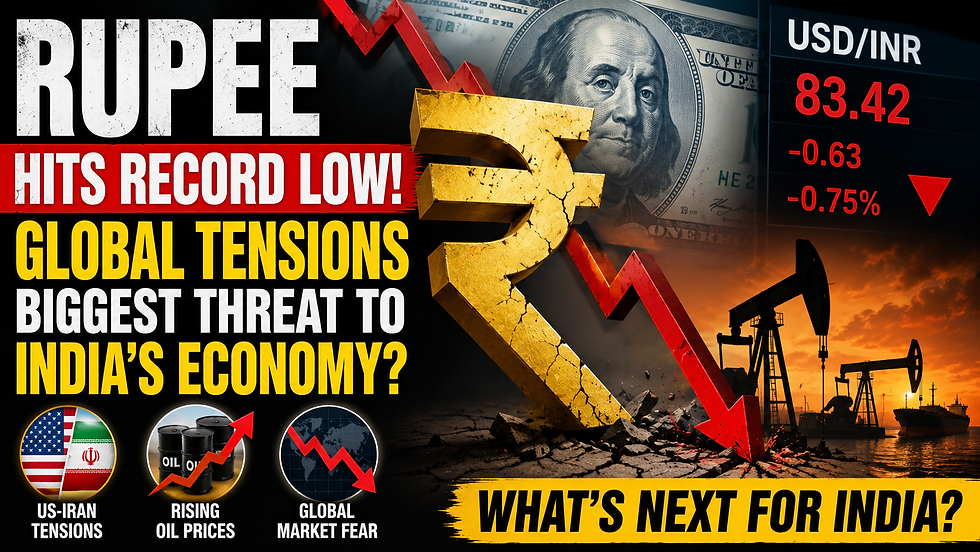
Rupee at Record Lows: Why Global Tensions Are Reshaping India’s Economic Equation
6 May 2026
Created by
The BV Team
The fall of the Indian Rupee to record lows against the U.S. dollar is not merely a financial event—it is a reflection of the increasingly fragile balance between geopolitics and economics. As hopes of de-escalation between United States and Iran weaken, global markets are beginning to price in prolonged uncertainty, and India is feeling the pressure through its currency markets.
This development highlights a larger reality: in today’s interconnected world, external geopolitical shocks can rapidly translate into domestic economic stress.
Currencies move based on confidence, capital flows, and economic expectations. In the current scenario, multiple forces are converging at once.
First, rising geopolitical tensions are driving oil prices upward. For a major energy-importing economy like India, higher crude prices mean larger import bills and greater demand for foreign currency. This naturally weakens the rupee.
Second, global investors are shifting toward safer assets. During uncertain periods, capital tends to flow into traditionally stable markets and currencies, particularly the U.S. dollar. Emerging market currencies, including the rupee, often face pressure as a result.
India’s economic growth remains closely linked to energy costs. Any sustained increase in crude oil prices impacts transportation, manufacturing, and inflation simultaneously.
This creates a chain reaction:
Higher oil prices increase import costs
Import costs pressure the current account deficit
Inflation risks rise across sectors
Currency stability weakens further
The rupee’s decline, therefore, is not just a market fluctuation—it is a signal of how exposed global economies remain to geopolitical disruptions in energy-producing regions.
A weaker rupee also makes imports more expensive, which can fuel inflation. For policymakers, this creates a difficult balancing act.
Raising interest rates too aggressively may slow economic growth, while allowing inflation to rise unchecked can weaken purchasing power and investor confidence. Managing this balance requires careful coordination between fiscal and monetary policy.
India’s economic managers now face the challenge of protecting stability without undermining growth momentum.
The rupee’s movement is part of a broader global trend. Across emerging markets, currencies are reacting to the same factors: geopolitical instability, rising energy prices, and cautious investor behavior.
This “risk-off” environment reflects how interconnected financial systems have become. A conflict or diplomatic breakdown thousands of kilometers away can influence currencies, stock markets, and commodity prices almost instantly.
Markets today react not only to events—but to expectations about future risks.
Despite the immediate pressures, India retains several long-term advantages. Strong domestic consumption, infrastructure expansion, and digital economic growth continue to support the broader economy.
In fact, moderate currency depreciation can also improve export competitiveness by making Indian goods relatively cheaper in global markets. The challenge lies in ensuring that inflationary pressures do not outweigh these benefits.
This distinction is important: short-term volatility does not necessarily imply long-term weakness.
From a broader strategic viewpoint, the current situation reinforces the importance of economic resilience. Countries that rely heavily on imported energy are increasingly vulnerable to geopolitical shocks.
For India, this strengthens the case for:
Diversifying energy sources
Expanding renewable capacity
Building larger strategic reserves
Strengthening export competitiveness
Reducing dependency on volatile external variables
The future of economic strength will depend not just on growth rates, but on the ability to absorb external shocks without destabilization.
What is happening to the rupee is part of a much larger transition in the global order. Geopolitical conflicts are no longer isolated military issues—they directly shape currencies, trade flows, and financial stability.
Energy chokepoints, sanctions, and diplomatic breakdowns now influence economic systems as much as traditional financial indicators do.
This means economic planning can no longer be separated from geopolitical strategy.
The rupee’s slide to record lows is a warning as much as it is a market event. It reflects the growing intersection between global conflict and domestic economic stability.
While the immediate pressures are significant, they also offer an opportunity for recalibration. Nations that build resilience, diversify strategically, and adapt quickly will be better positioned in an increasingly volatile world.
In the coming years, economic power will belong not only to those who grow fast—but to those who remain stable when the world around them becomes unstable.