
Popular Categories

Politics

Geo Economics

Lifestyle

Analysis

Geopolitics

Civilizational Lens

Defence

The Hidden Red Flag: Why Cash Flow, Not Profit, Reveals the True Health of Indian Companies
2 May 2026
Created by
The BV Team
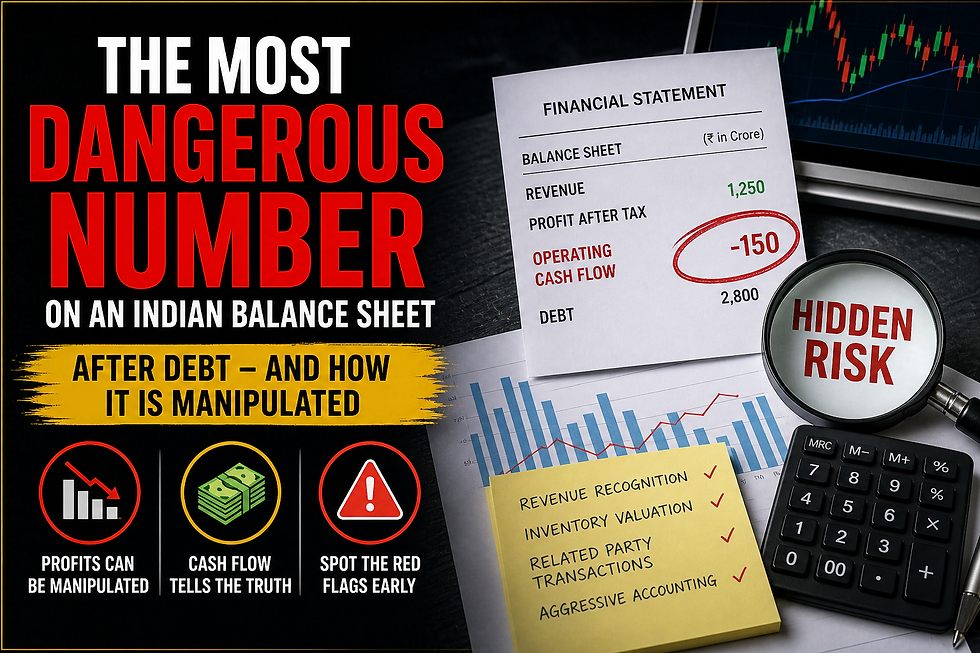
In the world of corporate finance, profit is often celebrated as the ultimate indicator of success. Headlines highlight earnings growth, investors track quarterly results, and companies showcase profitability as proof of performance. Yet, beneath this widely accepted metric lies a more critical—and often overlooked—indicator of financial health: cash flow.
In India’s evolving corporate landscape, analysts and investors are increasingly recognizing that profit alone can be misleading. The real story often emerges when cash flow is examined alongside earnings, revealing discrepancies that can signal deeper structural issues.
Profit, as reported in financial statements, is an accounting construct. It reflects revenue minus expenses, calculated using standardized rules that allow for certain adjustments, estimates, and timing differences.
Cash flow, on the other hand, represents actual money moving in and out of a business. It is harder to manipulate because it reflects real transactions rather than accounting interpretations.
This distinction is crucial. A company can report strong profits while struggling with weak or negative cash flow—a situation that raises questions about the sustainability of its business model.
One of the most significant warning signs in financial analysis is a persistent gap between reported profits and operating cash flow. When profits rise but cash flow does not follow, it suggests that earnings may be driven by non-cash factors such as aggressive revenue recognition or delayed expense booking.
This divergence can occur for legitimate reasons, such as business expansion or temporary working capital changes. However, when it becomes a pattern, it often indicates underlying stress or potential manipulation.
Companies have several ways to present a favorable profit picture without corresponding cash generation. These include extending credit to customers to boost sales, capitalizing expenses to defer costs, or adjusting inventory valuations.
While these practices may comply with accounting standards, they can obscure the true financial position. Over time, the gap between accounting profit and cash reality becomes difficult to sustain, leading to sudden corrections that catch investors off guard.
In India, where markets are rapidly expanding and investor participation is growing, understanding such nuances is critical. Many companies operate in competitive environments where pressure to show growth can incentivize aggressive accounting practices.
For investors, relying solely on profit metrics can lead to misjudgments. Evaluating cash flow provides a more grounded perspective, helping identify companies that generate real value versus those that rely on financial engineering.
The issue is not unique to India. Globally, several high-profile corporate failures have been linked to discrepancies between profits and cash flow. These cases highlight a universal truth: sustainable businesses are built on strong cash generation, not just reported earnings.
As financial markets become more interconnected, the ability to identify such red flags becomes increasingly important for maintaining stability and trust.
From a broader strategic viewpoint, the focus on cash flow reflects a shift toward deeper, more disciplined analysis. It moves beyond surface-level indicators to examine the underlying mechanics of a business.
This approach aligns with a more resilient investment philosophy—one that prioritizes long-term sustainability over short-term performance. It also reinforces the importance of transparency and accountability in corporate governance.
Ensuring financial integrity is a shared responsibility. Investors must adopt more rigorous evaluation methods, while regulators need to maintain strong oversight to prevent misuse of accounting practices.
Enhanced disclosure requirements, improved auditing standards, and greater awareness can collectively reduce the risk of manipulation and build confidence in the market.
The most dangerous number on a balance sheet may not be debt or profit, but the gap between reported earnings and actual cash flow. This divergence, when overlooked, can lead to significant financial misjudgments.
In an increasingly complex financial environment, understanding this distinction is essential. True financial strength lies not in what is reported, but in what is real—and cash flow remains the most reliable measure of that reality.