
Popular Categories

Politics

Geo Economics

Lifestyle

Analysis

Geopolitics

Civilizational Lens

Defence

Warsh's First Big Call: Why Tonight's Fed Verdict Could Push the Rupee Past 96 and Rattle Dalal Street
16 Sept 2026
Created by
The BV Team
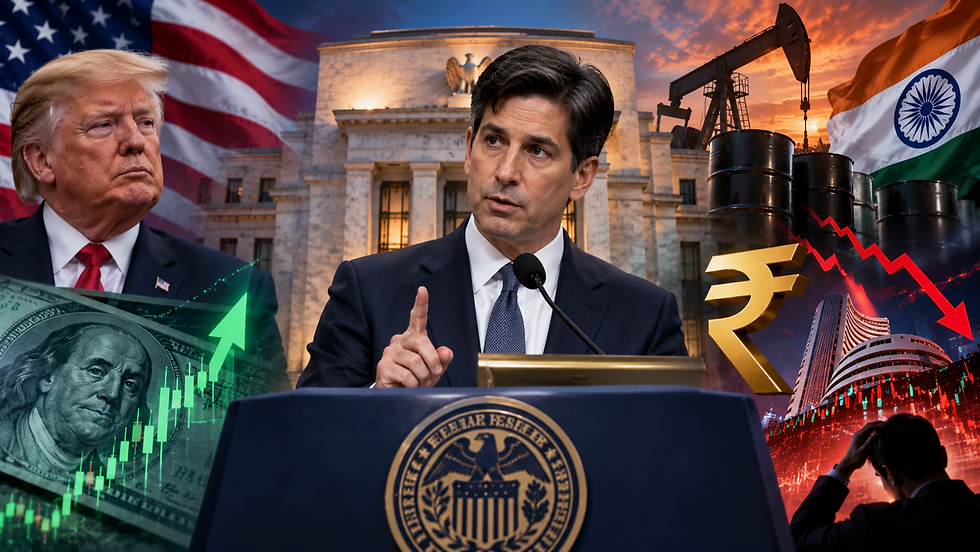
At about midnight in India, Kevin Warsh will walk up to a podium in Washington and likely make a statement that the world hasn't heard from the Fed in three years: an interest rate hike. It will be his first big policy bet since he was appointed Fed Chair and it is a surprising move for a market that was picking on rate cuts for the rest of this year. Just one-third of economists surveyed by Reuters-Kitco believed interest rates would rise a week ago, but that rose to 85 per cent when the inflation data came in for August. There are few policy shifts as speedy as that and few better than the one that reached India's ears as the audience was as curious as they.
The nervousness was already on display on Dalal Street even before the Federal Open Market Committee started its two-day meeting. The Sensex lost almost 778 points to close at 74,003.82 on Tuesday, while the Nifty tumbled close to 280 points to end at 23,118.60. The India VIX, the market's fear gauge, jumped almost nine per cent. Those factors along with a rupee that was near a seven-week low against the dollar at 95.9 and crude oil above $105 a barrel and US Treasury yields near the psychologically charged 5 per cent level all kept traders on their toes. It hasn't abated since the sun went down in Washington.
The Reserve Bank of India has already been using spot and non-deliverable forward markets to contain the rupee's further decline, but this hasn't stopped it from melting down. It's the first way, not in some abstract sense of world opinion, that tonight's decision makes its way to Mumbai and Delhi via the workings of currency defence. If made as widely anticipated, the quarter-point increase will push the federal funds rate to 3.75-4.00 per cent, which will be the first such increase since mid-2023, and occur at a time when the rupee has very few buffers to withstand additional dollar buying.
The one who made the call is no regular central banker. Warsh had his first experience with the Fed when the financial crisis hit in 2008, and was the Board's contact with Wall Street, as well as spending time with Ben Bernanke throughout the depths of the credit freeze. But even back then, his colleagues recall him as the inside voice that raised the alarm about the potential for inflation risk from aggressive rate cuts and bond-buying programmes a hawkish bent that has grown stronger over time.
He gets an Fed that, under his predecessor, has kept rates unchanged four consecutive meetings while issuing a warning that borrowing costs will likely remain high for longer than markets might hope. His own strategy to date has been to allow the markets, not the Fed, to speak for themselves. He has explicitly resisted having a forward-guidance script; after a previous meeting, he told reporters he was "trying to not tell the market what he expects; he expects market participants to do that. The position is for a chair that desires an immediate and unarguable reputation for fighting inflation, with the least amount of hand-holding possible.
Politics is present but not dominant or controlling in all these. Donald Trump has been openly advocating for the Fed to cut rates for months and over the weekend, speaking to reporters at the Irish Open, he acknowledged he didn't know where the Fed would go, but America should have the lowest borrowing costs in the world, no matter the data. That he hasn't pushed for a specific result this time around is a sign on its own: that the White House realized that it had to settle, quietly, for a Fed chair who was hawkish and would be made from a commitment to stop being the whitest house on the hill.
In the case of India, the transmission mechanism includes three channels, which are more significant than headline figures on the exchange rate of the rupee. The first is the import bill. Crude prices are close to multi-month highs and geopolitical tension in the Middle East keeps growing with no alleviation in sight, making every barrel costlier in local terms, thereby adding to the margin pressure faced by companies in oil-related businesses like aviation, paints and tyre companies, which have already announced margin pressures this quarter.
The next one is bond yields. Indian bond markets tend to reprice in line with the US Treasury yields as they approach the 5 per cent mark on the 10-year and beyond the 5.2 per cent mark on the 30-year, levels last seen in 2007. The third is portfolio flows. In the past, a better dollar and higher yields in the United States have driven foreign institutional investors out of emerging markets and Indian equities have already seen net selling heavy till now this month.
There's another, lesser-known good thing. However, in software services, pharmaceuticals and some manufacturing industries, a lower rupee is beneficial for exporters, as long as global demand remains strong and hedging books are in good hands. It can also act as a rupee hedge for overseas equity investments that have had the underlying dollar shares come under pressure adding to unhedged equity investments' rupee value.