
Popular Categories

Politics

Geo Economics

Lifestyle

Analysis

Geopolitics

Civilizational Lens

Defence

Beyond Claims and Counterclaims: What Iran’s Military Reality Reveals About Modern Power
22 Apr 2026
Created by
The BV Team
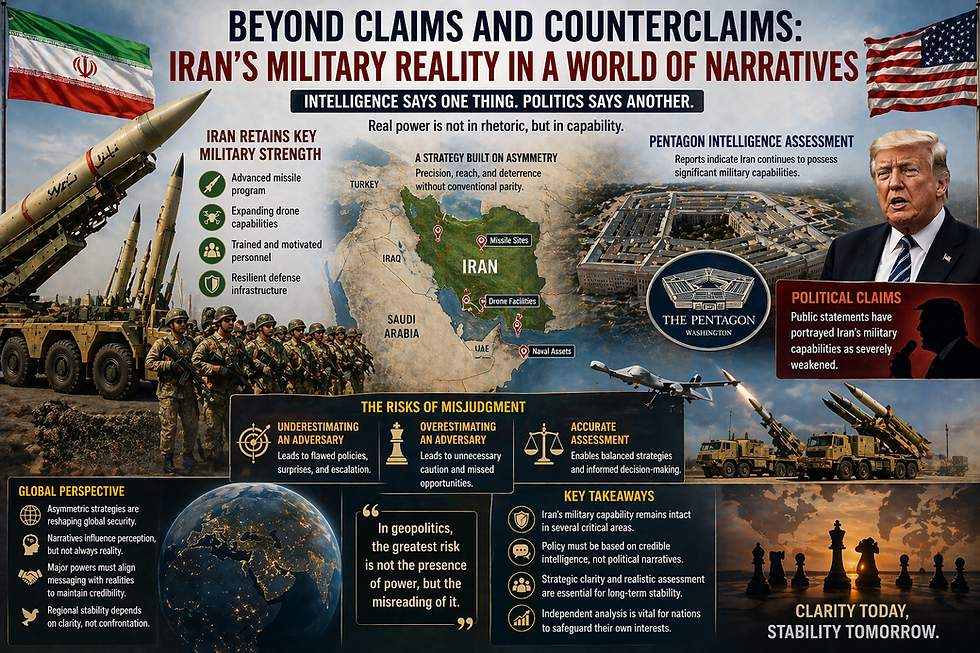
Recent assessments emerging from the Pentagon suggest that Iran continues to retain significant military capabilities, even as political narratives—particularly those associated with Donald Trump—have projected a far more diminished picture. This divergence between intelligence evaluation and political messaging highlights a critical feature of modern geopolitics: perception often competes with reality.
At the core of this development lies a fundamental question—how do nations measure strength? In traditional terms, military capability was assessed through visible assets: troop strength, weapon systems, and technological superiority. Today, however, power is layered. It includes asymmetry, adaptability, and the ability to operate effectively under constraints.
Iran exemplifies this shift. Despite facing prolonged economic pressure and international isolation, it has developed a defense structure that prioritizes resilience. Its focus on missile systems, drone capabilities, and decentralized operational strategies allows it to maintain deterrence without matching conventional power structures of larger nations.
This is where the gap between political rhetoric and intelligence assessment becomes significant. Political narratives are often shaped by domestic considerations—simplifying complex realities to align with strategic messaging or electoral positioning. Intelligence, on the other hand, tends to operate within a framework of detailed analysis, acknowledging both strengths and limitations.
The current contradiction between these two perspectives is not unique. Globally, similar patterns have been observed in conflicts and rivalries involving major powers. Narratives are constructed to influence perception, while ground realities remain more nuanced.
From a strategic standpoint, underestimating an adversary carries inherent risks. Misjudgment can lead to flawed policy decisions, escalation, or unintended consequences. Overestimation, on the other hand, can result in unnecessary caution or missed opportunities. The challenge lies in striking a balance—grounding decisions in accurate assessments while managing public perception.
Iran’s military posture also reflects a broader trend in global defense strategies. Nations that lack the scale or resources of superpowers are increasingly adopting asymmetric approaches. These include cyber capabilities, proxy networks, and precision strike systems. Such strategies complicate traditional deterrence models, making conflicts less predictable.
In the context of the Middle East, this complexity is further amplified by overlapping interests and alliances. Regional dynamics are influenced not only by bilateral relations but also by external actors with strategic stakes. This creates an environment where even localized developments can have wider implications.
For the United States, maintaining credibility requires aligning public messaging with ground realities. Discrepancies between the two can weaken strategic coherence and create uncertainty among allies. It also opens space for competing narratives to gain traction.
At a global level, the episode underscores the importance of analytical clarity. In an era of rapid information flow, distinguishing between narrative and reality becomes increasingly difficult. Governments, analysts, and the public must navigate a landscape where information is abundant, but not always consistent.
For countries like India, such developments are closely watched. The Middle East remains a critical region for energy security, trade, and diaspora engagement. Understanding the true balance of power is essential for informed decision-making.
This is where a pragmatic approach becomes essential—one that prioritizes independent assessment over alignment with external narratives. Strategic autonomy depends on the ability to interpret global developments through one’s own lens, rather than relying solely on external viewpoints.
Ultimately, the discussion around Iran’s military capabilities is not just about one country. It reflects a broader reality of contemporary geopolitics: power is multifaceted, narratives are contested, and clarity is often elusive.
The real takeaway lies in recognizing that strength cannot be reduced to a single dimension. It must be understood in context—historical, technological, and strategic. Only then can policy decisions be both effective and sustainable.
Because in today’s world, the greatest risk is not the presence of power—but the misreading of it.