
Popular Categories

Politics

Geo Economics

Lifestyle

Analysis

Geopolitics

Civilizational Lens

Defence

China's Fingerprints Are All Over the Drone That Rewrote the Rules of War
26 Aug 2026
Created by
The BV Team
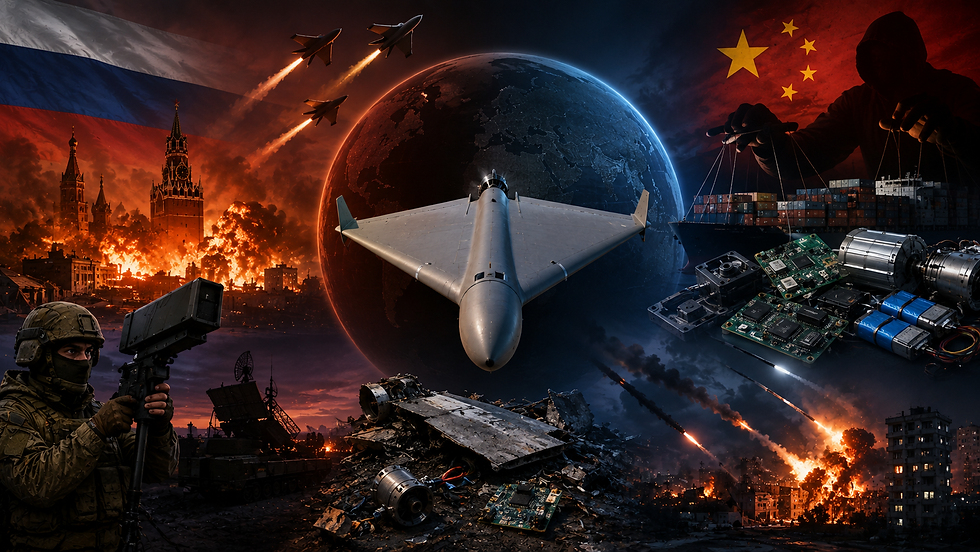
In the first week of July, air raid sirens blared well into the night in Kyiv, and people had become accustomed to hearing the low buzzing drone of Shahed drones overhead, but, rather, a high-pitched shriek that flew soar past 300 kmph. Russia had activated a newer, jet-powered model of the Iranian-designed weapon, nearly three times the speed of the original propeller drone that debuted over Ukraine last year. That night, some 30 people lost their lives due to the simultaneous drone and missile attacks. It was one more piece of information in a tale that has been chronicled over four years: a $200-a-kilogram flying bomb conjured up in Tehran is the new weapon of the twentyfirst century, with Chinese parts, technology and finally, tacit approval.
The Shahed-136 was never intended to be a sophisticated weapon. Iran developed it as a low-cost disposable missile that could be fired by the thousands, without necessarily hitting the target, to overwhelm air-defence systems. Its production cost is estimated between $20,000 and $50,000 per unit depending on the variant and who counts. After Russia started importing them by the thousands, and later created its own version, dubbed the Geran-2, the economics of this war were forever altered. When an enemy is bombing a country, the latter cannot only count on the most sophisticated air defenses and it would be a financial suicide. Spending $4 million to shoot down a drone that costs less than a thousand bucks is not defense, it's a controlled bankruptcy. The price of a THAAD interceptor is $12 million to $15 million per shot. Add the hundreds of drones, missiles, and decoys which now come in most nights and the numbers don't add up after weeks.
It's been a supply chain that passes straight through China that's maintained this weapon and kept it airborne. The companies within China reported hundreds of containers of engines, microchips, lithium-ion batteries, gyroscopes and fiber-optic cable were heading toward Iran and Russia factories, in some cases without any need to scramble the paperwork as exporters used to. One company, Xiamen Victory Technology, advertised aviation engines for the Shahed-136 under the banner of innovative solutions for aviation engines on its own website, which featured pictures of the drone. A company representative later told investigators the parts were intended only for civilian drones and that some of the marketing materials might have been generated by artificial intelligence, but customs data reviewed by reporters indicated that the opposite was true of those being purchased. Usually, funds for these shipments flow through shell companies that can be quickly created in Hong Kong, a process that has kept the identity of the final customer obscured even after the United States sanctioned one of these networks linked to a Tehran-based trader last year in 2024. Within a year, a new group of shell companies was reported to have taken over from the sanctioned network.
The change is in Chinese behavior, not in the underlying trade, says former US Treasury officials that previously ran these sanctions programs. China has been serving as the gateway for American and European parts for years to Iranian and Russian drone manufacturers. The difference today, of course, is that a bigger portion of that hardware is being produced within China itself, frequently in small factories with minimal Western oversight and, less importantly, minimal concern with compliance. Conflict Armament Research, based in the UK, which keeps track of components recovered from warplanes, has found that more parts from China have been found in the Shaheds, including a new anti-jamming antenna that gives the drones a greater ability to withstand Ukrainian electronic warfare than previous versions. The latest antennas retrieved from the wreckage have twice the number of signal-handling elements as those found months before, compelling Kyiv to broaden the area it can jam to maintain parity, Ukrainian officials claim.
In response to these findings, Beijing's foreign ministry has so far stated that it maintain export controls in accordance with its domestic laws and international commitments, a message it has been repeating in successive reports. But it is all in the money: one estimate puts the value of Chinese-origin, drone-related parts sent to sanctioned Russian companies at about $63 million from 2023 to 2024 alone and those are just the parts that appear in customs records.
The ramifications are now far-reaching beyond Ukraine. In parallel, Iran's own arms export industry has expanded in a similar manner, from an estimated $20 million in 2017 to over $100 million a year in just five years, according to arms trade analysts based in Stockholm, citing Tehran's claims of a billion dollars over a single year in recent years. Yemen Houthis created a domestic version, Waid, and employed it to hinder Red Sea shipping for two years. The same design has been employed by militia groups in Iran to take the lives of American servicemembers. In the most dramatic flip-flop in years, U.S. Central Command confirmed this year that it has also fired its own low-cost, one-way attack drones modeled after Iran's own technology, calling the strikes "American-made retribution that's built on a design that we once thought was crude.
By now virtually all of the answer that is emerging is a Ukrainian export. Just like the air defense systems were being destroyed, Kyiv has been developing an interceptor drone for roughly $2500 to $15,000, which are now shooting down a significant number of Shaheds, turning the tables on the cost of the attack. The drone barrage is now a standard solution to another war, with the Gulf states apparently canvassing for the same Ukrainian technology that they are now using themselves.