
Popular Categories

Politics

Geo Economics

Lifestyle

Analysis

Geopolitics

Civilizational Lens

Defence

Six Nights of Fire: Why the Hormuz War Is Now Bigger Than Iran
17 Jul 2026
Created by
The BV Team
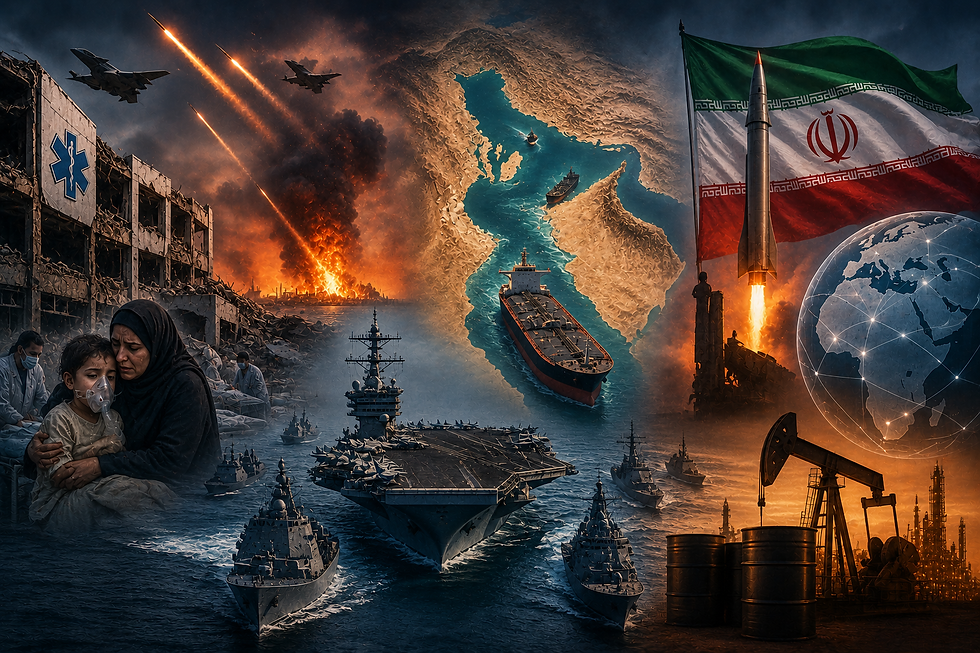
When American munitions were dropped near the children's cancer center (Shahid Baghaei) in Ahvaz on Wednesday night, the war engulfing the Persian Gulf since late February entered another realm. Kids in need of oxygen were carried outside into the darkness. One of the staff members, who was not named and shaken, told Iranian state media that the bombardment was too severe for the ventilators to work. For whatever purpose the utility had been meant, the optics were gone and it happened on the same day that Brent crude surpassed $85 a barrel and U.S. Central Command confirmed a 6th night of strikes on Iranian soil.
As of Friday, it's an ongoing battle, not one that's slowing down, nor one that seems to be heading toward a decisive victory, but one in which both sides continue to push. Now CENTCOM's overnight campaign has passed Bandar Abbas, Ahvaz and the southern port city of Chabahar, with US Defense Secretary Pete Hegseth posting video of a maritime control tower collapsing into dust. Within a seven-day period that saw Tehran attacked on the continent by international forces, the bridges have been destroyed in the province of Hormozgan, the rails that lead to Bandar Abbas, an Islamic Revolutionary Guard Corps naval base, and a missile base in the Persian Gulf.The bridges were destroyed in Hormozgan province, the rail lines that run to the port of Bandar Abbas, an Islamic Revolutionary Guard Corps naval base and a missile base in the Persian Gulf, all within a 72-hour span that Washington calls degrading Iran's ability to threaten shipping, while Tehran calls "war and a response on the continent, not miles away.
That reply has already gone far afield of Iranian waters. This week, missiles were fired at a water desalination plant in Kuwait, an escalation into civilian infrastructure that Gulf capitals had hoped to avoid. Strike back was felt in Qatar and Jordan. Then on Friday, Iranian troops or their proxies went to work in Iraq's Kurdistan region, only to be met with an unprecedented public condemnation from the office of Prime Minister Masrour Barzani, which warned that the attacks were "unjustified" and demanded federal government intervention in the region. Iran, on the other hand, is said to have instructed Hezbollah and other regional allies to brace for a broader conflict, a message that indicates Tehran believes the current conflict is not to be contained but is the prelude to a greater conflict.
This war becomes everyone's business when it starts to impact economics. In normal times, about one-fifth of the world's oil and one-fifth of its liquefied natural gas passes through the Strait of Hormuz. These are no ordinary times. Brent finished at $85.95 on Friday, more than 2 percent higher on the day and in the month's best week, trading data showed. WTI is up and over $79. Within the first seventeen hours it is back, Washington's naval blockade has already caught two commercial ships on its radar as they tried to circumvent it despite the blockade, CENTCOM says, while Donald Trump claims it is only targeting Iranian ships. Air travel companies in the European Union are urged not to fly over any part of the airspace in the Gulf.
But what worries the policymakers in Delhi, Tokyo and Berlin as much as anybody else in Washington or Tehran is a detail that's in the IMF note this week: the shock absorber that got the world through the first phase of this crisis is mostly gone. A lack of supply of about 4 million bpd was managed by consuming commercial and strategic stocks the IEA member countries released about 400 million bpd from emergency stocks at one point, the highest coordinated drawdown on record and by China reducing refinery runs and drawing on its own stocks. That buffer is pretty much depleted. There is much less margin of error to absorb future traffic slowdowns if Hormuz shipping collapses again as it did in early March, when shipping through the strait reportedly dropped more than 95 percent resulting in Iraq declaring force majeure on nearly 1.5 million barrels a day it exported. That $140 price is not an extreme guess by analysts, it was the price they were giving for a blockade that briefly occurred in March.
This is bound by a diplomatic tissue which is thinner on both sides's acknowledgements. The conflict was supposed to be over and Hormuz reopened by a memorandum of understanding signed in mid-June, and oil prices did indeed decline from the May highs, to the high $60s by July 1. It unfolded in just 14 days: Trump restored the blockade under the name of the "Iranian Blockade", and Tehran allegedly ordered the Houthi movement in Yemen to be ready to close the Bab el-Mandeb strait, which forms Saudi Arabia's Red Sea lifeline, if U.S. air strikes target Iran's power grid. This is a problem that Gulf shippers have observed as well, and one with which Secretary of State Marco Rubio was at odds in June when he dismissed Iran's proposal to toll the passage of traffic through Hormuz as unworkable, only to now be floating his own.
Both sides in this war don't fight it alone. A strike against a hospital in Ahvaz, a blockade imposed by a group of US carriers, a warning by the IMF from Washington, a stealthy rise in the price of fuel in Mumbai and Manila these are no longer five stories, but one. The question of the weekend is not if the strikes will go on. Centcom has already indicated they will. Whether anyone still thinks there's an offramp or whether both capitals have just decided that this is the nature of the relationship these days.