
Popular Categories

Politics

Geo Economics

Lifestyle

Analysis

Geopolitics

Civilizational Lens

Defence

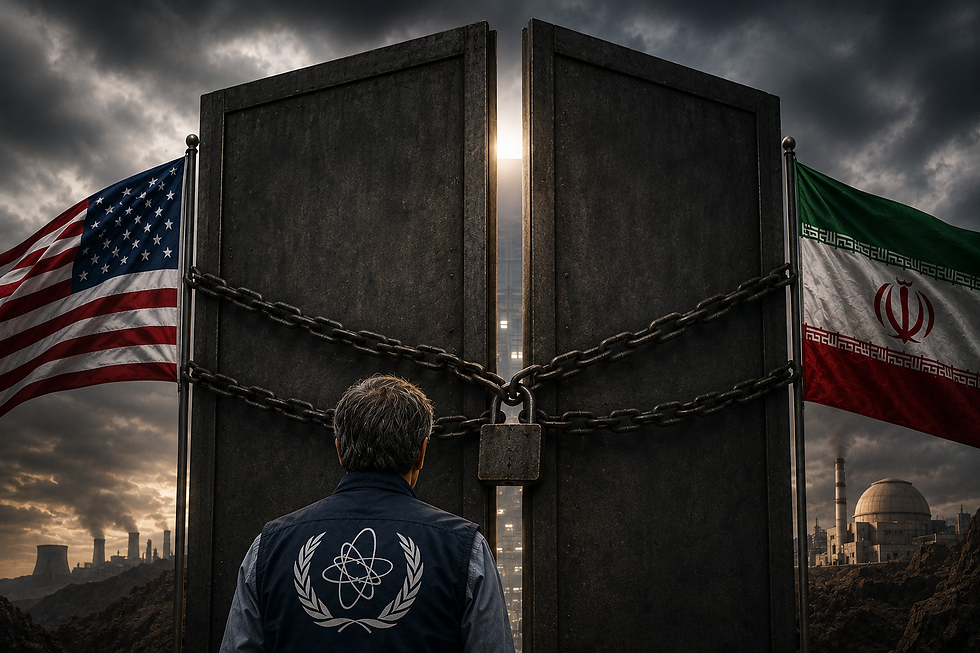
Tehran Slams the Door on the Inspectors, and the Iran Deal's Hollow Core Shows
23 Jun 2026
Created by
The BV Team
Tehran quietly withdrew the rug within hours of the White House patting itself on the back for making a "major milestone". In the capital on Tuesday, Iranian foreign ministry spokesman, Esmaeil Baghaei told reporters three things loud and clear. Iranian officials had not met with Rafael Grossi, head of the UN's nuclear watchdog, in Switzerland. No plans were made for an inspection of the nuclear plants that were broken open by American and Israeli ordnance earlier this year. There was no routine for this visit, in the first place," as he said. Iran would abide by its current obligations under the Non-Proliferation Treaty and the safeguards treaty it has with the IAEA, he said. Nothing beyond that.
That flat denial is a bit out of step with the sound emanating from DC. Vice President JD Vance said as he departed the Switzerland negotiations, just a day earlier, that Iran had agreed to re-open its doors to nuclear inspectors for the first time in a long time and that the United States would bolster its inspection regime to make sure Tehran could never assemble a bomb. Special envoy Steve Witkoff took it one step further in an off-the-record briefing to congressional leaders, saying Iran would assist in finding and revealing where the enriched material is being stored. President Donald Trump, who always speaks his mind, has tweeted that all were aware Iran would comply with the inspections of “Major Weapons” to ensure “nuclear honesty.”
So which is it? The truth after three days of a 60-day countdown is that no one outside the negotiating rooms at the Burgenstock resort above Lake Lucerne can say for certain. That's the uncertainty that's the issue. The most powerful office on earth is flatly contradicting a deal with the very government that signed it on the one element that will make or break its worth: verification.
To appreciate the significance of this, it is important to remember why the watchdog got itself in the mess. The agency pulled back its inspectors from Iran and halted its field work on safety grounds after the start of the strikes in late February. Then Tehran "freeze" cooperation and withdraw from a temporary one, which it had agreed on last autumn in Cairo, and then expel the people of the agency from all the sites where it had been hit. The watchdog admits it has long since lost what it calls “continuity of knowledge” over Iran's stockpile of nuclear material, a continuous monitoring of the process that allows the world to be sure that nothing has been siphoned off under the radar. In technical terms, 60 percent is just a hairs breadth from weapons grade and is the highest enrichment reached by Iran, the only non-nuclear-weapon state in the treaty to have made uranium metal. That material should be physically examined every about 30 days under normal safeguards. It has been nearly a year since last being properly counted.
The agency's published assessments reveal how much one-sided its picture has become. Of 13 major sites that had been officially declared, inspectors had been able to access only the few sites not destroyed by the bombing, including the Bushehr power reactor, which Russia had insisted Tehran maintain for refuelling. About eight damaged sites are left completely untouched and a newly-designated hall of enrichment at Esfahan never has been studied. But now, all that the world knows about the debris at Fordow, Natanz and the Esfahan tunnel complex is based on satellite photographs and inference. That's not verification. It's guesswork cloaked in oversight and that's exactly what Baghaei's Tuesday briefing indicates is Iran's plan.
Baghaei did leave a narrow door ajar, and worth it is to read carefully. He cited the memorandum of understanding signed last week by Tehran and Washington, which calls for a delay in the nuclear issue till the end of the 60-day period of negotiations, freezes the current state of Iran's programme till then and continues inspections of the unaffected plants. That is, the Iranians are providing continuity, not new access. The sites that are ruined remain sealed and the ones that actually let you know what has been destroyed and what may have been spirited away remain sealed. Whether Vance and Witkoff have been saying to lawmakers or not, the Iranian stance has not budged.
The memorandum is an amazing document, and it helps to explain the American side's excitement over progress. Under the terms of the agreement, Iran will ratify its commitment not to develop a weapon, an end to hostilities on all fronts, the lifting of the U.S. naval blockade, commercial traffic through the Strait of Hormuz will reopen within 30 days, the lifting of U.S. sanctions and a reconstruction package that is reportedly valued at at least 300 billion dollars. Tehran has already been given the green light to resume oil sales. High-level talks mediated by Qatar and Pakistan and attended by Vance, Witkoff and Trump's son-in-law Jared Kushner concluded with all participants signing onto a roadmap for a final settlement and working groups that oversee, sanctions and the nuclear file. In essence, on paper it sounds like the most audacious Middle East deal in a generation.
The problem is the people who would have to trust it the most have been kept furthest from the table. The memorandum came about as a result of neither Israel nor Hezbollah signed it, and the deal's future now rests on a fragile ceasefire in southern Lebanon that is being broken by both sides. The similarities with 2015 deal brokered by Barack Obama cannot be missed from Jerusalem, and are not welcome. The earlier deal was touted as the one that would kill the regime's options for a bomb, but critics have said it only postponed and fattened the regime in the interim. In Washington, Republican hardliners are already making the same association, saying a deal that doesn't subject Iran's most sensitive sites to scrutiny or its enrichment "right" to restriction is a rerun of the original sin and is in fact a "learning from it" deal. For his part, Iran's President Masoud Pezeshkian told his own public that the delegation went to Switzerland without making “one concession” and Iran would not back down from the right to enrich. He was winging his way to Pakistan on Tuesday, as Tehran is also hard at work strengthening its own regional ties while negotiating.
There is a hard-nosed way of interpreting all this that has its merits and goes something like this. A handshake at a Swiss hotel does not suddenly domesticate a regime that has for a year kept inspectors at bay from its uranium, armed and funded proxies from Lebanon to the Gulf and threatened from time to time to choke off the world's most important oil artery. There are no legal obligations on anyone but Tehran and the only currency is that of unfettered, intrusive access to all sites, including those that are damaged. Less than that is a promise, and the promises from this quarter don't last long. On that measure, Israel's decision not to cede its security to a document it never signed is not obstruction, but prudence, and Washington's exuberant optimism sounds less like diplomacy than a sales pitch, with an election cycle on the home front behind it.
That suspicion is accentuated the moment you begin tracking the money, as the stakes here extend beyond the region. The Strait of Hormuz is a choke-point for nearly 20% of all oil transported anywhere in the world, making it the world economy's weak spot, shaken every time Tehran rattles it. During the war, Brent crude tore past 120 dollars a barrel. When traders started wagering on a reopening of the strait, it fell below 80 in days, losing about 17 dollars in four trading sessions, and bringing oil futures down some 8 percent. This week it's back to the high 80's again, jittery from all the conflicting headlines. The strait is believed to still be littered with an unknown number of Iranian mines and it is estimated that it will take several weeks to remove all of them, so the world's largest ship owners are asking for clarity before they start to send their vessels. The gulf had been hiding the transponders of a few supertankers, with a total capacity of about six million barrels, which only recently escaped from the gulf.
All of this is no theory for an energy-hungry importer like India. The bulk of the crude oil is imported from outside the country and a major part of it through the Hormuz, and the economic slowdown has been a direct trigger for inflation, the rupee and the current account. New Delhi has plenty of reason to hope the waterway will remain placid and the agreement will stand and plenty of reason to stay vigilant about how quickly it could fall apart. It was true in Tokyo and Seoul, where the stock exchanges saw their markets sway with the ups and downs of the war report; and it was true in an American economy where motorists were already complaining about the price of petrol during the summer. Even Washington's own war bill is due: The Pentagon has been seeking some 80 billion dollars from an impaled Congress to pay for the Iran campaign, which focuses the mind on the cost of not a workable peace.
Which leads me back to Baghaei's stand in Tehran. Clothes off the diplomacy and the message he delivered to the world on Tuesday is clear. The one mechanism that has the potential to make this tenuous knowledge more enduring, an honest reckoning on what remains in Iran's bombed-out plants, is the one mechanism Tehran has just ruled out. All of this other stuff in the memorandum, the oil, the sanctions relief, the 300 billion dollars, the re-opened Strait, everything rests on a foundation that no third party can review at the moment. It's not as if 60 days is a long time to overcome that much of a deficit. Until the inspectors can visit the sites in person and take a tally of what they have found, and until then, the rest of us have been left to guess, based on satellite photos, and take a whole lot on faith.