
Popular Categories

Politics

Geo Economics

Lifestyle

Analysis

Geopolitics

Civilizational Lens

Defence

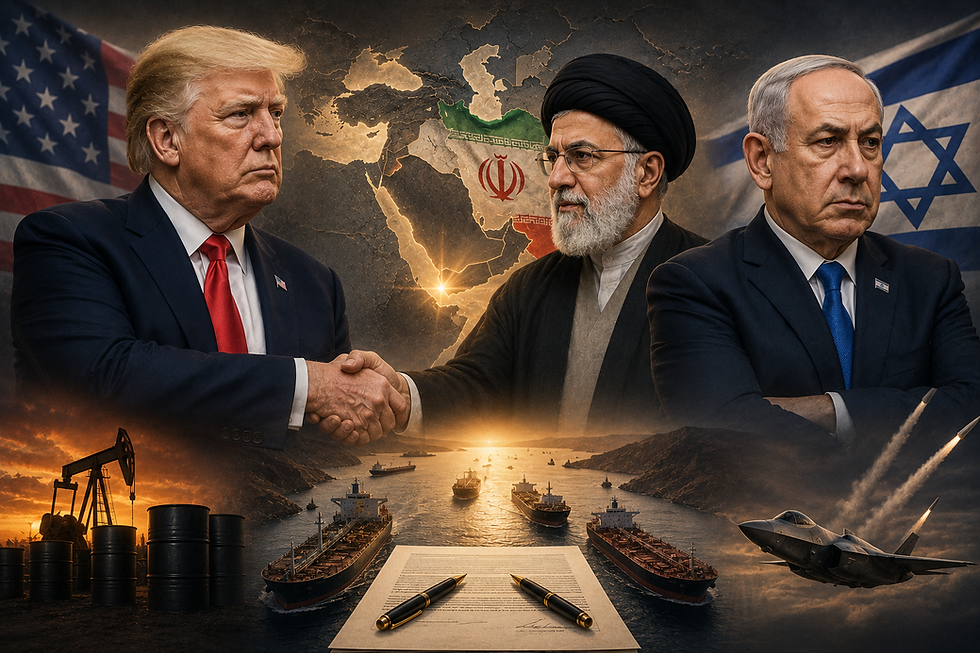
The Deal That Left Israel Out, And What Washington Just Told the World
15 Jun 2026
Created by
The BV Team
There are diplomatic agreements, and then there are earthquakes, disguised as agreements. What the United States and Iran formally agreed over the weekend landed in the middle of the second type not only because it marks the end of more than three months of open warfare, but because of what it shows about how Washington has assessed its strategic interests, and how little it values its oldest partner in the region when those interests do not align.
President Trump unveiled on Sunday night what he termed a "deal" with Iran that was reached through a memorandum of understanding, largely through Pakistani intermediaries, and that will be formally signed Friday, June 19, in Geneva, Switzerland. US Vice President JD Vance has said that he will attend. Tehran will be represented by the speaker of its parliament and chief negotiator Mohammad Bagher Ghalibaf, Iran's highest leadership since the 1979 Islamic Revolution. That alone is a geopolitical headline. However, it's in the small print that the real story is to be found.
The Framework
Major events that led to the War becoming a Deal.
Feb 28, 2026
Supreme Leader Ali Khamenei is killed as a result of joint US–Israeli strikes on Iran ("Operation Roaring Lion"). Iran shuts the Strait of Hormuz. Brent crude tops $100 per barrel.
Mar 4, 2026
Iran officially declares the Strait "closed. QatarEnergy announcing force majeure on all LNG exports. Oil is 14 million barrels short every day, the largest supply shortage in the history of the global oil market, according to the IEA.
Early April 2026
First US – Iran ceasefire under the Qatar's mediation. Almost an hour later, Israel attacks Lebanon, threatening to stall negotiations. On the initial ceasefire news, Brent drops ~16%.
May 28, 2026
US and Iranian negotiators sign a tentative MOU to extend ceasefire and start nuclear negotiations. Trump gives it a two-week delay. Brent closes at $93/barrel.
Jun 11, 2026
Trump says he is canceling a planned new round of strikes against Iran and is indicating, “There should be a deal announcement pretty soon.” Risk premium is immediately priced out of the market.
Jun 14–15, 2026
Full framework confirmed. Nikkei 225 surges 5.5%, Kospi jumps 5.7%, S&P 500 futures climb ~1%. Oil drops sharply. Geneva, June 19, signing ceremony.
As detailed by Iran's Mehr news agency and confirmed by several Western sources, the agreement is composed of a 60-day negotiation period which is to begin after Friday's signing. The United States has also pledged to release up to $24 billion in funds that are frozen in its account in Iran, with about $12 billion going out before the talks start, and the rest paid out during the talks. The US establishment, including Vice President Vance, strongly rejected the description initially, saying that there is no cash-for-showing-up. As of Monday morning, the issue of the differences between what Washington has publicly stated and Tehran has published in a 14-point MOU document has not been officially settled.
The one thing that is indisputable: the Strait of Hormuz is reopening. In the same social media post, Trump himself authorised the end of the US naval blockade of Iranian ports. Engines, start your engines, Ships of the World," he wrote. "Let the oil flow." That is the most economically significant statement made by any world leader this year: The 14 million bpd trading volume that was paralysed since early March, about 20 per cent of all maritime trade in oil, was in question.
The Indian stock market is expected to open on Thursday at 9:50 AM.The Indian stock market is scheduled to open at 9:50 AM on Thursday.
The initial number of fatalities was reported by Al Jazeera and CNBC, while the Gulf News and Euronews provided updates later.
Prior to the war in late February, the price of Brent crude was around $70/barrel. At peak disruption, it went to over $120/barrel. The decline today marks the sharpest one-session energy price relief rally since April 2026's ceasefire.
If Iran would have had a nuclear weapon, for two hours Israel would not exist. Netanyahu should be very thankful to us for doing this.
Withdraw the nomination of Donald Trump for ambassador to the United Nations, published on June 14, 2026, by the U.S. President, Donald Trump.
The Rift, Which leads me to the other headline that will last years beyond the market euphoria. In a stunning interview that was released Sunday evening, Trump didn't mince his words when he described Israeli Prime Minister Benjamin Netanyahu as "a very difficult guy" and he wasn't just blowing steam. It was issued along with a threat: If Iran does not finalise a nuclear agreement in the 60-day timeframe, Trump said he would either resume military strikes against Tehran or be “the guardian of the Middle East” in return for 20 percent of the area's revenues. This was the most transactional Trump. This was very much a quieter message: Israel wasn't covered by this agreement, it was not consulted over it, and, according to the White House's message, it was supposed to take that kind of thing on the chin.
Following the two leaders' discussion, Netanyahu's office released a statement that clearly outlined Israel's stance: "Israel is not a party to the memorandum of understanding with Iran. The statement was also outlining Israel's "red lines" for any final deal: no enriched uranium, dismantlement of enrichment facilities, missile production restrictions and cessation of assistance for regional proxies such as Hezbollah. These are not small asks. The current MOU is said to leave the status quo (no enrichment, no facility expansion) for the 60-day period window, and everything else is put off until negotiations that haven't really started yet.
What the MOU does not Address vs. What It Defers
Ceasefire & Hormuz reopening (30%)
The first tranche of asset release is set to take place at 8%.
Temporary nuclear freeze (12%)
Enrichment, missiles, proxies - deferred (50%)
None of the three original war aims suspension of Iran's nuclear programme, end of missile development and cessation of aid to armed proxies has been answered conclusively in the MOU. All three are within the 60 day negotiation window.
Israeli officials are not just worried about the procedure of exclusion. The original war aims were to expunge the path to nuclear weapons in Iran, to disable its ballistic missile programme and to cut Tehran's support to armed proxies in the region, all of which failed to materialise. Three and a half months later Iran still has a missile programme, Hezbollah is still a fighting force in Lebanon and the new supreme leader Khamenei's son, who hasn't been seen publicly since the war started would have to give personal approval before Tehran could sign off on any deal. That approval, confirmed by US President Trump to reporters, seems to have been granted.
Iran's soldiers, in turn, were quick to dub the operation a success. The general staff quoted the Iranian forces as having "humiliated" America and Israel and "demonstrated with strength that the enemy has no path other than accepting defeat and surrender," the state television station reported in a statement. This is the state propaganda language of course. Domestic utility for Tehran is real though. No matter what Iran settles for at the table, the story it is telling its people is one of stoicism, of resistance which in the past makes it more difficult, not easier, to make a final deal.
The Economic Stakes
Iran's Frozen Assets — Historical Context & Current Deal
MOU Tranche 1
(before talks, 2026)
$12B
MOU Total Release
(60-day window, 2026)
$24B
2015 JCPOA-
Assets
unlocked (est.)
~$29–56B
Iran's Total Frozen
Assets (all estimates)
Up to $150B est.
Iran's frozen assets include funds covered by sanctions, Chinese investment pledges and foreign reserves of the oil ministry. Estimates vary significantly. Brandeis University analysis indicates that $150B is the upper bound for all frozen categories while $29B is the most mobile, readily available component.
The geopolitics aside, the economic impact alone is enormous. The Strait of Hormuz blockade that has been underway since March 4 has resulted in “the largest supply disruption in the history of the global oil market,” according to the IEA. Crude oil prices jumped above $120 per barrel, having been around $70 per barrel a few weeks ago. QatarEnergy declared a state of emergency. Kuwait, Iraq, Saudi Arabia and the UAE accounted for the bulk of the Gulf's oil production, which dropped by more than 10 million b/d in two weeks. Downstream, shipping insurance prices literally skyrocketed, fuel supplies were thin from Vietnam to Southern Europe, and central bankers from Frankfurt to Seoul were forced to confront inflation scenarios they hadn't considered in a decade. The ECB was reportedly considering rate hikes even as the European economy went into decline. The RBNZ, which had been making heavy rate cuts over the previous 18 months, was forced to hold at 2.25% with a new inflation threat from energy on the horizon.
The Geneva signature on Friday thus has a much greater significance than the bilateral U.S.-Iranian relationship. So long as the Strait remains open and no toll is imposed, as Trump said, and so long as the 60-day negotiation period doesn't collapse, the global reset in energy prices will lead to lower inflation numbers in two quarters, more room for central banks to manoeuvre and a major boost to manufacturing-led Asian economies that have been operating on a reduced fuel supply since March. Hyundai Engineering, South Korea's Hyundai Group, jumped 21 percent in Monday's opening session. That's not a trading sentiment. That's the market anticipating the return of its 102-day denied energy supply.
The Larger Question
However, it is here that the sentiment must pause and pose itself a more difficult question. The war cost Iran its air defence and most of its missile launchers and production plants, its important nuclear installations, and its highest-ranking military staff. It has not yet been seen by its new Supreme Leader since February. At home, hardliners already accuse the negotiators of being traitors and demonstrate in front of the Foreign Ministry demanding their resignation video confirmed by AFP shows the protesters. In that domestic pressure cooker, Iran's government now must enter a 60-day negotiating room, which Trump has presented as guaranteeing Iran "can never" possess a nuclear bomb. Just how far a weakened, internally divided Iranian establishment can go without setting off a political crisis at home is an unknown. The 60 day clock begins Friday. It won't seem like a long time.
The Israel factor itself has its unresolved tension. Israel's defence minister and Netanyahu have both ordered the military to maintain Israel's ability to strike Iran's nuclear programme on its own should the agreement fail to meet Israel's needs. It is not lip-smacking rhetoric. Israel has the air force, intelligence systems and, crucially, the experience of operating without the permission of the United States when its leaders believe they are otherwise doomed. Trump's "Iran would not be around for two hours" if it's nuclear" remark is the most telling thing he's said on the subject in years, not because of the dramatic nature of the statement, but because he is saying that the issue is truly existential and that Washington decided not to address it now but to wait for a future negotiation.
There is one interpretation of this that makes some sense from a strategic standpoint: Washington decided that the cost of the Strait disruption was not worth the effort of a maximalist Iran nuclear resolution, at least in terms of economic benefit to the world, and to domestic energy and inflation politics. But selling that framing to Israel, which was literally left outside the negotiating room, is a different matter. The UK, France, Germany and Italy have already indicated that they are prepared to remove sanctions against Iran after the deal, as long as Iran "can never" develop a nuclear weapon. The calculations of Europe here are almost entirely energy-based. Asian importers don't need to be asked twice. There are many more people in the world who want the oil flowing than those who want to wait for a perfect nuclear deal.
Netanyahu, apparently, said he appreciated Trump's pledge to take the enriched material out and "dismantle enrichment infrastructure" which as of this writing has been expressed, but not yet included in the MOU text. But the biggest ambiguity in the MOU is the difference between what Trump says on the interview circuit and what the MOU really requires, and it is unlikely that that will be sorted out before the ceremony on Friday. What is signed in Geneva is a platform for dialogue. That is a dialogue that could lead to a momentous denuclearisation breakthrough or another 60 days of a controlled escalation between a regime that thinks it is unbeatable and a leadership that fears it will be swept from power by the next Israeli strike on a Hezbollah position in Beirut or Iranian-backed operation in the Gulf.
What is evident today is this: the map of Middle Eastern security is being redrawn and this time, it's not being drawn in Tel Aviv. The deal without Israel doesn't have to be a bad deal. But it's a message loud and clear as to the kind of leadership Washington is willing to be, and what it will have its oldest regional allies believe in order to achieve oil price stability and a peace now 60 days old.