
Popular Categories

Politics

Geo Economics

Lifestyle

Analysis

Geopolitics

Civilizational Lens

Defence

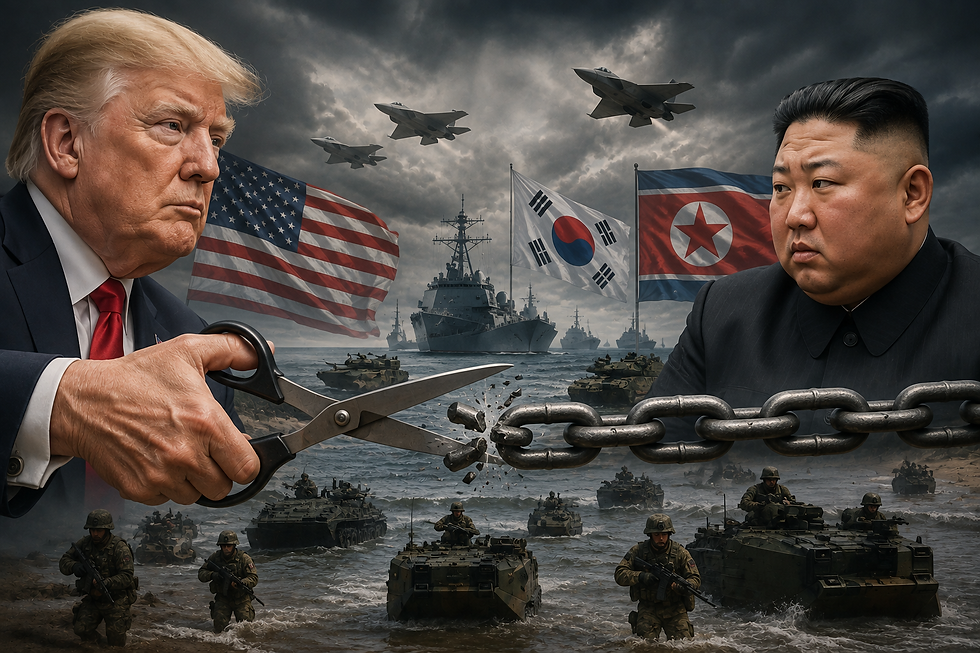
Trump's Drill Cut Hands Kim a Win Washington May Struggle to Take Back
20 Aug 2026
Created by
The BV Team
The call to cut down came from Washington just hours before eighteen thousand South Korean troops were to report for duty for the annual Ulchi Freedom Shield exercise. On his social media page ahead of the drill, President Trump stated he was not pleased that the U.S. "has long agreed to joint war games with Seoul" and "told Defense Secretary Pete Hegseth" to reduce American involvement "significantly. He framed the exercise as expensive and as an “unnecessarily provocative” message to a North Korean leader, whom he said had been “respectful” to Washington throughout his tenure in office.
There wasn't much time for the Pentagon or South Korea's military to make a subtle move. The exercise was conducted as scheduled from Aug. 17 to Aug. 27, but at battalion or higher level, there were fewer combined field-training events this year, cutting the number by about a fifth from last year. Numbers remained unchanged the 28,500 American service members stationed on the peninsula are permanently there and that's not what got cut instead of numbers it was tempo that got rolled back. That's important because it's training tempo and not number of people that make an alliance truly ready when a crisis occurs.
Trump tied his decision to two grievance and not one. The first was cost, a complaint he has already made since his first visit, when during his first visit to Singapore, he hung up larger exercises after his meeting with Kim Jong Un and said the drills were provocative and costly. The latter grievance has been that Seoul has yet to join Washington's military effort against Iran earlier this year, which the president mentioned specifically in the same post he announced the drill reduction. But the inclusion of an unrelated foreign policy issue in this peninsula security planning is a telling indicator as well, indicating that the drills are not just a defense requirement anymore, but a tool for use when Washington wants to raise a red flag against Seoul on any issue.
The numbers of money are far less than the political ones. The Special Measures Agreement between South Korea and the U.S. for financing the stationing of American forces in the country has resulted in a steady increase in South Korea's contribution to its cost. Under the agreement, which was inked in late 2024 and is valid for five years, South Korea's contribution to the cost of stationing American forces in the country will hit roughly 1.4 trillion won in 2025, up from 924 million dollars in 2019, and will further rise to 1.52 trillion won, or about 1.14 billion dollars, in 2026. In the past, Trump has suggested that it should be much, much larger, once proposing a number in the billions of dollars annually and calling South Korea a money machine. In that context, cutting a training drill is a rounding error of costs and benefits in Washington's defense budget, but it will come with a price tag far more difficult to measure the certainty that allies rely on when they plan their own defenses.
Regional analysts have been focusing on the predictability issue. This year's Ulchi Freedom Shield was supposed to be a demonstration of the conditions required to move the operational control of South Korea's war forces from the American-led Combined Forces Command to South Korea, a goal long sought after by the South Koreans and one that the current U.S. defense strategy aims to speed up as allies take on more of the burden of deterring North Korea. As the last-minute cut in the very act could be interpreted as a mismatch of the intention to justify that transition, alongside Washington's desire for South Korea to assume more responsibilities. The more the rehearsal, the more difficult it will be to certify the graduation.
Meanwhile, Kim Jong Un has made no public statement of what he has gotten from the gesture. North Korea had already labelled the exercise as a rehearsal for invasion before it even started the joint training, a response it proffers against almost every joint exercise, big or small, no matter how much it tests a ballistic missile in the runup to the training. The negotiation stance of Pyongyang has also become tougher since the Hanoi talks collapsed in 2019, with Kim rejecting recent invitations from Trump and South Korea's Lee Jae Myung to reconvene talks while denuclearization remains a prerequisite. Between those summits, analysts of the North's finances observe Pyongyang selling its munitions and troops to Russia for its war in Ukraine, and earning money and technology that has reduced Kim's reliance on sanctions relief and thus made him far less inclined to do so than he was before the first time he met with his South Korean counterpart.
A higher signal will read off the peninsula. Treaty allies in Asia and Europe interpret Washington's actions based on the level of its security promises to one ally as a signal of how much it's willing to offer others, and a promise that's wobbled and weakened because a U.S. president has made no secret of his personal friendship with an enemy is just one of the many factors that defense ministries must factor into their calculations. South Korea's government has made a public statement that it will continue the exercises as planned and the alliance is not being dissolved. The new scenario is an alliance that has been forged for seven decades, based on the premise that exercises are not questioned but that's no longer the case, and the next cut may not come in the wake of a new provocation.