
Popular Categories

Politics

Geo Economics

Lifestyle

Analysis

Geopolitics

Civilizational Lens

Defence

Trump's North Korea Charm Offensive Is Quietly Reshuffling Washington's Asia Playbook
24 Aug 2026
Created by
The BV Team
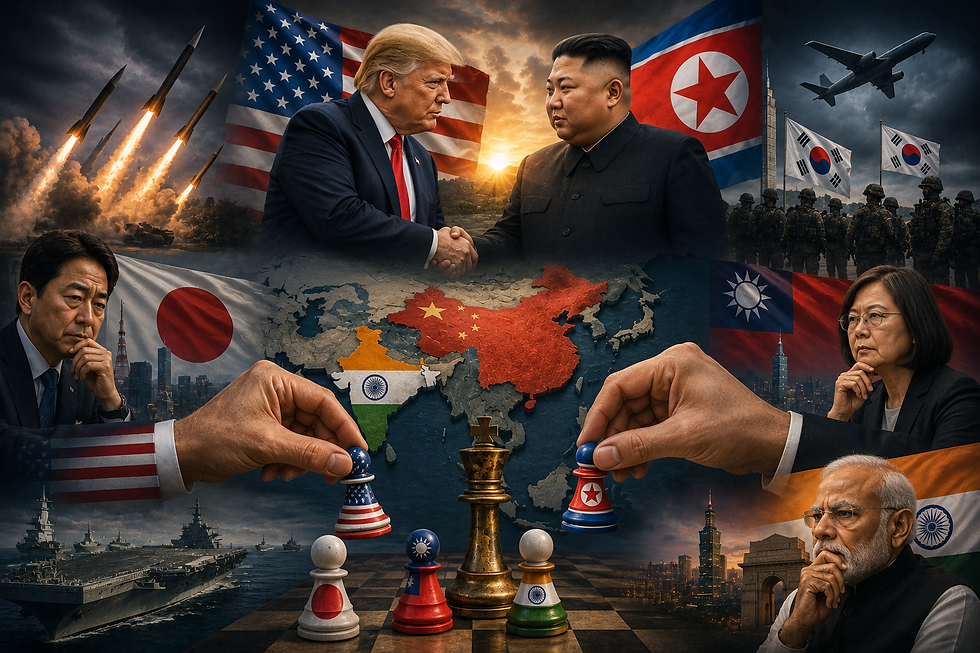
This week Tokyo, Taipei and New Delhi have a particular kind of anxiety in their foreign ministries, as a superpower begins its improvisations. Donald Trump's latest proposal to meet with Kim Jong Un and his decision to reduce the number of joint military drills with South Korea has irritated an old treaty ally. It has raised again an issue that Asian capitals have long believed they had resolved years ago: What can they really expect from Washington if the President decides that a symbolic gesture of peace is more important than a long-standing security agreement.
The primary catalyst was last week's sudden curtailment of drills with Seoul by Trump, which he described as a “goodwill gesture” to Pyongyang, but not as a step away from an ally. The North Koreans retaliated with a barrage of ballistic missiles fired off the coast of their country, triggering South Korea and Japan's respective missile alerts within hours, and demonstrating that in the nuclear arms race, words can mean one thing but actions may mean quite another. Officials behind the scenes believe the math is simple for Trump: He's tied up in a domestic unpopular standoff with Iran, and he's looking for a foreign policy success that looks good on Twitter, and a handshake with Kim is the showy part of that, no matter the cost to the larger alliance system.
Japan is closely watching all this. Tokyo is in the middle of trying to reach an agreement with Washington on the cost of housing American troops, and the worry now is that an unpredictable White House is likely to do the same with Tokyo, as it has done with Seoul, using security pledges as bargaining chips instead of obligations. Last week a former Japanese defence minister was blunt in his warning on television that encouraging a nuclear armed Pyongyang would be a “serious problem for the stability of the region.” Then again, Taiwan is getting ready for another shock: an upcoming Trump-Xi meeting at which it might fear that the fate of its friendly yet delicate relationship is in the hands of a party it is not a part of.
India's version of this unease has been growing for more than a year and has its own texture, different from the deployments, rather than tariffs or oil purchases, or even an incremental loss of strategic goodwill. The tussle peaked in the second half of 2025 when Washington imposed a punitive 50 percent tariff on Indian exports, which comprised 25 percent of a reciprocal tariff, plus an additional 25 percent based on India's continued purchases of discounted Russian crude. That combined rate was among the highest any trading partner faced in the U.S. and was levied on over half of India's approximately 87 billion dollars in annual exports to the American market (excluding a few sectors like pharmaceuticals, semiconductors and critical minerals).
It was only in February this year that a bilateral trade plan came in which lowered the real tariff to 18 percent in exchange for India moving to zero duties on U.S. goods, a shift away from Russian oil, and a promise to eventually absorb over 500 billion dollars in U.S. exports ranging from defence hardware to energy, farm produce to transportation equipment. Oxford Economics economists (and many others) swiftly pointed out that some of the headline figures from the deal such as the full 500bn dollar commitment had not been confirmed on the Indian side, allowing the deal to unravel under its own weight.
What has been observed since is not a break, but "cold feet" a cooling off in enthusiasm. Indian officials at the highest level have taken great care over signing favourably long-term defence deals with Washington, two officials close to the Indian discussions in New Delhi describe, a move that comes as a change as Washington and India have long been able to find a common bond in their military ties despite all their other disagreements. Adding to that caution, the Pentagon has in June renamed its military headquarters in the Indo-Pacific region from Indo Pacific Command back to Pacific Command, a move that the Pentagon has said has no strategic meaning but is several analysts have interpreted as a kind of subtle message: India's days of occupying quite the same pride of place in America's regional planning that it did a few years ago may be numbered.
None of it is a sign of India turning its back on Washington, and over the tariff deadlock period, the two nations have been conducting joint military exercises and working out new deals on equipment purchases. However, there has been a change in the emotional climate. Washington's decades long counter-China campaign in Asia which it used to run has now been shifted to New Delhi, where there is more hedging, more diversifying of defence suppliers, and less trust in American assurances. Those who have been following the overall trend say that this is the “real cost of a foreign policy style that favors alliance renewal over alliance maintenance,” and that trust is a “very costly thing to regain.”
But in the real sense of the word this is not about North Korea, it is about what North Korea has brought to light. Washington's Asian friends and allies are becoming more sensitive to the fact that their security assurances are now subject to a floating rate, subject to adjustment at the President's convenience. That is a very uneasy negotiating position to be in for a decade-planning region.
