
Faith, Identity, and Law: Supreme Court’s SC Status Debate and Its Civilizational Impact
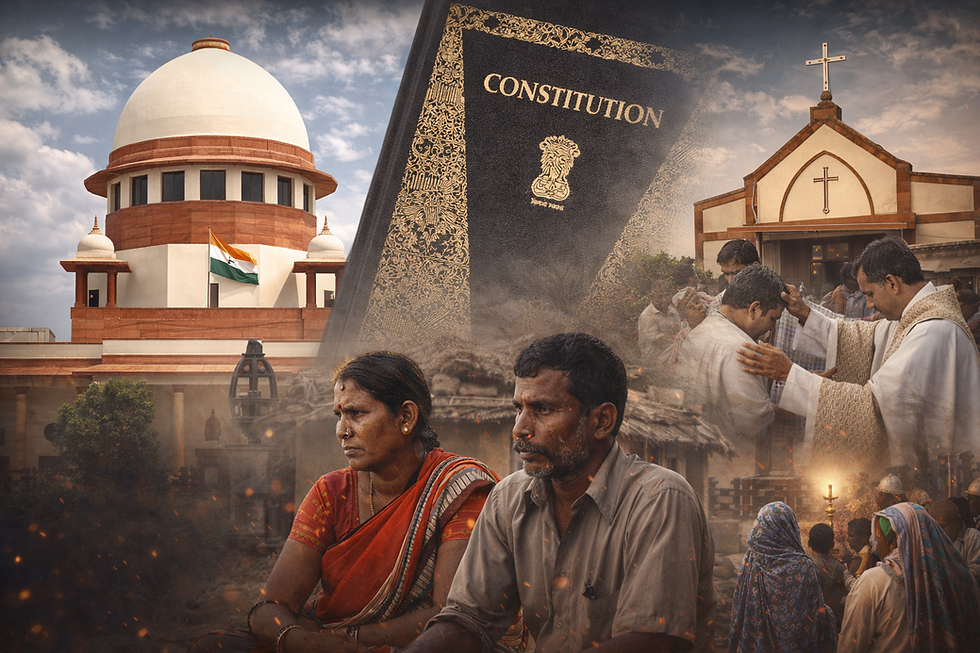
The recent deliberations around Scheduled Caste (SC) status for individuals who have converted to Christianity have once again brought India to a critical intersection of law, identity, and civilizational continuity. While the legal debate appears technical on the surface, its deeper implications extend into the social fabric, historical justice frameworks, and the future trajectory of India’s constitutional philosophy.
24 March 2026
The BV Team
The recent deliberations around Scheduled Caste (SC) status for individuals who have converted to Christianity have once again brought India to a critical intersection of law, identity, and civilizational continuity. While the legal debate appears technical on the surface, its deeper implications extend into the social fabric, historical justice frameworks, and the future trajectory of India’s constitutional philosophy.
At the heart of the issue lies a foundational constitutional question:Should individuals who convert from Hinduism, Sikhism, or Buddhism to Christianity continue to retain SC status?
India’s existing legal framework restricts SC status to specific religious communities—primarily Hindu, Sikh, and Buddhist groups—on the premise that caste-based discrimination is historically rooted within these traditions. The argument presented by those seeking inclusion post-conversion is that social discrimination does not automatically disappear with a change in religion.
However, the counterpoint—strong and deeply rooted—is that reservation benefits were designed as a remedy for civilizational and structural injustices specific to certain social frameworks, not as a universal economic or social upliftment tool across all religious identities.
From a Sumit Peer perspective, this is not merely a legal technicality—it is a question of civilizational integrity and policy coherence.
If conversion to another religion is seen as an exit from the original socio-religious structure, then continuing to claim benefits tied to that structure creates a contradiction. It raises a fundamental question:
Can one exit a system and still claim its historical protections?
This is where the debate shifts from legal reasoning to philosophical consistency.
One of the most significant concerns in this debate is the potential creation of perverse incentives.
If SC benefits are extended irrespective of religious identity post-conversion, it could unintentionally:
Encourage conversion driven by material benefits rather than belief
Blur the distinction between social justice and policy exploitation
Strain the already limited reservation framework
India’s affirmative action system operates within finite limits. Expanding eligibility without recalibrating the framework risks diluting benefits for those it was originally designed to support.
Globally, affirmative action policies vary widely, but they are typically tied to race, ethnicity, or historical disadvantage, rather than religious identity alone.
For instance:
In the United States, affirmative action is linked to race and systemic discrimination
In Europe, social welfare programs are largely economic rather than identity-based
India’s model is unique—it combines historical injustice, social hierarchy, and constitutional safeguards. Any alteration to this system must therefore be approached with caution, as it impacts not just policy, but societal equilibrium.
It is equally important to acknowledge a critical ground reality:Many argue that caste-based discrimination does persist even after religious conversion.
This presents a genuine social challenge. However, the policy question remains:
Should the solution be:
Extending SC status across religions?
OR
Creating a separate framework to address post-conversion discrimination?
From a strategic governance perspective, the latter may offer a more balanced approach—addressing the issue without distorting the original intent of SC reservations.
This case is not just about one category—it has the potential to set a precedent.
If SC status is extended beyond current religious boundaries, similar demands could emerge across other categories and communities. This could lead to:
Policy fragmentation
Increased litigation
Political polarization
For a country as diverse as India, maintaining clarity and consistency in policy frameworks is essential for long-term stability.
From Bharat Vichar’s viewpoint, the issue must be seen through three lenses:
Civilizational Consistency – Policies must align with the historical and philosophical foundations they were built upon
Strategic Clarity – Avoid creating frameworks that can be misused or diluted over time
Balanced Justice – Address genuine discrimination without compromising systemic integrity
This is not about exclusion—it is about precision in policymaking.
The Supreme Court’s engagement with this issue represents a defining moment in India’s legal and social evolution. The outcome will not only shape reservation policy but also influence how the nation balances identity, justice, and constitutional intent.
As Bharat continues to evolve, such debates will become more frequent. The challenge will be to ensure that solutions remain rooted in logic, fairness, and long-term national interest—rather than short-term pressures.
Because in a civilization as layered as India,every legal decision is also a cultural statement.
11 April 2026
Institutional Continuity or Strategic Placement? Decoding the Latest Rajya Sabha Nomination
The recent nomination of Harivansh Narayan Singh to the Rajya Sabha, following the retirement of former Chief Justice Ranjan Gogoi, may appear on the surface as a routine constitutional exercise.

The BV Team
11 April 2026
High Turnout, Higher Stakes: What India’s Assembly Elections Reveal About a Shifting Political Mood
The recent assembly elections across Kerala, Assam, and Puducherry have delivered one clear message: voter participation is rising, and with it, the intensity of India’s democratic engagement.

The BV Team
7 April 2026
Chandigarh Attack Uncovered: Proxy Networks, Internal Security, and the Expanding Shadow War
The recent crackdown on a suspected foreign-backed module linked to the grenade attack on a political office in Chandigarh marks more than just a local law-and-order success—it reveals the evolving nature of covert conflict being waged beneath the surface of everyday life.

The BV Team
6 April 2026
Delimitation Debate Intensifies: Representation Reform or Political Flashpoint?
India’s political landscape has once again been stirred by a sharp exchange over the issue of delimitation—the redrawing of parliamentary constituencies based on population changes. What should ideally be a constitutional and administrative exercise is now being framed as a high-stakes political battle, with competing narratives shaping public perception and strategic positioning.

The BV Team
5 April 2026
India’s Census Reset: Data, Power, and the Future of Governance
India’s long-delayed population census is not just a statistical exercise—it is a foundational reset that will shape governance, economic planning, and political dynamics for the next decade. In a country as vast and diverse as India, data is not merely informational; it is strategic. The upcoming census carries implications that extend far beyond counting people—it is about recalibrating how the nation understands itself.

The BV Team
31 March 2026
One Leader, 294 Seats: What Mamata Banerjee’s Strategy Signals for Indian Politics
As political momentum builds in West Bengal, a striking narrative is emerging—one that places leadership, identity, and centralized messaging at the heart of electoral strategy. Mamata Banerjee’s call to be seen as the face across all 294 assembly seats is not just a campaign line; it reflects a deeper shift in how regional politics is being structured and communicated.

The BV Team
28 March 2026
Assembly Disruption to Global Echo: What the J&K Protest Reveals About Narrative, Politics, and Power
A recent disruption inside the Jammu & Kashmir Assembly, triggered by protests over developments linked to Iran’s leadership, may appear at first as a localized political episode. But beneath the noise and confrontation lies a far deeper issue—one that connects domestic politics, global narratives, and the evolving nature of ideological influence.

The BV Team
26 March 2026
“Not a Dalal Nation”: India’s Strategic Signal in a Shifting Global Order
India’s External Affairs Minister S. Jaishankar recently made a sharp and telling remark during an all-party meeting: India will not act as a “dalal nation” in global affairs. The comment came amid discussions around the possibility of Pakistan positioning itself as a mediator in potential U.S.–Iran engagements. While the phrasing may appear blunt, the underlying message reflects a deeper shift in India’s diplomatic posture—one that prioritizes sovereignty, clarity, and strategic self-respect over transactional opportunism.

The BV Team
24 March 2026
Opposition vs RSS: Political Theatre or Strategic Pressure Campaign?
The recent opposition-led march targeting the RSS and demanding Prime Minister Narendra Modi’s resignation over alleged international linkages has once again brought Indian politics into a high-voltage narrative battle. While the immediate trigger revolves around controversial global allegations, the deeper story is far more layered—touching upon political positioning, institutional targeting, and narrative warfare.

The BV Team
24 March 2026
Faith, Identity, and Law: Supreme Court’s SC Status Debate and Its Civilizational Impact
The recent deliberations around Scheduled Caste (SC) status for individuals who have converted to Christianity have once again brought India to a critical intersection of law, identity, and civilizational continuity. While the legal debate appears technical on the surface, its deeper implications extend into the social fabric, historical justice frameworks, and the future trajectory of India’s constitutional philosophy.

The BV Team

19 March 2026
When Law Meets Power — Decoding India’s New Institutional Battlefield
In modern India, the most decisive political battles are no longer fought only at the ballot box. Increasingly, they are being shaped inside courtrooms, investigative corridors, and institutional frameworks.

The BV Team
19 March 2026
What Modi’s Kuwait Call Reveals About India’s West Asia Playbook
At a time when West Asia is navigating heightened instability, Prime Minister Narendra Modi’s conversation with Kuwait’s Crown Prince Sheikh Sabah Al-Khaled is not just routine diplomacy—it is a signal. A signal of intent, positioning, and strategic clarity.

The BV Team
19 March 2026
What The Mamata–ED Case Reveals About India’s Political-legal Battlefield
When political strategy firms, investigative agencies, and the Supreme Court intersect in a single case, it is no longer just a legal matter—it becomes a test of how power operates within India’s democratic framework.

The BV Team