
Popular Categories

Politics

Geo Economics

Lifestyle

Analysis

Geopolitics

Civilizational Lens

Defence

BJP Sends Its New National Chief to Lucknow, and the 2027 Battle for Uttar Pradesh Is Officially On
4 Jul 2026
Created by
The BV Team
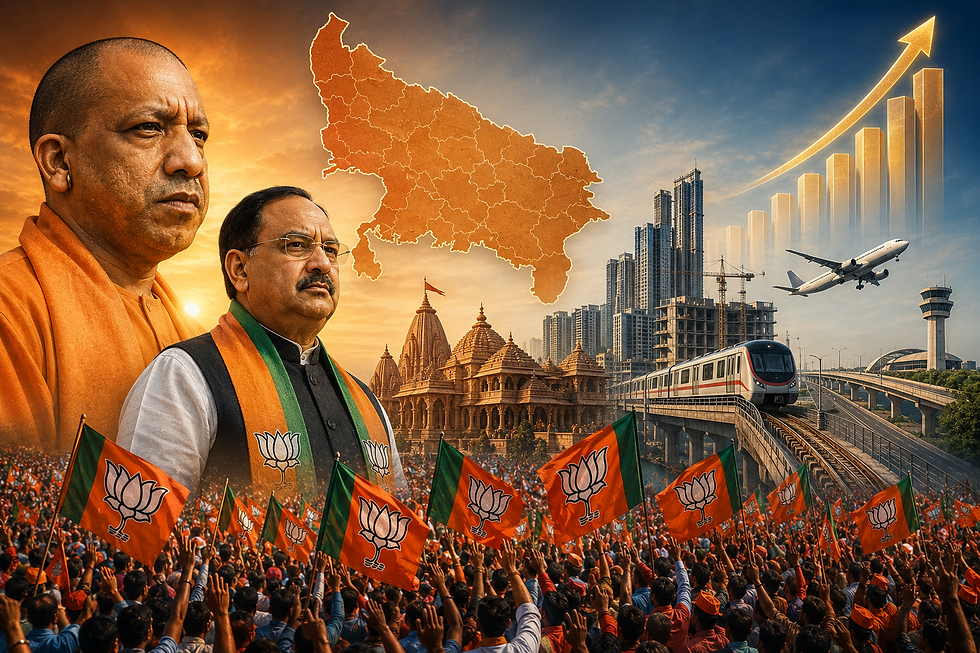
Nitin Nabin landed in Lucknow on Saturday morning where he was met with a reception befitting a general's arrival, not a party functionary. Chief Minister Yogi Adityanath, who was accompanied by his two deputy Yogi Maurya and Brajesh Pathak, the newly installed president of the state unit Pankaj Chaudhary and a large number of ministers and MPs, was waiting on the tarmac at the Chaudhary Charan Singh International Airport. From there, the BJP's national president got on to a decorated chariot and took a roadshow to the party's state headquarters for a distance of eighteen kilometres, where workers were lined up at over half a dozen points. It was choreography, and everyone in Lucknow knew what they were choreographing the formal launch of the BJP's state-election campaign which is 10 months away, but already feels like the most critical contest on India's 2027 calendar.
Nabin was not one to mince her words. He has told the reporters that while delivering the speech after the roadshow that the party would return to power for a third term in Uttar Pradesh and the enthusiasm that he had observed among party activists in Lucknow was a testament to the party's readiness to fight. He referred to the Temple towns of Kashi, Ayodhya and Mathura as proof of the state being remade, and the one that everybody will be quoting from Lucknow this weekend: the lotus will bloom again, were delivered in the final nine years of Adityanath. It is not a new metaphor for BJP, but the timing is important. This is the first visit by Nabin to Uttar Pradesh since he took over the party on national level, and his first-ever encounter with the party's recently formed (9 days ago) state unit. That sequencing is intentional, in BJP's own parlance. A new national president taking the oath by a new state Cabinet is supposed to be read as the starting gun.
Nabin's two-day stay in the capital is packed with a number of engagements, not just pictures. He is having two consecutive sessions with the state office-bearers, regional and district presidents and chief of various frontal organisations of the party, and then a session with Adityanath, both deputy chief ministers, sitting MPs, MLAs, MLCs and allies of the party in the National Democratic Alliance. He is supposed to visit the Hanuman Setu temple, attend a core committee meeting and spend Sunday with the booth level workers at the Rashtriya Prerna Sthal, where he will discuss the nitty gritty of Indian politics strengthening of booths, panna pramukh coverage and voter-list management down to the polling station. He will also raise a booth president in Peer Nagar, a symbolic move but an indication of where he thinks the Uttar Pradesh elections are fought not in TV studios but on the ground in the last mile.
Lucknow's swagger must be viewed in a more nuanced context than the one indicated by the roadshow. The BJP's own recent history in Uttar Pradesh is a tale of falling margins in spite of stable vote share. The party had its best-ever performance in the state, winning 312 of 403 assembly seats in the wake of the post-demonetisation and post-Ayodhya-mobilisation euphoria in 2017. That was more than enough for a second term but by 2022 it had reduced to around 255, a testament to the fact that Akhilesh Yadav's Samajwadi Party was doing well contesting along with smaller regional parties. The shock of 2024 came next. During the general election, BJP's own seat-list in UP crashed from 62 seats to 33 seats, while the opposition alliance led by the Samajwadi Party won 43 of 80 Lok Sabha seats, for the first time in a decade, they became the single largest party in the state based on seats. The Centre for the Study of Developing Societies (CSDS) survey revealed that the erosion was precisely in those constituencies which the BJP could least afford non-Jatav Dalits and non-Yadav OBC voters, in whom its social league had been forged during the sweeps of 2014, 2017 and 2019. While the BJP's share of non-Jatavs dropped from 48 percent in 2019 to 29 percent in 2024, the opposition alliance has secured a majority of non-Jatavs.
This one data point accounts for a lot of what has happened within the party since. The reshuffle of the state unit, which took place just over a week before Nabin's visit, is widely interpreted by political observers as a continuation of the process of reweighting Uttar Pradesh's cabinet in favour of OBC and Dalit representation and not merely a coincidence as opposed to Adityanath's first term. Akhilesh Yadav, on his part, has been taunting the ruling party in public in recent weeks, alleging that the BJP has lost faith in 225 of its sitting Lokpal members and will have to make wholesale changes to its candidate list, especially in areas in and around Prayagraj, where the party also did badly. He has pointed to inflation, unemployment, corruption and an erosion of constitutional and reservation guarantees, describing his own prescription as the well-known PDA – which stands for backward castes, Dalits and minorities – and which has enabled the Samajwadi Party to grow far beyond its traditional base of Yadavs and Muslims in 2024. Deputy Chief Minister Brajesh Pathak, however, brushed aside the claims as “speculation” and “lack of political maturity” on the opposition side, and turned the tables on the opposition, asking them whether they could even confirm the “seat sharing” inside INDIA bloc with Congress, hinting at a real fault line at the opposition end: the unity in the opposition bloc was by no means as settled as the opposition figures of 2024 might indicate and a resurgent Bahujan Samaj Party, even a partial one under Mayawati, could play havoc by breaking the anti-BJP alliance in a way that would benefit the ruling party more than it would harm it.
Beneath the rhetoric lies an economic issue that both sides are vying to make their own, and that's a pretty big one. When Adityanath assumed the office in 2017, the gross state domestic product (GSDP) of Uttar Pradesh stood at around Rs 13 lakh crore and at present, it is estimated at Rs 36 lakh crore to Rs 40 lakh crore, which is nearly three times the previous value, and the state's share in the country's overall GSDP stood at around 8 percent which has now risen to close to 9.5 percent. During the same period, per capita income has risen from Rs 43,000 to more than Rs 1,20,000. As per the state government's own estimates, made in the first formal Economic Survey this year, the government can easily continue spending on capital projects, as the budget has more than doubled to over Rs 9 lakh crore, the fiscal deficit has been kept near 3 percent of GSDP and the government's debt is 28 percent of GSDP, comfortably below the national average. Between April 2019 and June 2025, cumulative FDI inflows reached approximately Rs 17,000 crore, the number of airports has increased from 2 to 16 (fifth international airport opened at Jewar this year) and the metro or rapid-rail service has been extended to 7 cities, which did not have such transportation a decade ago. In global terms, its economy, if Uttar Pradesh were a country, would rank among the thirty largest, just ahead of countries like Denmark and Bangladesh in terms of nominal output, which is the message the BJP wants people and global investors to take home before the next round of Global Investors Summit.
An independent point, not one that comes just from Samajwadi Party talking points, is that headline GSDP and infrastructure numbers have not matched neatly with broad based job creation, and reduced regional inequality within the state. Eastern Uttar Pradesh lags the industrial belt around Noida, the western districts; most people work in the informal sector; and the state's own trillion-dollar economy target, first mooted for 2027 and then deferred to 2029-30, has been acknowledged even by government appointed consultants to be a four-fold increase in GSDP of which the current growth rates cannot comfortably be a part. But that is the real contest of the 2027 campaign not the temple talk or roadshow numbers, as important as those are for building an atmosphere on Day One but the contrast between an unmistakable infrastructure and investment narrative and a labour market that is lagging.
Nabin's visit actually underlines the fact that the major camps have decided that the battle begins now, 10 months before, through organisation and not through manifestos. But the BJP hopes that infrastructure creation, welfare-scheme saturation and a rejigged caste arithmetic will reverse the tide of the 2024. The Samajwadi Party is hoping that the PDA arithmetic that helped it to the Lok Sabha's upside can be replicated on an assembly level across the 403 seats, a much bigger organisational challenge with local selection of candidates and booth-level muscle playing a key role as opposed to any national wave. But Congress and Bahujan Samaj Party are the wild cards whose moves–not any speech in Lucknow this weekend–may be what ultimately determines the lotus' fate.
There's a larger lesson in this for those who have been following Indian federalism from outside the country. The election calendar of Uttar Pradesh has effectively become a litmus test read by international investors, credit rating agencies and even foreign missions, as closely as by domestic analysts in part because the economic heft of the state now equals that of a mid-sized nation and because the outcome of its poll determines the makeup of the next Lok Sabha more than any other single state. A wobble for the ruling party would have reverberations on sentiment on infrastructure and manufacturing wagers linked to the state's growth narrative while a comfortable win will be read as vindication of Uttar Pradesh's investment-led governance model that it has been peddling at successive global summits. Few state elections have audiences on both sides one in the country, worried about employment and representation, and another in the world, worried about where capital goes and Nabin's two days in Lucknow are the first step in an argument that will have to be convincing to both.