
Popular Categories

Politics

Geo Economics

Lifestyle

Analysis

Geopolitics

Civilizational Lens

Defence

India's Cockroaches Storm the Capital and This Time, They Have a Manifesto
6 Jun 2026
Created by
The BV Team
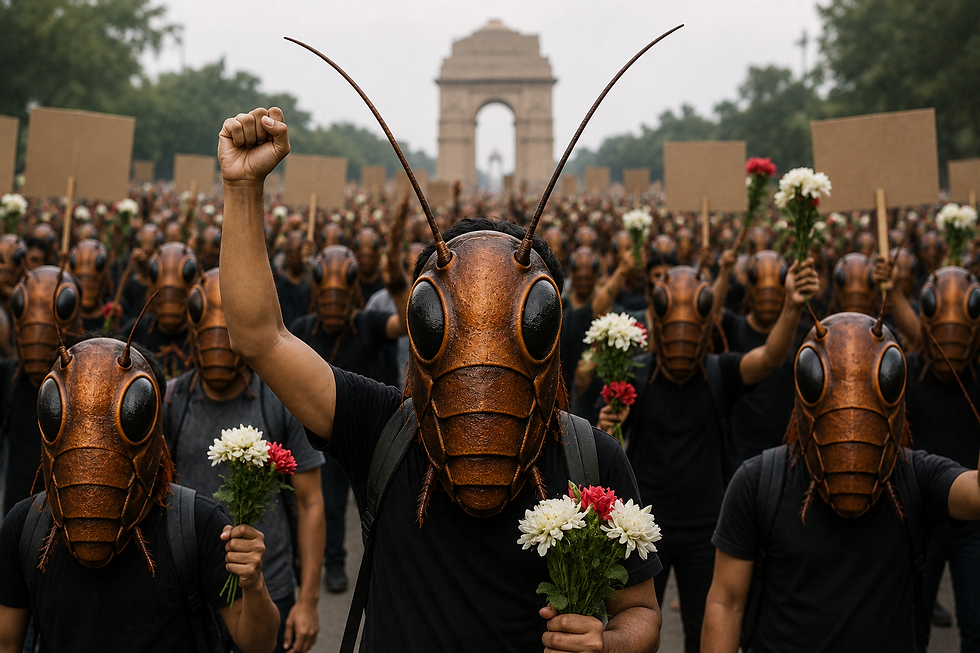
New Delhi, June 6, 2026. Sometimes a slogan speaks more loudly than a dozen policy reports that describe a country. It was one of those days today. Clad in cockroach masks and waving flowers, hundreds of young men and women appeared at Jantar Mantar, the traditional ground of public anger in India, to voice their dismay over what they regard as a government which has systematically failed them. They were not parasites, as the Chief Justice of India appeared to think just over three weeks ago. They were voters. It was students who had been studying for years for exams and had sold these exams in advance. They were the graduates and they were seeking employment in an economy that continues to talk about "demographic dividend" but that does not honor the underlying promise.
The satirical youth movement, which has been the most buzzed-about political issue in India this summer, the Cockroach Janta Party (CJP), organised its first-ever physical protest on Saturday at Jantar Mantar against the NEET 2026 paper leak and irregularities in the CBSE's On-Screen Marking system, demanding the resignation of Union Education Minister Dharmendra Pradhan. The slogan reverberating from the premises was very clear: "Dharmendra Pradhan, step down. We demanded Make in India, you delivered Leak in India.
To grasp that thousands of strangers, never having met before, would want to get together under the banner of an insect, one has to go back three weeks to a Supreme Court hearing that most people would never have noticed.
During a hearing on the issue of fake legal credentials, on May 15, 2026, Chief Justice Surya Kant said there are youngsters like cockroaches, who are not getting jobs and have not any place in the profession, some of them are working as media, some of them are working as social media, RTI activists, activists and they start attacking everybody. Later, the CJI clarified that he was being misunderstood, and that he was not saying that those who were jobless were to be blamed for obtaining fake degrees, but that those who used fake degrees to enter the legal profession were to be blamed. The clarification was delayed a day. By that time it had been insulted to.
Political communications strategist Abhijeet Dipke said the next day on social media that the platform was "for all the cockroaches out there" and the criteria were that they had to be unemployed, lazy, chronically online, and be able to "rant professionally". This was a well-timed and well-thought-out joke. The CJP's Instagram account became a trusted source with over 3 million followers in 78 hours. Within five days it crossed 10 million mark and became the top handle among all political parties, including the ruling Bharatiya Janata Party's handle. As of late May, it is over 20 million.
That number is no fluke. It is a signal.
The issue of unemployment amongst India's youth is not a hidden reality, but one that is still under-discussed in reality. As per the latest PLFS Annual Report, while the overall unemployment rate for the population above 15 years was 3.1 percent, the unemployment rate for the youth (aged 15 to 29) was 9.9 percent, almost three times higher. It rose to 13.6 percent in urban India where the majority of the degree holders look for salary jobs. According to the World Bank's modelled ILO estimates, India's youth unemployment rate stands at 16 percent for 2025, not much different from what it was three years ago despite GDP growth figures which are routinely making headlines.
In other words, the economy is expanding without being able to absorb. India is bringing about 1 million young people into the labor force each month. Job creation in the formal sector is not keeping up. Less than 5 percent of 15-29 year old young people say they are trained formally in any vocational or technical field, leaving the country with a lot of potential talent in its educational pipeline but a weak talent-to-jobs pipeline not just a preparation-to-jobs pipeline because of the poor level of preparation for the job market.
The NEET crisis came as a match to dry paper, amidst this frustration. The cancellation of NEET 2026 after being accused of a paper leak had left 22.7 lakh young aspirants (most from families who never were able to afford the fee of private medical colleges) in a state of paralysis. These were students of families who had sold land and moved to coaching centres in Kota and Sikar and had invested years of their life and money for a government medical seat. The 2026 leak is one of the most blatant documented instances ever, with a guess paper that was circulating weeks in advance with 120 out of 410 questions. The 2024 edition already had 67 students who got full marks (only 2 students got full marks the previous year) and investigations had identified 155 beneficiaries of that leak.
A 23-year-old aspirant from Sikar coaching belt of Rajasthan died by suicide days after the cancellation of the 2026 session. He was a labourer's son who had been living away from his family for years while he saved money to buy property, only for his family to sell land and borrow money to enable him to have his dream. The investigation is still on by CBI. The minister continues to serve as minister.
It was that mix the judge's words, the exam scandal, the suicide, the apparent untouchability of the minister that brought people to Jantar Mantar on Saturday. Hundreds of persons, mostly young, arrived in masks of cockroaches with flowers. The students of the school came along with their parents. Most were comprised of school and college students and young professionals. Dipke had earlier suggested that they bring flowers to the police as a symbol of peace and the national flag, and that they bring books. The government had granted the demo as an "exception" on the direction of the Supreme Court.
Speaking to the audience, Dipke said: "This is a prolonged fight. We had been demanding Pradhan's resignation from social media last month but these guys are so shameless that instead of listening, they have been busy with other things hacking our accounts, deleting our posts etc. You can delete our posts but you can't delete us from this place.
The hacking and deletion comment wasn't hyperbole. The CJP's official X account was suspended in India on May 21 after the government issued a directive under Section 69(A) of the Information Technology Act (ITA) on Intelligence Bureau inputs stating that it posed a threat to the sovereignty and national security of the country. The block was issued when the account had around 90,000 followers. The CJP website was also shut as it had released an online petition on May 23 calling for Pradhan to resign because of the NEET leak. On the next day, Dipke had complained about his own Instagram account being hacked along with the CJP's account being hacked. Then Dipke took the Delhi High Court against the block of the X account.
The governments response to the CJP's rise has been: at least, disproportionate. To label a satirical party that arranges clean-up events in cockroach costumes an "attack on national sovereignty" is akin to the sort of hyperbole that proves the point for the movement's adherents. If you block a parody party for getting followers, you don't appear to be a safe government. You sound like the kind of person who's afraid of his voters.
The political establishment's reaction has been split along predictable lines. Union minister Sukanta Majumdar accused 49 percent of CJP's followers to be Pakistanis and 9 percent Indians, which was a direct denial from Dipke as he shared the audience statistics that showed more than 94 percent followers were Indians. Opposition leaders on the other hand lined up to say "we stand with you". Congress MP Shashi Tharoor said the CJP is expression of the youth who are frustrated by unemployment, inflation, and the NEET leaks. Akilesh Yadav, the Samajwadi Party president, released "BJP banam CJP" via social media. Climate activist Sonam Wangchuk, who has faced government suppression himself, termed himself an honorary cockroach. Even Anna Hazare, who has a few tricks up his sleeve when it comes to taking a dikhada extra national, announced that "youth power is national power.
Internationally, the story has been told by Reuters, The Guardian, BBC, CNN, Al Jazeera and the Associated Press, and the approach is basically the same a generation of Indian youth who have been dismissed and disillusioned have taken an insult and made it their own. It has international implications. India is on a contest to attract investments and talent. The optics of a government intervening to prevent a Gen Z satire movement from coming to fruition, and citing reasons of online dissent suppression, aren't exactly favorable.
This has more of an economic context, which also needs more than a footnote. Much of India's narrative for the last decade has been premised on its "demographic dividend" growth based on the burgeoning working-age population due to the country's youth bulge. That dividend needs jobs and skills to be realised, functioning public institutions. What this crisis of the NEET is a constant reminder of is that the institutional structures designed to convert this young potential into productive economic involvement are rusted. But, entrance tests that one can buy, education ministries that don't have to answer to anyone, a top judge who flippantly labels young activists as parasites are not cosmetic defects. They are the working gears of meritocracy in disarray.
The CJP's 5-point agenda is unambiguous and explicit. It requires that no Chief Justice should be given a seat in the Rajya Sabha as a token of his post-retirement efforts. It demands the cancellation of licences of media houses which are the property of big industrial conglomerates so as to remove the hindrance to independent journalism. It calls for 50 per cent representation of women in Parliament and Cabinet not 33 per cent, not ‘eventually', but ‘now'. It suggests a ban on party hoppers for 20 years. These are not “meme demands.” These are the needs of people who have listened.
It is an open question whether the CJP can turn the 20 million followers it has on Instagram into real political power. Viral movements in India have been known to die down fast after gaining momentum. Critics have said the one who was earlier an active member of the Aam Aadmi Party, Dipke was nothing but ‘manufactured opposition in Gen Z attire'”. That's a complaint worth holding but it doesn't account for the apparent 350,000 who have signed up, nor the government's efforts to shut down accounts, nor the need for a heavy security presence to protect a room full of young people with flowers and cockroach masks to protest to a minister who they believe deserves none of the security he currently enjoys.
The flowers matter. These were words on the nature of this anger. Not the kind that is to break things. The sort that persists until somebody is accountable. This type of may be the most hazardous of all.