
Popular Categories

Politics

Geo Economics

Lifestyle

Analysis

Geopolitics

Civilizational Lens
Defence

The last loyalist walks out: Madan Mitra's exit leaves Mamata Banerjee's Trinamool fighting for its own name
15 Jul 2026
Created by
The BV Team
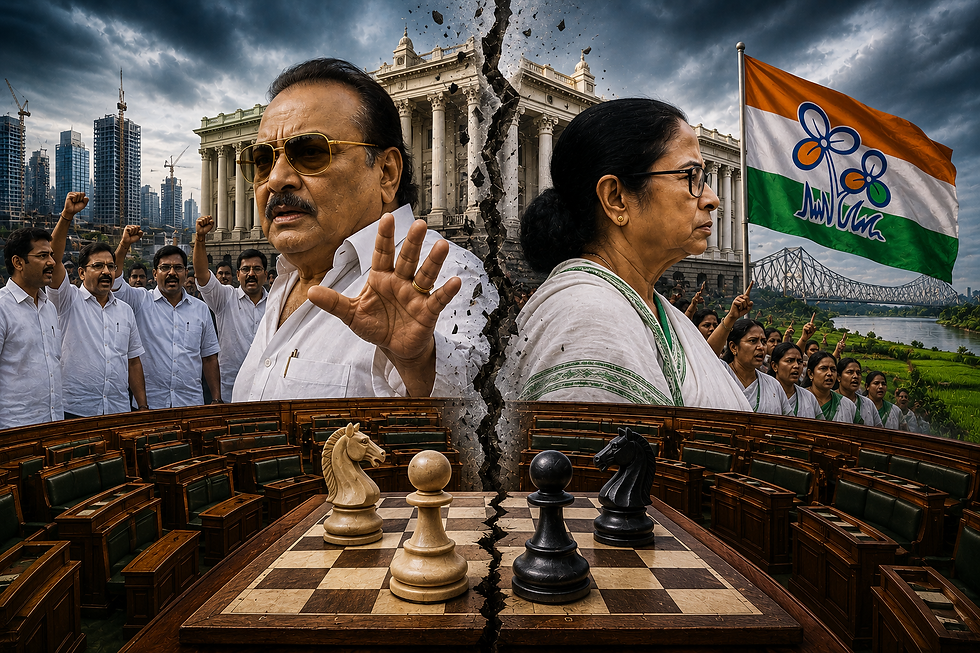
But as usual in Bengal, the political performance kicked into high gear on Wednesday, where the man walking across the Assembly floor wasn't someone who was low on the pecking list of any backbencher. Thereafter, Kamarhati MLA Madan Mitra, who had been close to Mamata Banerjee for 40 years, walked into the Vidhan Sabha, joined the Leader of Opposition, Ritabrata Banerjee, and officially broke all the organisational ties he had with the party from its inception. He gave up his post as chief whip. He had stepped down from the State and National Committee of the present “Kalighat TMC”, albeit with some amount of irony. Then he did what all Bengal politicians have known how to do over the decades, which was to claim he did not leave anything! He told reporters that he has "only" changed his room, not his house, and that he is still very much in TMC.
The difference is not as evident as it seems. Mitra is not giving up his seat in the assembly, nor is he joining the BJP or other party. What he has done is lend his own star power to the rebel wing that, over the last six weeks, has been developing a strong legacy as the true successor of the Trinamool name. That group has its roots in the first week of June when 58 MLAs (members of parliament), who opposed Mamata Banerjee's nomination, supported the expelled Ritabrata Banerjee as Leader of Opposition. The numbers soon grew; by early June, Banerjee openly boasted support from 64 of 80 legislators the party had sent to the Assembly and the size of the majority became hard for the old guard to shrug off so many times as to make talk of a floor test possible. That goes unchanged on paper when Mitra arrives, and for the time being, is an independent operator, next to the rebels, not on the rebels' list. However, on the symbolic level, it is the one heaviest blow that the breakaway camp has struck. He had been one of just two leaders Mamata Banerjee had personally promoted to the state committee as general secretary earlier this month, seemingly in an effort to bolster just the sort of old-guard allegiance that has been fractured.
Mitra did not run away. After the meeting, he fired his guns at party general secretary Abhishek Banerjee, calling him up and asking him to relinquish his active leadership for six months to a year and allow the party to rebuild. He said Abhishek had refused, saying that he will not leave the party when "the party has sunk the boat, has sunk," Mitra added. He also said that the party's organizational framework had been narrowed down to the protection of one member, not the party's masses and that Mamata Banerjee should view the current situation as a marathon, rather than a sprint. Note that his transfer wasn't exactly without pressure. A day earlier, the Enforcement Directorate had summoned his wife and sons in its probe into alleged money-laundering in the West Bengal municipal recruitment scam, and on Tuesday night, Mitra was seen meeting with rebel aligned personalities at the residence of MLA Sandipan Saha at Entally, which gave rise to further speculations that were further strengthened on Wednesday morning.
Cut out the personalities and what is playing out is a struggle for the right to hold a political legacy for the next three decades in a state that no longer has the luxury of managing its government to cover up fissures. On the flip side, the economy of the state of West Bengal, into whose hands the BJP's Suvendu Adhikari-led government has inherited the state of the state after the TMC's defeat in May, is reasonably fit for the task on paper: West Bengal produces an estimated gross state domestic product (GSDP) of about Rs 20.3 lakh crore and industrial growth was 7.3 percent last year, well above the nationwide average, while exports have surpassed Rs 1.09 lakh crore in the last full fiscal year. But as long as that same data has been accompanied by an asterisk. The real growth of West Bengal's GSDP during the last 10 years was less than 5.5 percent, the national average, while the ratio of debt to real GSDP in the state is higher than that of most large states, at more than 37 percent, and the contribution of West Bengal to the country's output has been dwindling year after year irrespective of the party in power at the Secretariat. That the same fear has been raised by analysts monitoring the state's investment climate time and again: the investment plans of industry are usually drawn out over two decades or more, whereas India's political cycles run every five years, and the memories of Singur and Nandigram taint the outside capital. The prolonged public debate on who is in charge of the Trinamool's organisational machinery does nothing to assuage that unease; quite the opposite, when a party is incapable of working out differences among its members, it's a more difficult proposition for an opposition party to rally around, and harder for a ruling party to negotiate with when it comes to issues of labour, land and infrastructure that extend beyond any one term.
This lesson is a familiar one worldwide. But economies that have turned political transition into lasting growth, from Seoul to Singapore and Frankfurt, have one thing in common: continuity of the rules of the game, despite the changing of the guard at the top. While it is the time for an opposition to make itself look like a viable and coherent alternative, Bengal is engulfed in a battle over its name plate. The effect of Madan Mitra's changing rooms will likely be significant or insignificant. But it shows that the Trinamool Congress, which has been thirty years in existence since its inception by its founder Mamata Banerjee, is experiencing a similar schism in its ranks, and the rest of Bengal's politics and economy will have to wait and see how it unfolds.