
Popular Categories

Politics

Geo Economics

Lifestyle

Analysis

Geopolitics

Civilizational Lens

Defence

When a Nomination Form Became a Political Weapon, The Meenakshi Natarajan Affair
12 Jun 2026
Created by
The BV Team
There is a moment in Indian electoral politics that becomes the sword from a fine print of the law, one that could annihilate the anti-corruption movement. The day has come in a conference room at Madhya Pradesh state assembly in Bhopal on June 9, 2026 and the ensuing events have triggered a full-fledged battle for the integrity of the country's democratic processes.
Congress leader Meenakshi Natarajan, 52, who was once a MP from Mandsaur, was being nominated by her party to contest one of the three Rajya Sabha seats from Madhya Pradesh that are up for grabs before the June 18 polls. The arithmetic was simple enough to understand: In the 230-member Madhya Pradesh assembly, the BJP has 163 seats and the Congress has 66, and the minimum of 58 first-preference votes per seat meant that the BJP could easily secure two RS seats and the Congress could muster just enough. This was by any of the numbers a seat for Congress to lose.
But they lost it anyway and not at the ballot box.
What really went on in that Scrutineer's room?
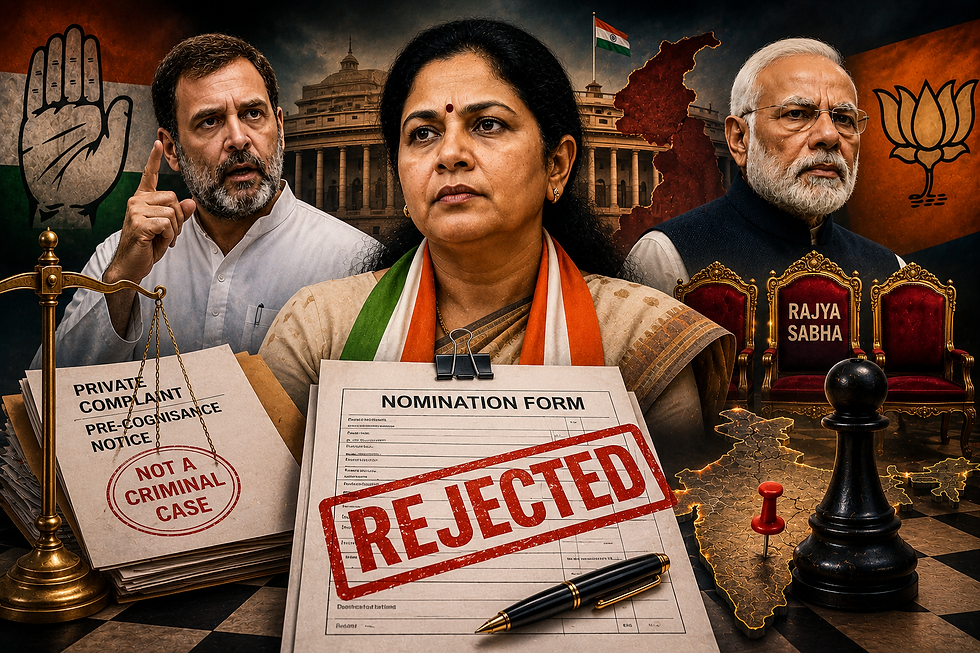
However, when scrutiny opened on June 9, BJP operatives Mahesh Kewat and Rahul Kothari were seen at the assembly complex with a copy of a private complaint from a magistrate court in Hyderabad. The private complaint was a pre-cognisance petition, a legal instrument which provided only a notice asking why the case should even be investigated.
Natarajan was not a direct target of the grave accusations in the complaint. They challenged the elections of another Congress leader Kumbham Shiva Kumar Reddy who was accused of committing sexual assault on a woman party worker. In 2025, the complainant filed a fresh complaint before a Hyderabad magistrate, not for the assault but for the failure to act on her grievance when she brought it to the attention of these seven Congressmen.
The court had not sent out any notices and no case had been filed. The FIR filed on Shiva Kumar Reddy did not even have the name of Natarajan.
That didn't matter a bit. Natarajan, who is also the Madhya Pradesh Assembly's Principal Secretary, had responded to a notice issued by the Hyderabad court in October 2025 but had not mentioned the matter in Form 26 submitted along with her nomination papers, found the Returning Officer Arvind Sharma. The order stated the affidavit was incomplete, and thus rejected her candidacy.
However, after the demise of Congress candidate, all the three BJP nominees were to contest the Upper House contests without any opposition.
The Legal Fault Line
The Congress argument, and the one that a few legal commentators found to be interesting, hinged on a very specific question what is a "pending criminal case" that needs to be disclosed in a Rajya Sabha nomination?
Natarajan argued that the order of rejection was legally unsound as there was no criminal case against her as the order for taking cognisance of the private complaint had not yet been issued by any court and a pre-cognisance notice could not be deemed to be a pending criminal case for mandatory disclosure.
Form 26 does not touch upon all the FIR/notice answered by a candidate. It enquires as to cognisance. It's not a trivial distinction. The Code of Criminal Procedure makes it clear that a criminal case cannot be said to have been commenced till the time the court takes cognisance and up to the time the court takes cognisance it remains a complaint, a notice, a pre-litigation instrument. Natarajan's lawyers argued she had correctly filled out the form.
The Week quoted a veteran government official as saying that this document is "pending criminal case" and has "zero weight" as a document. However the Returning Officer, while agreeing with BJP's interpretation, ruled that the Supreme Court's mandatory disclosure guidelines mandated that all candidates disclose pending criminal cases.
In granting the leave to her petition, Justice PK Mishra and Justice AS Chandurkar, sitting on a bench, on Friday, said she could now approach the Madhya Pradesh High Court with an election petition. The SC did not rule on the merits, it refused to interfere, as per Article 329, courts cannot intervene in electoral process during the process. The bench pointed out that the decision could have been wrong but emphasized that the legal recourse would be available after the elections on the downfall of the nomination.
There was the Double Standard Allegation.
The decision did not go down well with Congress. The party had pointed out that in the case of Natarajan, the Election Commission was being "double standard" as the nomination papers filed by Rajya Sabha candidate Parimal Nathwani in Jharkhand had allegedly missed out on some details in the form 26 disclosure and yet he had been given a chance to clarify and rectify.
The inaction of the ECI worsened the situation. We had approached the Election Commission but it did not take any decision even after 48 hours, it has been maintaining silence," said Natarajan. On June 10, the Congress had a meeting with the Election Commission, following the rejection, which saw no reversal.
Congress General Secretary K.C. Venugopal called it "daylight robbery of democracy" and said BJP went after Natarajan only when they realised it was not getting its way with Congress MLAs. It can be presumed that the horse-trading efforts the traditional Indian politicking of luring, or drawing, legislators to “cross the line” did not work out and the opposition resorted to the next available option: a procedural kill-shot.
The party issued a statement to claim that the cancellation of Natarajan's nomination was only “a result of conspiracy to ensure BJP get a third Rajya Sabha seat for which it does not have any democratic mandate.”
The Bigger Picture: Upper House Arithmetic and Why This Seat Matters
It's not just a process dispute. The significance can be appreciated by examining the nature of the Rajya Sabha as a battleground of legislation.
The 245 member Rajya Sabha has 72 seats for which elections are scheduled in 2026. The NDA's strength is expected to rise to around 145 and the strength of INDIA bloc is expected to drop to around 75. Based on the legislative assembly strength, the BJP is expected to get 37-38 seats. The Congress is battling for every seat it can win as it will have no members in the Rajya Sabha from 17 states and union territories.
In that regard, one seat from Madhya Pradesh is not too negligible. It's yet another voice on the floor of the upper house when legislation is discussed, when constitutional amendments are voted on, when the balance of the ruling coalition to push through laws is tested. The Congress was well outnumbered in that seat. The numbers became moot.
It is Madhya Pradesh itself that is interesting to study as a canvas for politics. The BJP won 163 seats in the state assembly in December last year with a record voter turnout of 77.82%, defeating Congress, which secured 66 seats in the house. The BJP got a landslide mandate at the State level with that outcome. However, a party with two-thirds majority in the assembly would get two seats from the state and not three in the Rajya Sabha. The third seat was automatically the Congress's.
A book in which Natarajan speaks truth and lies about her daughter.
After hearing her petition, the Supreme Court rejected it and Natarajan, who addressed reporters, said: "We are not shocked by the court's decision, but we all should be worried about the tremors being felt by democracy. She refuted the "seat chori" allegation, stating that it was very apparent and everyone was a witness to it.
Significant, however, was her restraint on the court's decision itself she was adamant that she would not comment on the judicial ruling but was very clear about the political process which led to it. “Seat chori” (theft of seats) had been a Rahul Gandhi coinage and the Congress party had soon made it the narrative of the episode.
The party has also considered the political repercussions of the nomination rejection to be serious, as Jitu Patwari, its state chief in Madhya Pradesh was detained during the Satyagraha protest. From their point of view, this is by no means a battle of paperwork. It's a test case on whether the opposition parties in India can nominate candidates without their nomination documents being used as weapons against them.
The Kill and its Systemic Implications
The means adopted here is worthy of a thorough scrutiny, as it shows a gap in the nomination scrutiny system in India, not just in this particular case.
The returning officer has no authority to either accept or reject nomination made to the Rajya Sabha except on the basis of the documentary evidence which is available at the time of scrutiny. That examination window is narrow hours and there's no real way to challenge an unexpected objection with legal argument or additional material. The pace is intentional: elections have to go quickly. However, that speed can be turned into weaponry.
The BJP in the case of Natarajan had produced a document which failed to cross the line of a criminal case, according to several legal experts. They brought it at exactly the right time when the window was open and the candidate had less time to respond. It was in that compressed window that the Returning Officer made its call and that call held out for the duration of the election.
That the High Court may ultimately set aside the result by an election petition is irrelevant as the fact that BJP has swept the three seats is a reality. Remedies in Indian election law, by their very nature, are retrospective. Machinery comes first, courts come second.
Nominations have been rejected in contesting situations in Indian elections earlier as well. The nomination papers submitted by the Samajwadi Party's candidate for the Khajuraho seat in Madhya Pradesh were rejected on procedural grounds last year (2024) due to the placement of signatures and an uncertified voters list, leaving the way clear for the BJP candidate. Nominations scrutiny as a pressure point against opposition candidates has been a recurring theme of criticism by electoral observers.
The Democratic Deficit Argument
This is a systemic rather than partisan criticism. The Rajya Sabha, the deliberative house, is supposed to be the house of states, a house that is required by the Constitution of India to give continuity to legislation and to prevent the excesses of the representatives of the people in the House of People. How diverse political opinion gets to the upper chamber is through its proportional composition, directly linked to the number of state assemblies.
If the result of Rajya Sabha elections is different from what the legislative arithmetic would deem appropriate, there is something amiss in that design. It does not matter whether it's horse-trading, defection or as Congress contends here some form of procedural sleight of hand in the upper house that determines who gets nominated or who doesn't, as long as it's done in a way that means the upper house's composition no longer represents the political makeup of the states.
But this is not a personal setback, it is a setback to democracy and constitution, said Natarajan. That framing which sounds rhetorical is not rhetoric. A seat which the democratic math placed in the Congress column, based on the Congress's own calculations evidentiary to the effect that 66 MLAs elected on Congress tickets chose a candidate has come to sit in the BJP column, thanks to a pre-cognisance notice issued by a Hyderabad court that was, by the Congress's reckoning and many in the legal fraternity, never a criminal case at all.
The question of whether the courts will interpret it in that manner and whether the Election Commission will review the manner in which it responded to two days of pointed requests for intervention will define whether or not it will be remembered as a grievance or a precedent.
From June 18 onwards, three BJP candidates from Madhya Pradesh will be occupying the seats in the Rajya Sabha. One of them will be seated in a chair that by the numbers wasn't theirs to take.