
Popular Categories

Politics

Geo Economics

Lifestyle

Analysis

Geopolitics

Civilizational Lens

Defence
Words, Optics, and Power: Why Global Narratives on India Are Becoming a Strategic Battleground
23 Apr 2026
Created by
The BV Team
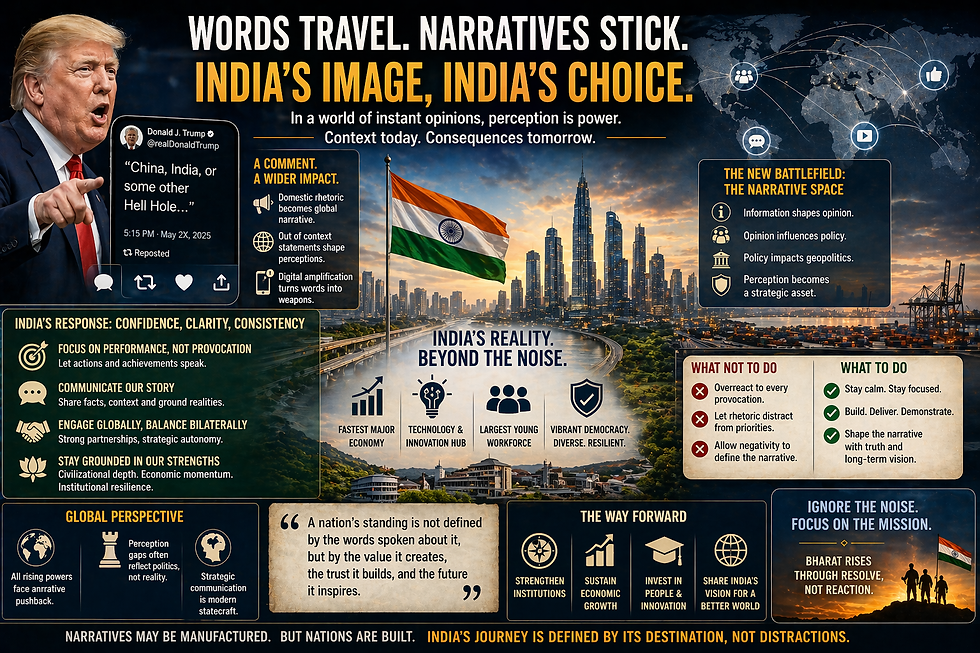
A recent social media amplification linked to Donald Trump—where disparaging language about countries like India and China resurfaced—may appear, at first glance, as just another moment in the fast-moving world of digital commentary. However, beneath the surface, it reflects a deeper and more consequential shift: the growing role of narratives in shaping geopolitical perception.
In today’s interconnected world, statements—especially from influential figures—do not exist in isolation. They are picked up, amplified, reframed, and often weaponized within broader information ecosystems. What begins as a comment can quickly evolve into a narrative, and narratives, in turn, influence how nations are perceived globally.
The specific context here revolves around debates in the United States on issues like birthright citizenship. In such domestic discussions, references to other nations are often used rhetorically—to draw contrasts or make political points. However, when these references carry negative connotations, they can have unintended diplomatic and reputational consequences.
For India, the situation highlights an important reality: as its global profile rises, so does scrutiny—and, at times, criticism. This is not unique to India. Historically, nations transitioning into greater economic and strategic prominence often become subjects of intensified narrative contestation. Their policies, systems, and societal structures are examined, debated, and sometimes mischaracterized.
From a strategic standpoint, this is less about the comment itself and more about the environment in which it circulates. The global information space has become a contested domain. Governments, political actors, and non-state entities all participate in shaping narratives, whether intentionally or indirectly. Social media platforms act as accelerators, ensuring that messages travel faster and reach wider audiences than ever before.
This creates both challenges and opportunities.
On one hand, negative narratives—if left unaddressed—can influence perception, particularly among audiences with limited direct exposure to ground realities. On the other, the same platforms offer the ability to counter, contextualize, and present alternative perspectives.
India’s response, therefore, must be rooted in confidence and clarity. Rather than reacting to every provocation, the focus should remain on consistent communication of its strengths—economic growth, technological advancement, democratic resilience, and cultural depth. Over time, sustained performance tends to outweigh episodic commentary.
Globally, similar dynamics can be observed in how countries like China are discussed within Western political discourse. References are often shaped by domestic priorities rather than nuanced understanding. This underscores a broader point: international narratives are frequently extensions of internal debates.
The key, then, is to distinguish between rhetoric and policy. Statements made in political contexts do not always translate into official positions. However, they can influence public perception, which in turn shapes the broader environment in which diplomacy operates.
For India, this reinforces the importance of strategic communication. As it positions itself as a major global player, the ability to manage narratives becomes a critical component of statecraft. This involves not only responding to external commentary but also proactively shaping the conversation.
There is also a lesson in resilience. Nations with strong internal foundations—economic, institutional, and societal—are better equipped to absorb external criticism without disruption. Confidence in one’s trajectory reduces the need for reactive engagement.
From a broader perspective, the episode reflects a transition in global power dynamics. Influence is no longer exercised solely through military or economic means; it is also shaped through perception. The battle for narrative space is becoming as significant as traditional domains of power.
Ultimately, the incident serves as a reminder that words, while powerful, derive their impact from context. In an era of constant information flow, the challenge is not just to respond, but to maintain perspective.
Because in the long run, a nation’s standing is determined less by what is said about it—and more by what it consistently demonstrates.